
The app discovery journey is becoming more fragmented as AI search engines rapidly emerge as another discovery layer between user intent and app install.
Users are beginning to ask ChatGPT, Gemini, or Claude which app they should download. These systems interpret intent, retrieve information from across the web, and synthesize recommendations in a single response. After receiving that shortlist, users then open an app store to confirm the app aligns with their needs before installing.
This new discovery layer does not eliminate the app stores as the primary conversion environment. But it changes how consideration is formed. Visibility is increasingly influenced by how AI engines understand your app, how clearly it aligns with specific user intents, and how consistently it is represented across the web.
Key takeaways
- AI search engines such as ChatGPT, Gemini, and Claude introduce a new upstream discovery layer where users receive curated app shortlists before opening the app store
- AI app discovery is intent-driven and recommendation-based, meaning systems interpret the user’s underlying task and synthesize a shortlist of apps rather than ranking links by keyword relevance
- AI search engines rely on two primary inputs: model training knowledge, which builds associations between app names and use cases, and live web retrieval, which extracts relevant passages to generate answers
- App store listings are the single most-cited source in ChatGPT app recommendations, accounting for 47.5% of all citations in AppTweak’s analysis — making your App Store and Google Play metadata one of the highest-leverage AI visibility surfaces available
- AI visibility depends on clear intent alignment, consistent web representation, and strong use case associations, which explains why AI recommendations and app store rankings are correlated but not identical.
What is AI app discovery?
AI app discovery refers to how AI search engines recommend apps in response to user intent.
Instead of returning a list of links like traditional search engines, AI search engines such as ChatGPT, Gemini, and Claude generate synthesized answers that directly suggest specific apps. These recommendations appear inside AI-generated responses as curated shortlists tailored to the user’s question.
AI app discovery is intent-driven, not keyword-driven. Users describe what they want to achieve, such as “a budgeting app for freelancers,” “a dating app for serious relationships,” or “a calorie tracker that works offline.” The AI search engine interprets that intent, expands the query internally, retrieves relevant information from across the web, and determines which apps best match the underlying job to be done.
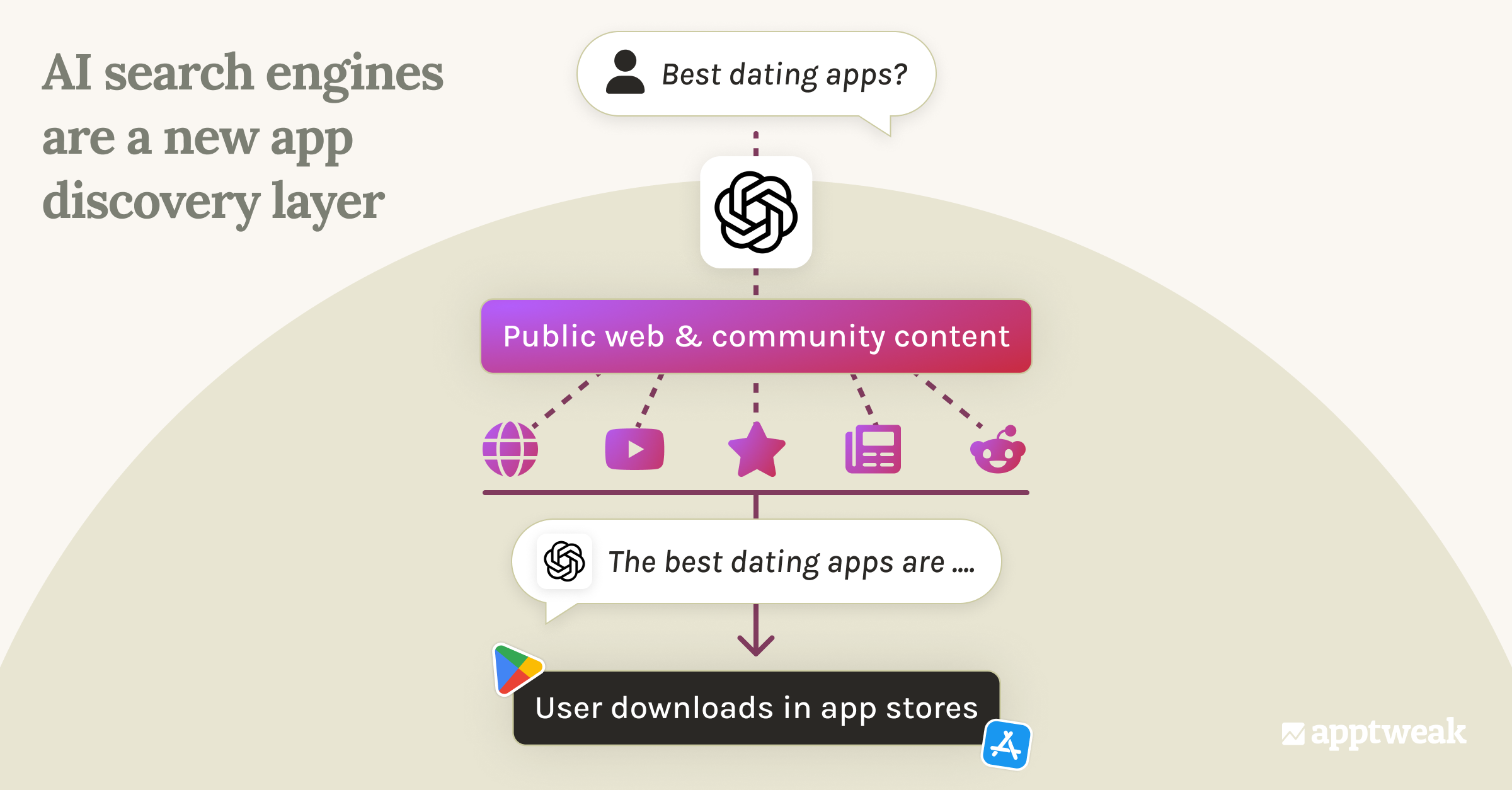
AI app discovery is recommendation-based, not ranking-based. Unlike traditional search engines that present ten blue links, AI search engines evaluate multiple sources and suggest a small set of apps as solutions. The output is structured as guidance rather than search results.
AI app discovery also sits upstream of App Store conversion. In many cases, users first receive a shortlist from an AI assistant and only then open the App Store or Google Play to evaluate screenshots, ratings, pricing, and positioning before installing. The app stores remain the primary conversion environments, but AI search increasingly shapes which apps enter consideration.
Want practical guidance on improving your app’s visibility in AI search?
Watch our on-demand webinar How to get your app discovered in ChatGPT & LLM search. Together with industry experts from Reddit and Yodel Mobile, we unpacked how AI search engines interpret intent, evaluate signals, and surface app recommendations across categories. You’ll walk away with actionable insights for your app’s AI discoverability. We also provide a deeper dive based on the webinar in our recap blog on getting your app discovered in ChatGPT.
How do AI search engines decide which apps to recommend?
AI search engines rely on two primary inputs when recommending apps: model training knowledge and live web retrieval.
Understanding this distinction is important. Visibility in AI-generated answers depends both on how your app is represented across the internet and on what content the system can access when responding to a specific query.
Input 1: Model training knowledge
AI search engines rely on large language models (LLMs) trained on massive amounts of public text, including websites, forums, blogs, reviews, and online discussions.
During training, these models learn associations between:
- App names and use cases
- App names and audiences
- App names and attributes
If an app is frequently mentioned in conversations about a specific task, the model develops a stronger association between that app and that intent.
This means online community discussions, comparison pages, and editorial mentions contribute to how AI search engines “understand” your app. However, once a model is trained, that internal knowledge does not change until the next version is released.
Input 2: Live web retrieval
In addition to what they have been trained to know, most AI search engines fetch live web content before generating an answer.
When a user asks for an app recommendation, the system:
- Interprets the intent behind the question.
- Searches the web for relevant content.
- Extracts the most relevant passages.
- Synthesizes a shortlist of apps.
This retrieval input favors content that clearly and directly addresses user intent. Structured comparisons, question-based explanations, and unambiguous descriptions are easier for AI search engines to extract and synthesize than vague or purely promotional language. AI search engines typically retrieve and evaluate specific passages (“chunks”) from documents rather than processing entire websites end-to-end in real time.
The same web content also drives classic SEO for apps.
Where ChatGPT sources its app recommendations
In AppTweak’s analysis of 125,000+ ChatGPT recommendation responses across 9,489 app prompts (US market, May 2026), one finding stands out: app store listings are collectively the largest cited source in AI-generated app recommendations, accounting for nearly half of all citations at 47.5%.
- Apple App Store: 37.6% — the single most-cited source
- Google Play Store: 9.5%
- Open web (long tail): 27% — primarily brand-owned pages and app aggregator sites
- No source cited: 22.6%
Source: AppTweak | US Market | May 2026. Citations sourced from publicly indexed web versions (apps.apple.com and play.google.com). Updates made in App Store Connect or the Play Console are reflected there over time.
The practical implication: what you publish in App Store Connect or the Play Console is not a secondary signal that “might” influence AI recommendations. It is one of the most direct citation surfaces available to app marketers today.
Why this matters for app discovery
An app can be recommended by an AI search engine because:
- It is strongly associated with a specific use case in the model’s training knowledge.
- It appears clearly and consistently in retrieved web content — including its app store listing pages.
- Or both.
One of the strongest patterns in AppTweak’s research: apps with highly specific, defensible positioning surface more consistently than apps with broad or vague positioning. Google Translate is a clear example. Across intents related to travel communication, offline translation, bilingual conversations, and translating text quickly, it repeatedly appears in top recommendation positions. Not by covering loosely related use cases, but by reinforcing a tightly aligned set of intents consistently across its content. AI search engines favor apps they can retrieve and recommend confidently.
This explains why AI visibility does not perfectly mirror App Store rankings. Download volume may indirectly influence AI visibility because popular apps generate more reviews, comparisons, and editorial coverage. But clarity of positioning and strength of store listing content directly influence recommendation likelihood. To ensure your app is matching user intent within the app store, check out our blog on How AI is changing relevance in app store search.
Do AI search engines use app store rankings to recommend apps?
This is one of the most commonly misunderstood aspects of AI app discovery, and the distinction is worth being precise about.
App store ranking position — where your app ranks in App Store or Google Play search results for a given keyword — is not a signal AI search engines directly use when generating recommendations. AI systems do not have access to internal app store algorithms or proprietary ranking data.
App store listing pages are a different matter. The publicly indexed versions of your App Store and Google Play pages (apps.apple.com and play.google.com) are content that AI search engines retrieve and cite directly. In AppTweak’s analysis, Apple App Store listing pages accounted for 37.6% of all sources ChatGPT cited when recommending apps — the single largest category by a significant margin. Google Play contributed an additional 9.5%. Together, app store listings represent nearly half (47.5%) of all citations in AI-generated app recommendations.
The implication is clear: ranking higher in the app store does not automatically translate into more AI recommendations. But the quality, clarity, and specificity of your store listing content directly influences what AI search engines can retrieve and cite about your app.
For a deeper look at app store ranking signals, see our articles on the top App Store ranking factors and top Google Play ranking factors.
At a high level, AI search engines evaluate apps based on:
- How clearly the app aligns with the user’s specific intent
- How strongly the app is associated with that use case in model training knowledge
- How consistently the app appears in relevant retrieved sources, including store listing pages
This explains why AI visibility and App Store rankings are correlated but not identical. An app may dominate a high-volume keyword inside the App Store yet appear infrequently in AI recommendations if its listing content is vague or poorly structured. Conversely, a niche app with specific use-case language and clear positioning in its description may surface regularly in AI-generated answers even without top App Store rankings.
How source backing changes with recommendation position
One additional pattern from AppTweak’s data: ChatGPT cites far fewer sources for apps recommended at lower positions in a response.
In AppTweak’s analysis, ChatGPT cited a source to back its recommendation in 80–85% of cases through the first four positions. At position 5, that drops to 68%. By position 7, source backing falls below 50%. At position 8, ChatGPT cites a source less than 25% of the time.
An app at position 7 with weak source backing is more vulnerable to displacement than one at position 3 with strong, consistent retrieval signals. For apps trying to break into a competitive category, this is both a warning and an opening: improving the retrievability of your app store listing content can strengthen your footing in recommendation responses even before you move up in position.
Example: App Store rankings vs ChatGPT recommendations
To illustrate this difference, on February 13 (the day before Valentine’s Day) we compared:
- The top dating apps in the U.S. App Store (per AppTweak data)
- ChatGPT’s response to “What are the top dating apps in the U.S.?”
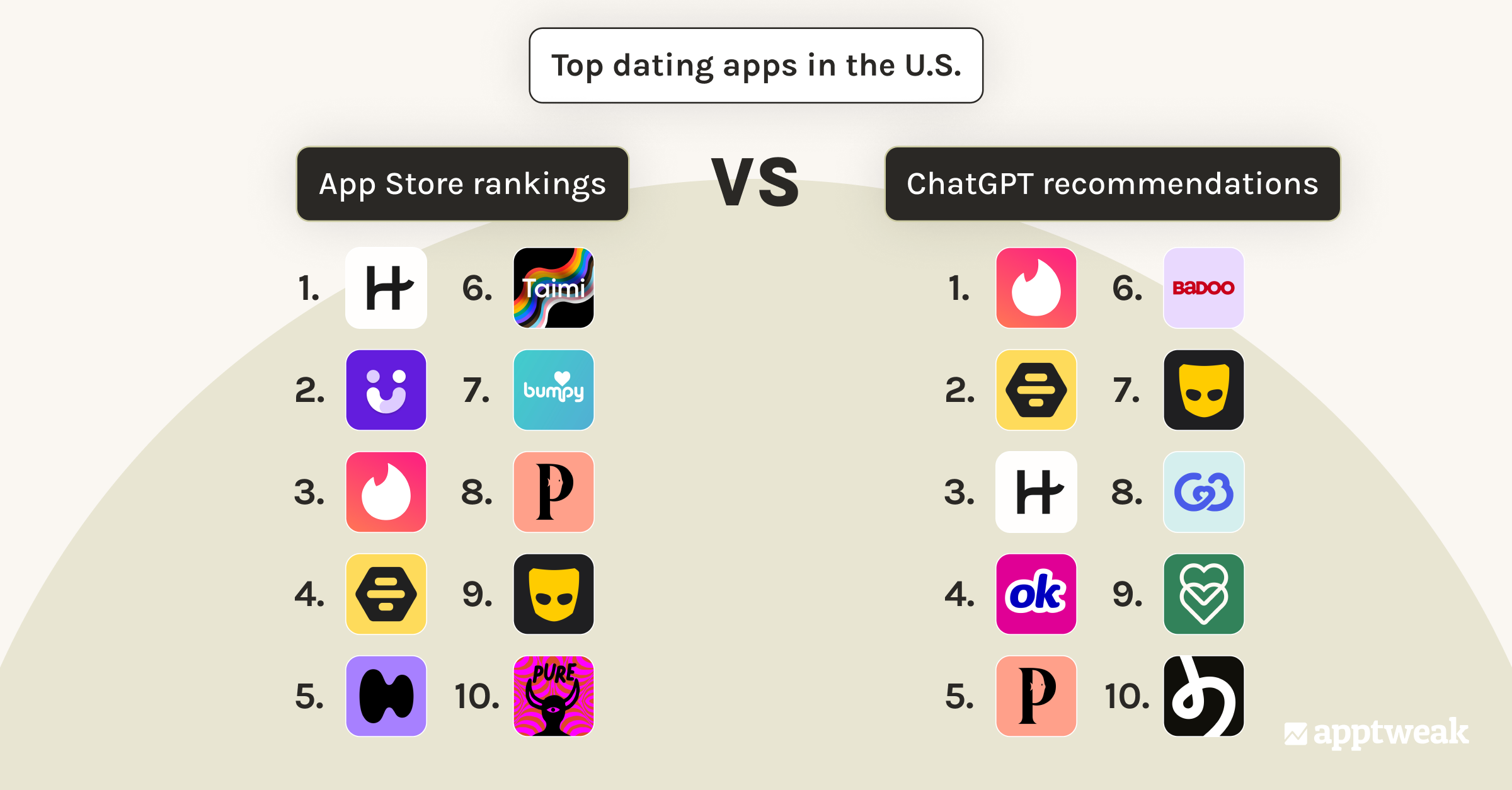
There is meaningful overlap between the two lists. Major players like Tinder and Hinge appear prominently in both, indicating that overall popularity still influences AI-generated recommendations through broader training associations and web coverage.
However, the lists are not identical. Some apps that rank highly in the App Store appear lower or not at all in ChatGPT’s recommendations, while others surface more prominently than their store rank alone would suggest.
This difference reflects the distinct inputs at play: App Store rankings tend to prioritize downloads, conversion, and keyword performance, whereas AI search engines prioritize intent alignment, training associations, and the quality of retrieved web sources, including store listing content.
For ASO and UA teams, this distinction is critical. ASO remains essential for conversion and in-store discoverability. But AI search introduces an additional recommendation environment where ranking position alone is not sufficient to drive visibility.
Conclusion
AI search introduces a new way for apps to be evaluated and recommended. It’s not replacing the app stores, but it is reshaping how users arrive there.
ASO remains essential for conversion and in-store visibility. At the same time, users are increasingly turning to AI search engines to find the right app for their needs. These systems evaluate apps through a different lens, interpreting intent and synthesizing recommendations based on the signals they retrieve and associate.
For ASO and UA teams, this means app discoverability now depends on more than ranking position alone. Understanding how AI search engines assess and surface apps is becoming an important extension of traditional ASO strategy. And the data is now clear on where to start: your app store listing is one of the most direct surfaces you can optimize for AI visibility.
FAQs
How are apps discovered in ChatGPT, Gemini, Claude, and other AI search engines?
Apps are discovered when AI systems interpret user intent and generate recommendations based on model training knowledge and live web retrieval. These platforms do not rank apps using app store ranking signals.
During training, large language models learn associations between app names and specific use cases. When a user asks for a recommendation, the system interprets the underlying task, retrieves relevant web content, including publicly indexed app store listing pages, and synthesizes a shortlist aligned with that intent.
AppTweak’s analysis of 125,000+ ChatGPT responses show that Apple App Store listing pages were the single most-cited source at 37.6% of all citations. This makes store metadata one of the most direct surfaces app marketers can optimize for AI visibility.
How does AI search impact app store installs?
AI search impacts app store installs by influencing which apps users consider before they ever search in the App Store. When users ask ChatGPT, Gemini, Claude, or other AI search engines for recommendations, these systems interpret intent and generate curated shortlists of apps that align with the user’s needs.
In many cases, users then open the App Store to evaluate screenshots, ratings, and pricing before installing. While installs still occur within the store environment, AI search can shape which apps enter that evaluation stage. As a result, AI-generated recommendations increasingly play a role in upstream consideration, even though the App Store remains the primary conversion point.
Why do some major apps consistently appear in AI-generated recommendations?
Large apps often appear in AI recommendations because they have strong training associations and broad web representation. High download volume leads to more reviews, comparisons, discussions, and editorial coverage.
This widespread presence reinforces:
- Model training associations
- Retrieval likelihood in live web searches
- Perceived authority for specific use cases
However, popularity alone does not guarantee inclusion. AI search engines still evaluate intent alignment. Apps that are clearly positioned around specific jobs to be done are more likely to surface consistently.

More articles in AI Visibility, App Marketing, Artificial Intelligence (AI)

 Pierre-Antoine Roy

 Micah Motta

