AI Visibility: The first AI search platform built for mobile apps
 by Georgia Shepherd
Senior Product Marketing Manager at AppTweak
— 11 min read
App discovery is changing. People are increasingly finding new apps and products through AI search.
When someone asks ChatGPT to find an app, they get a direct answer to their need, and only then do they go to the app stores. The download decision is shaped before they ever see a search result.
For most app teams, this is a huge blind spot. Most don’t have a view of how their app is being mentioned in AI search, which competitors are winning AI visibility instead, or what AI truly understands about what the app does.
Until today, there’s been no reliable way to measure this for the mobile market.
Key takeaways
- AI search is shifting app discovery from app stores to conversational answers, where users receive recommendations before visiting the store.
- AppTweak’s AI Visibility is the first platform built specifically to measure how apps are recommended in AI tools using app-level data rather than web signals.
- AppTweak’s AI Visibility methodology combines 10,000+ prompts, thousands of intents, and 200+ app subcategories derived from real app store data.
- AI visibility optimization for apps requires consistent positioning across app store metadata, web content, and external signals.
A new layer of app intelligence, now available in AppTweak
AppTweak’s AI Visibility is the first AI search platform built specifically for the mobile app ecosystem.
Understand what AI search means for app discovery
It helps you understand how and where your app is showing up in AI search and how that compares to your competitors – powered by 10+ years of real app store data and market intelligence:
- 10,000+ prompts curated around how people actually search for apps in ChatGPT
- 1,000+ intents covering a full range of user goals across hundreds of app subcategories
- Key metrics to measure, compare, and improve your app’s AI visibility over time
Let’s see what that looks like in practice, taking Calm as an example.
AI Visibility Score
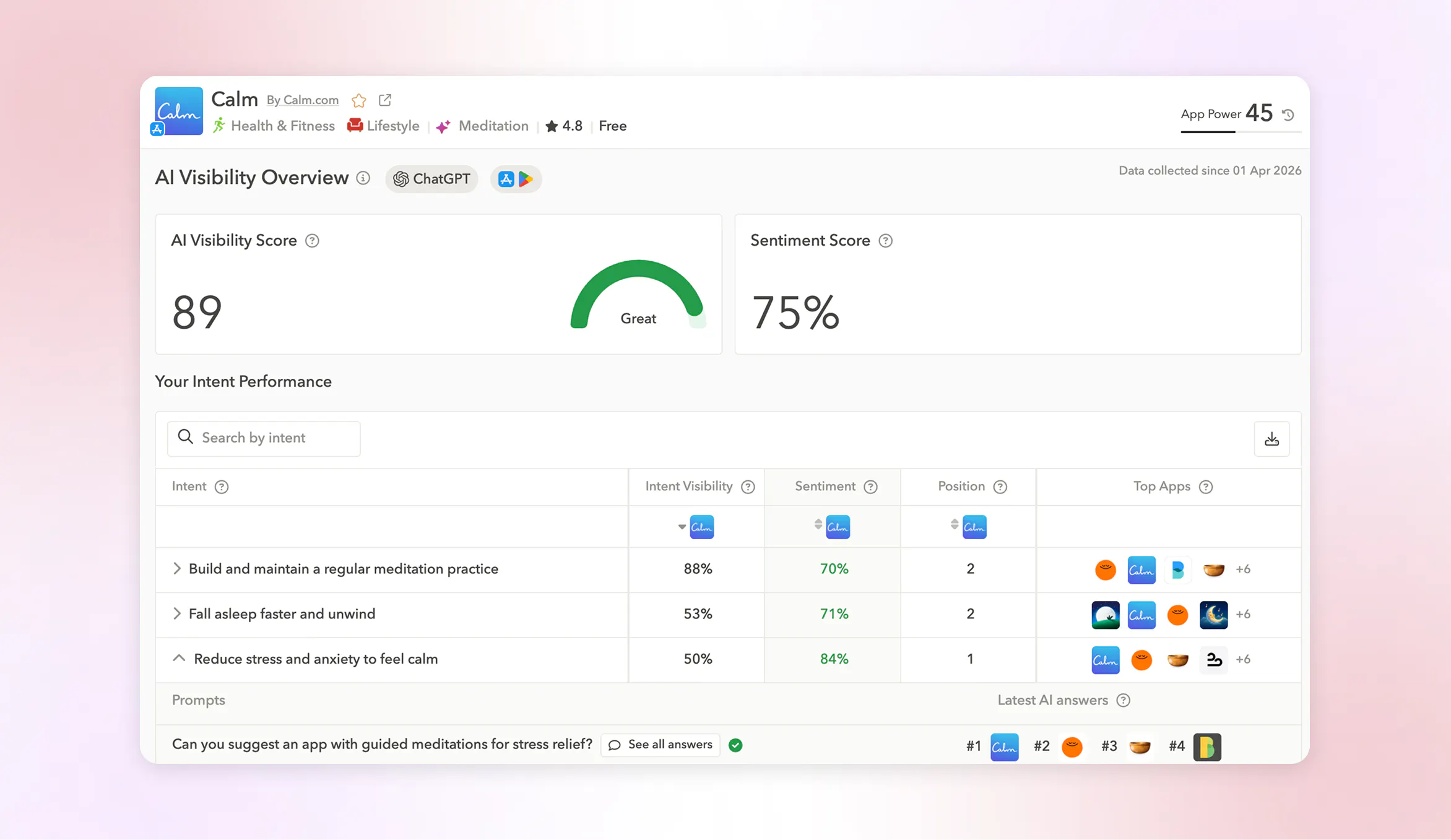
The AI Visibility Score is a benchmark score (0–100) showing how often and how prominently your app is recommended compared to all other apps in AppTweak.
Based on thousands of prompts run weekly, it’s a stable signal you can track over time to measure how your efforts are paying off in AI search.
Calm’s AI Visibility Score is currently 89, positioning it among the more visible apps for AI-driven discovery.
Intent Performance
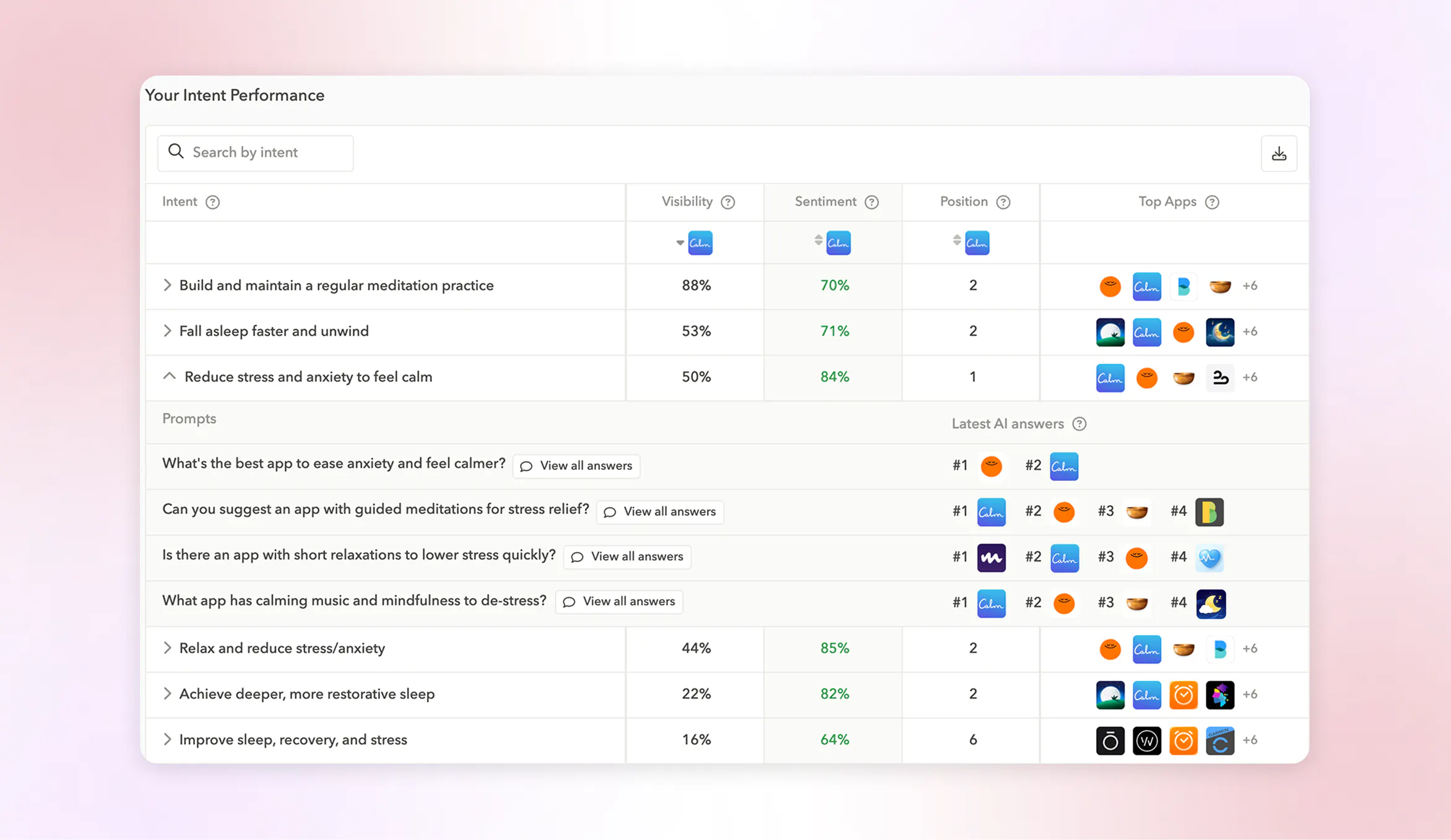
An intent is the specific reason a user turns to AI to find an app. Not a keyword or a topic – but a goal.
“Build a regular meditation habit,” “Fall asleep faster and unwind.” These represent common needs users when looking for a meditation app, and they drive different recommendations.
Calm performs well on the intents “Reduce stress and anxiety to feel calm.” When users ask questions (prompts) to express that intent, Calm is mentioned often and positively by ChatGPT.
Expert Tip
Who is mentioned alongside your app might surprise you. AI Visibility can show challengers recommended on intents you own, and those you never considered targeting.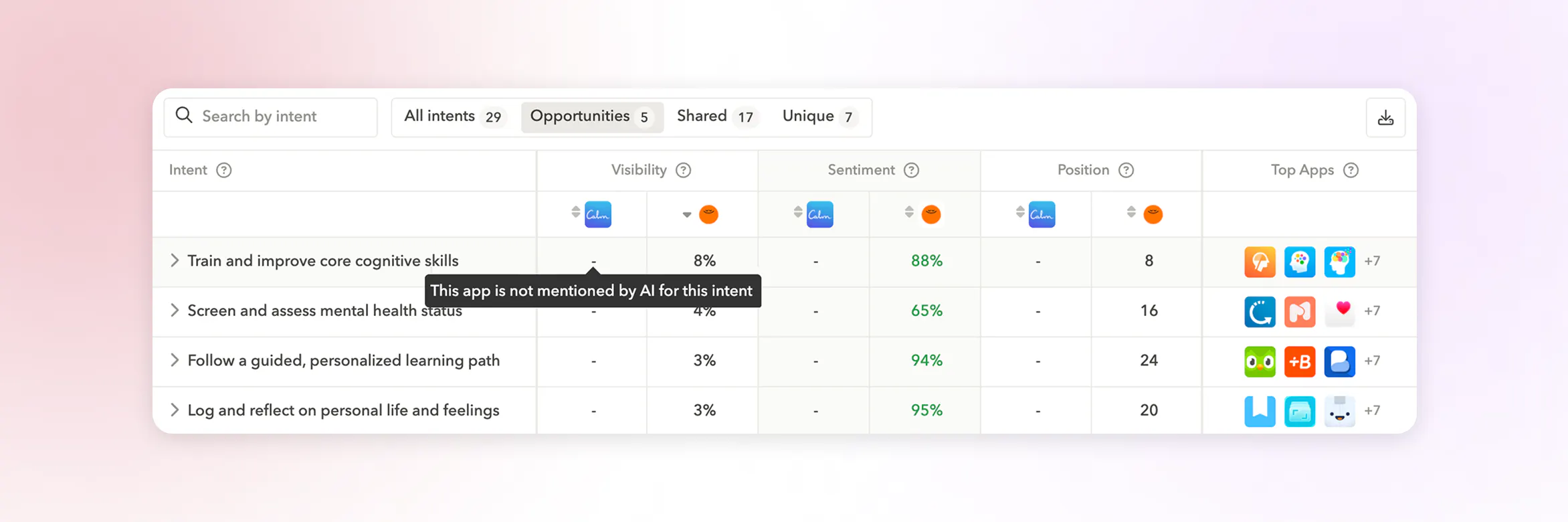
Position Map
With the Position Map, you get a cross view of competitors’ performance in AI search across key intents: who’s leading where, where the pressure is, and where your next opportunity might be.
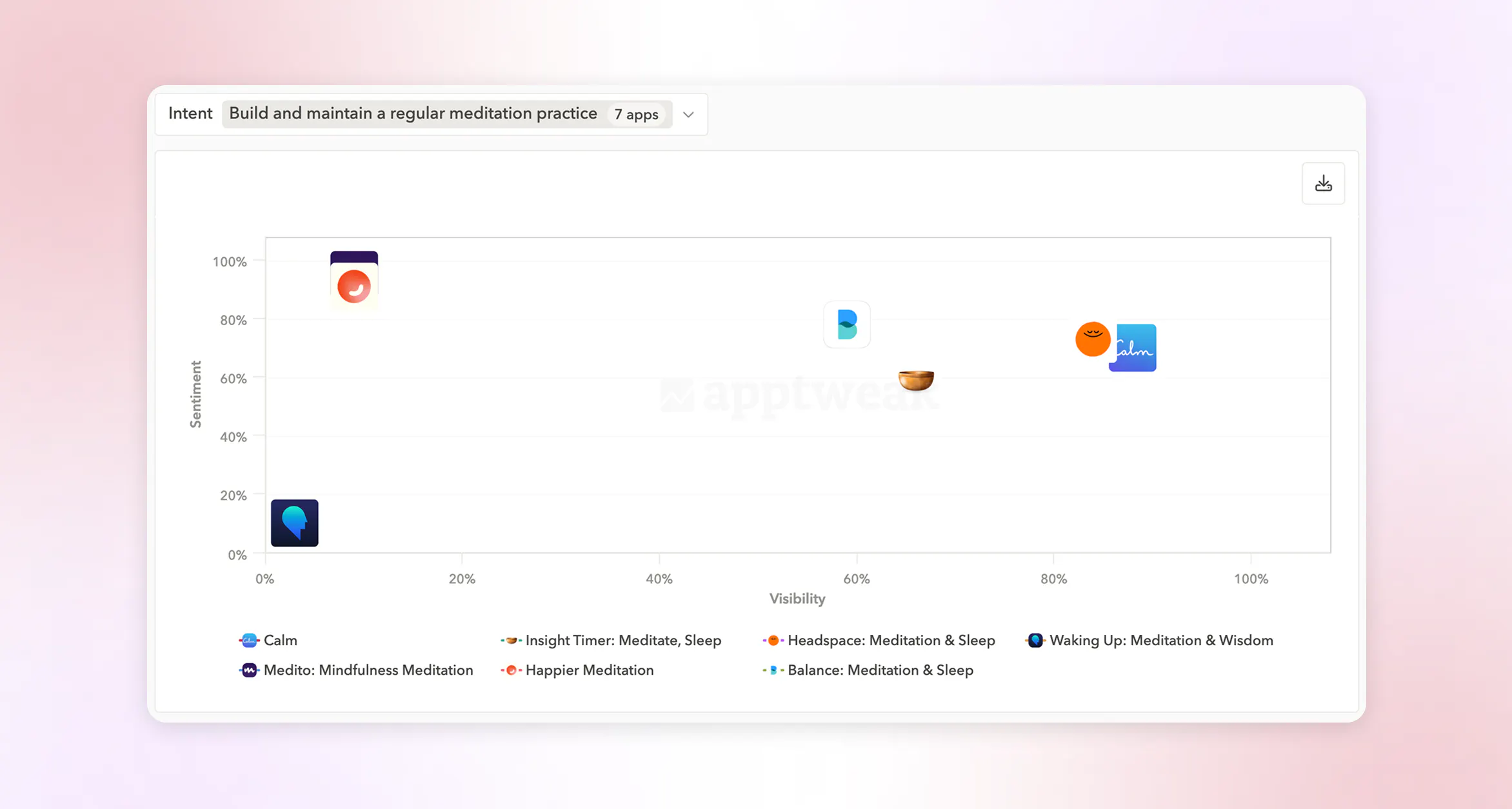
It maps intent visibility to sentiment, so you can understand not just where apps are recommended, but how they are positioned and perceived by AI.
What makes AppTweak’s AI Visibility different?
Most teams tracking AI visibility today rely on tools built for websites, not apps. These platforms typically start from your domain, identify where your brand is mentioned across the web, and measure how often it shows up in AI-generated responses.
This approach works well for web discovery, but app discovery requires a specific layer of intelligence.
AppTweak’s AI Visibility is built end-to-end around how users discover mobile apps. Every intent, every prompt, and every metric is designed with the mobile app ecosystem in mind.
Side-by-side: Web-based AI search platforms vs. AI visibility for apps
| Web-based AI Visibility | AppTweak AI Visibility for Apps | |
|---|---|---|
| Starting point | Your brand or domain | Your app market (AppDNA, 200+ subcategories) |
| Prompt methodology | You create your own prompts or the platform generates prompts after reading your website | Non-branded prompts built from 10+ years of app store intelligence. Each prompt is mapped to a specific user intent – the goals that drive people to search for an app |
| What gets tracked | Domain citations, brand mentions | Actual apps recommended by name, matched to real app IDs |
| Competitive view | Brands – your top web competitors | Real apps being mentioned alongside yours in AI search |
Improving AI visibility for apps: where to start
As we’ve been working with app teams on this topic, one question comes up every time. How do I improve my app visibility in AI search?
Reddit, Yodel Mobile, and AppTweak – How to get your app discovered in ChatGPT
We’re still in the early days, but what we do know is that measuring comes first. You can’t improve what you can’t see.
Today, AI-driven discovery sits at the intersection of ASO and SEO (which some are calling Generative Engine Optimization, or GEO, for apps).
Here’s where we recommend you start:
- App store metadata. Titles, descriptions, and update notes are now grounding data for AI – not just conversion tools. In your app store metadata, make sure you describe real user goals. Take the time to explain what changed in your app with update notes (“bug fixes” is a wasted signal).
- Web presence. Ensure you have a clear webpage that describes what your app does, who it’s for, and what problems it solves. FAQs that answer “how do I…” and “can this app…” add real value for AI visibility.
- External authority. Reviews, press mentions, and “best apps for X” articles are among the top content formats retrieved by AI engines; they shape how AI understands and trusts your app. Encourage descriptive reviews. For example, a review that says “this app helped me fall asleep in 10 minutes” does far more work than “love this app.”
AI engines evaluate your app across every surface they can find. They’re looking for one thing: consistency.
Apps that describe themselves clearly and coherently get recommended. If your teams are optimizing in isolation, your AI visibility will show it.
Measure your app’s visibility in AI search
We’ve seen AI referral traffic already appearing in console analytics for many apps. Volume is small but consistent – and conversion is often high. Users arriving from an AI recommendation already know what they want.
The question is not whether AI-driven app discovery is happening. It’s whether you have the tools to measure and improve your visibility within it.
With AI Visibility, you can now get reliable, app-specific intelligence on how and where your app is being recommended in ChatGPT.
If you want to see how your app is performing in AI search, we’d love to show you.
AI Visibility for Apps is now available as an add-on to AppTweak’s ASO Intelligence.
FAQs
What is AI visibility for apps?
AI visibility measures how often and how prominently an app is recommended in AI-generated answers. It reflects whether your app appears when users ask tools like ChatGPT for solutions.
AI visibility is driven by how well AI systems understand:
- What your app does
- Which user needs it solves
- How it compares to competitors
Unlike app store rankings, AI visibility captures discovery before users reach the app store. It introduces a new acquisition layer where recommendations happen before app store search and shape user decisions ahead of download.
Platforms like AppTweak’s AI Visibility enable teams to measure and track this visibility across user intents and competitors.
Why is AI search becoming a key discovery channel for apps?
AI search is becoming a key discovery channel because users now ask for solutions and receive direct app recommendations instead of browsing store search results.
This shift reflects a broader change in behavior:
- Discovery starts with a question, not an app store search
- AI tools return curated recommendations instead of lists
- Users often decide before visiting the app store
Early data already shows AI tools like ChatGPT appearing as referral sources in app analytics, with lower volume but higher-intent users.
As this behavior grows, visibility in AI-generated answers becomes a critical factor in app acquisition. AppTweak’s AI Visibility helps teams understand and quantify this shift.
How is AI visibility different from ASO?
AI visibility focuses on being recommended in AI answers, while ASO focuses on ranking and converting within app stores.
Key differences:
- ASO targets keywords and conversion inside app stores
- AI visibility targets user intents and recommendations before store entry
However, both rely on similar signals:
- App store metadata
- User reviews and ratings
- External content and authority
AI visibility extends ASO by adding a new discovery layer that influences users before they reach the app store, with apps that are clearly understood and aligned with user needs more likely to be recommended.
What are intents in AI search for apps?
Intents are the specific user goals that drive app discovery in AI search. They represent what users want to achieve, not the keywords they type.
Examples:
- “Fall asleep faster”
- “Track expenses automatically”
- “Find a serious dating app”
AppTweak’s AI Visibility derives intents from real app store data, ensuring they reflect actual user needs across a category.
Tracking intent performance helps teams:
- Identify which needs they dominate in AI search
- Discover gaps where competitors win
- Align messaging with real user goals
How does AppTweak measure AI visibility?
AppTweak measures AI visibility using a structured system of intents, prompts, and app-level matching.
The process includes:
- Mapping the app market using AppDNA (200+ subcategories)
- Defining relevant intents based on real app store data
- Generating multiple prompts per intent
- Running prompts regularly in AI search
- Matching responses to real apps using app IDs
This methodology produces stable metrics such as:
- AI Visibility Score
- Sentiment Score
- Competitive Positioning
It ensures unbiased results that reflect real discovery dynamics, not one-off queries.
Which tools can measure AI visibility for apps?
Only specialized tools built for the mobile ecosystem can accurately measure AI visibility for apps, as most existing platforms are designed for websites.
Web-based AI visibility tools:
- Track domain citations and brand mentions
- Focus on website content and SEO signals
- Do not show which apps are actually recommended in AI answers
App-specific tools like AppTweak:
- Track real apps recommended by name and matched to app store IDs
- Use non-branded prompts that reflect how users actually search for apps
- Map visibility across competitors within the same app market
AppTweak’s approach is built on:
- AppDNA, a granular classification of 200+ app subcategories to structure the market
- Intent mapping, derived from real app store data to reflect why users download apps
- 10+ years of app store data and market intelligence, capturing how apps compete
This combination enables a more reliable view of AI-driven app discovery, helping teams measure visibility and identify gaps in a way generic web tools cannot.
Who should manage AI visibility (SEO vs ASO)?
AI visibility should be managed collaboratively by SEO and ASO teams, as it impacts user acquisition across the entire funnel from web discovery to app store conversion.
AI search spans the full app acquisition funnel:
- Web content and brand presence influence how AI understands your app
- AI-generated answers determine which apps are recommended
- App store pages drive final conversion and downloads
Typical roles:
- SEO teams: manage web presence, content, and external visibility signals
- ASO teams: manage app store metadata, positioning, and conversion optimization
How teams should typically work together:
- Both SEO and ASO teams analyze AI visibility data to understand how the app is recommended across different user intents
- SEO teams optimize web content, landing pages, and external authority to influence AI understanding
- ASO teams align app store metadata, creatives, and messaging with the same user intents and positioning
- Both teams contribute to acquisition strategy, including campaigns, content, and positioning decisions
AI visibility requires consistent messaging across all surfaces. As AI-driven discovery evolves, the distinction between SEO and ASO will continue to blur, making shared ownership essential.
How can app teams improve AI visibility?
Improving AI visibility requires aligning all content signals around clear user needs and consistent positioning.
Key areas to optimize:
- App store metadata: describe user outcomes, not just features
- Web presence: create pages and FAQs answering user questions
- External authority: generate detailed reviews and third-party content
AI systems prioritize apps that consistently communicate the same value proposition across metadata, web content, and external sources.
Tools like AppTweak’s AI Visibility help teams understand where their app is visible in AI search in and connect those insights directly to ASO and acquisition strategies.

More articles in Artificial Intelligence (AI), Product Updates