
AI plays a role in nearly every part of app marketing.
We use it to rewrite metadata, spark creative ideas, analyze competitors, and summarize results. It has quickly made the operational side of ASO and Apple Ads faster, smoother, and more collaborative.
But most AI isn’t built for the app stores.
Not because the tech isn’t impressive. But because it wasn’t trained to understand the ecosystem we operate in.
Today, generic AI doesn’t have access to real-time or historical keyword ranking data. It doesn’t know app store search volumes. And it can’t access (or help you scale) live Apple Ads campaigns.
So if you’re responsible for growth, the question isn’t whether to use AI.
It’s which intelligence layer you trust to guide your ASO and Apple Ads decisions.
This blog gives you a marketer-first framework for evaluating different tools in your marketing stack, and explains why context built on years of app store data matters far more than AI buzzwords.
Key takeaways
- Not all AI is built for the app stores. While most AI tools can boost productivity, they lack access to real performance data or app store-specific signals – making them unreliable for strategic ASO or Apple Ads decisions.
- “Good AI” for app growth must go beyond automation. The best AI understands how the app stores actually work, connects ASO and Apple Ads insights, and delivers expert guidance with transparent logic you can trust.
- Generic AI tools (like ChatGPT) have clear limits. These models can’t interpret real performance data, keyword intent, or store behavior – and often hallucinate answers, creating risk for budgets when accuracy is critical.
- AppTweak’s Atlas AI is purpose-built for app marketers. It’s trained on 500M+ data points, giving it unmatched context and precision.
- Atlas AI powers both insight and execution. From review tagging to keyword suggestions to Ad Agent, every feature is rooted in real store behavior, not assumptions or surface-level trends.
- AppTweak puts marketers in control. Unlike black-box AI bidding systems, Atlas AI is designed for explainability and strategic oversight, helping teams act smarter without handing over the wheel.
- You don’t need more AI. You need the right kind. AppTweak’s Atlas AI acts as the intelligence layer behind your ASO and Apple Ads growth, delivering clarity, accuracy, and confidence at scale.
What “good AI” looks like for app store marketing
With AI everywhere, teams expect faster insights, smarter guidance, and automation that feels safe.
But for ASO and Apple Ads, AI only works if it’s built on real app store signals, tailored to how both ecosystems behave, and reliable enough that people can trust it.
Good AI for app store growth should do five things:
- See the stores the way the algorithms do. Good AI understands keyword intent, ranking behaviors, category dynamics, and how the stores match all these elements together.
- Connect ASO and Apple Ads directly. Good AI understands how both channels influence each other—because Apple Ads visibility depends on organic strength, and organic growth accelerates when paid is aligned.
- Give expert-level recommendations. The strongest AI guidance is trained on proven ASO and Apple Ads strategies, not generic marketing advice.
- Handle repetitive work instantly. AI should free more of your team’s time for testing, refining messaging, and making strategic calls.
- Be reliable and transparent. Good AI should help you understand why a recommendation is made, and give space for human oversight.
Where traditional ASO and Apple Ads workflows fall short
Even before exploring AI, most app marketing and growth teams rely on familiar workflows like dashboards, spreadsheets, internal expertise, or agency work.
These traditional approaches all struggle with the same problem: they weren’t built for the speed, scale, and interconnected nature of ASO and Apple Ads today.
Here’s where traditional workflows naturally break down.
Dashboards and reporting tools
Great for seeing what happened. Not built to explain the why—or what to do next.
Dashboards show metrics from Apple Ads, App Store Connect, Google Play Console, and ASO tools. But they don’t tell you what those changes mean, or what you should do about them.
Dashboards fall short because:
- They flag what moved, not what matters.
- They show changes, but don’t explain root causes.
- They don’t help you prioritize next steps based on impact.
- They rely on manual interpretation, which can be slow and prone to error.
Dashboards are essential for monitoring. But they’re not enough to steer your strategy.
Manual expertise
Sharp judgment. Slow and hard to scale.
Internal expertise is irreplaceable—but manual ASO and Apple Ads analysis can quickly become a bottleneck for your team. Here’s why:
- It takes hours to piece together performance trends each week.
- Early signals in keywords, creatives, or intent are easy to miss.
- Decisions rely on an individual’s intuition and memory.
- It’s hard to scale across markets, thousands of keywords, or complex account structures.
- It slows experimentation and iteration.
Manual expertise matters. But alone, it can’t keep pace with the demands of competitive app store marketing.
Agencies and consultants
Experienced partners. Limited by human bandwidth.
Agencies bring depth, especially for lean or growing teams. But they face structural limitations:
- They’re costly.
- They usually rely on manual workflows.
- Scaling across many markets takes significant time.
- They monitor performance at defined checkpoints, not continuously.
- Recommendations depend on meeting cadence, not real-time signals.
- They keep knowledge outside of your team.
Agencies deliver expertise. AI delivers expertise plus speed, scale, and continuous visibility.
Where current AI tools fall short for ASO and Apple Ads
Traditional approaches will get you part of the way there. But they rely on people to stitch everything together, which is where things start to slow down.
Naturally, teams turn to AI for help—expecting faster insights and clearer direction. But the reality is that most AI still isn’t trained on how the app stores work. This creates a new set of limitations.
Large language models (ChatGPT, Claude, Gemini, etc)
Great for writing. Not built for app store decision-making.
LLMs are powerful tools for rewriting metadata, summarizing research, or generating ideas. But they have clear shortcomings for ASO and Apple Ads:
- They can’t access or interpret your real performance data.
- They don’t understand keyword semantics, search intent, or app store market dynamics.
- They hallucinate numbers and recommendations with confidence.
- They can’t holistically connect organic and paid signals.
- They can’t prioritize what your app should do next.
LLMs changed the game to boost productivity. But they’re not yet designed to guide app store performance strategy.
AI from alternative app store marketing platforms
Useful additions. Not built for high-stakes decisions.
Many ASO and Apple Ads platforms now offer AI-powered features—from keyword suggestions and creative insights to AI bid optimization for Apple Ads. These push the industry forward, but have limitations that matter when performance and budget are on the line.
These tools often:
- Analyze estimated, market-level trends—not your real performance.
- Produce suggestions that hallucinate or feel surface-level without deep store mapping.
- Rely on disconnected ASO and Apple Ads architectures, limiting the synergy between both.
- Lack the context engineering and data history needed to understand how the stores actually work.
- Promote black-box systems like fully hands-off AI bid optimization that oversimplify nuanced Apple Ads mechanics and put your budget at risk.
- Highlight what moved, but not what will be most impactful for your next decision.
New AI tools for the app stores offer convenience. But without relevant context, 10+ years of historical data, and real performance grounding, they’re not built for scalable optimization.
What makes AppTweak’s AI different
Most tools start with an AI model and try to fit app store data into it.
AppTweak did the opposite.
And that decision has unlocked advantages other AI tools simply can’t offer.
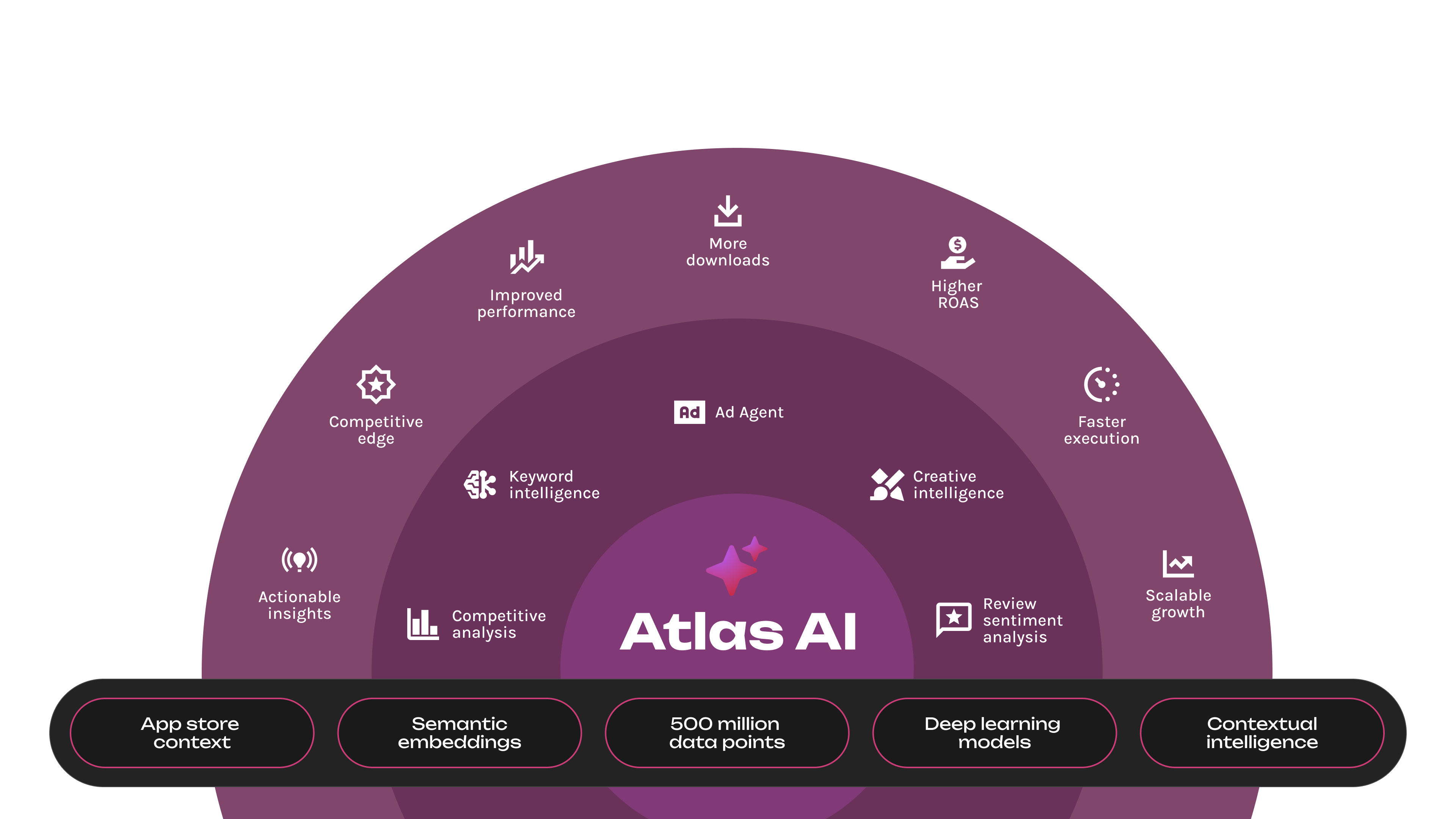
1. Accurate App Store & Google Play data since 2014
App store behavior isn’t random. Ranking, search intent, category movements, and competitive shifts follow patterns that only become visible over time.
For more than 10 years, AppTweak has been collecting, structuring, and refining app store data from both the App Store and Google Play, giving Atlas AI the largest database of clean, trustworthy signals to learn from.
This historical depth is something alternative AI tools will never be able to catch up to.
2. A semantic map of how the app stores actually work
In 2021, we introduced Atlas AI.
At its core, Atlas AI was the first semantic mapping of how keywords cluster together, where different apps fit into those clusters, how users search, and why certain terms trend across markets.
Today, Atlas AI is the intelligence layer behind every feature at AppTweak. It powers our entire platform with a core understanding of real behavior inside the app stores—not from assumptions or generic language patterns.
No alternative tool has mapped the app stores to this level.
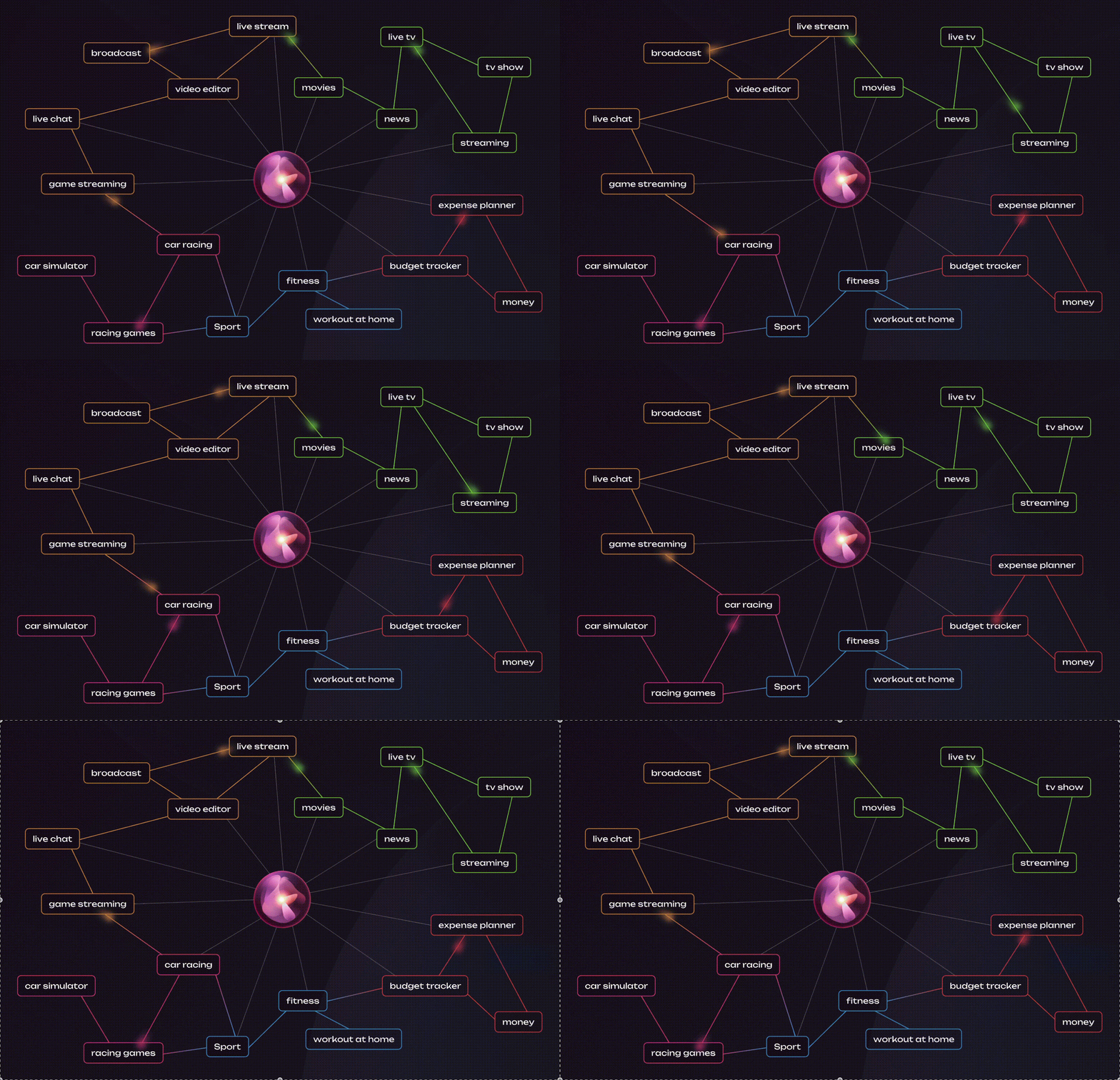
Learn more about Atlas AI, AppTweak’s AI model for the App Store & Google Play
3. Impactful AI features that save you hours each week
Atlas AI doesn’t just power recommendations. It powers AppTweak’s ecosystem of ASO and Apple Ads features.
From AI screenshot search to review tagging, keyword suggestions, app store taxonomy models, and more, every signal feeds back into a consistent, unified understanding of the stores.
Because Atlas AI is trained on high-quality, structured, and historically consistent data, every feature is grounded in relevant app store context.
Ad Agent: Your AI strategist for Apple Ads
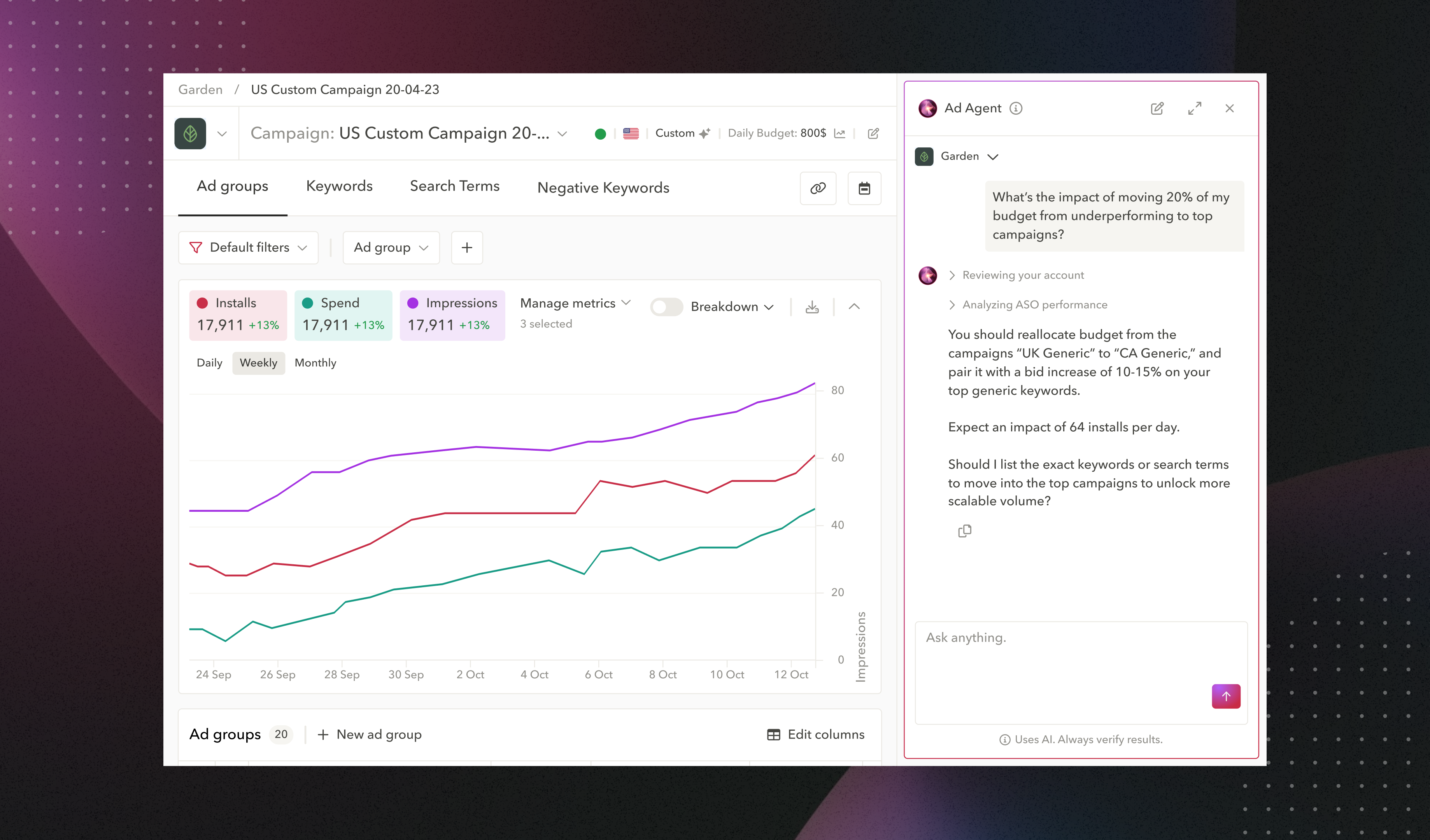
Atlas AI also powers Ad Agent—the only AI agent designed to help you scale Apple Ads with real performance context.
Unlike alternative agents built on market estimates or generic logic, Ad Agent connects directly to your Apple Ads account.
It can answer any question about your campaigns, interpret what changed, explain why, and recommend your next strategic move—all in plain language.
As every insight is grounded in your real ASO and Apple Ads performance and a decade of app store understanding, you get strategic leverage without giving up control.
In AppTweak, agents don’t just summarize estimated data. They help you scale with clarity.
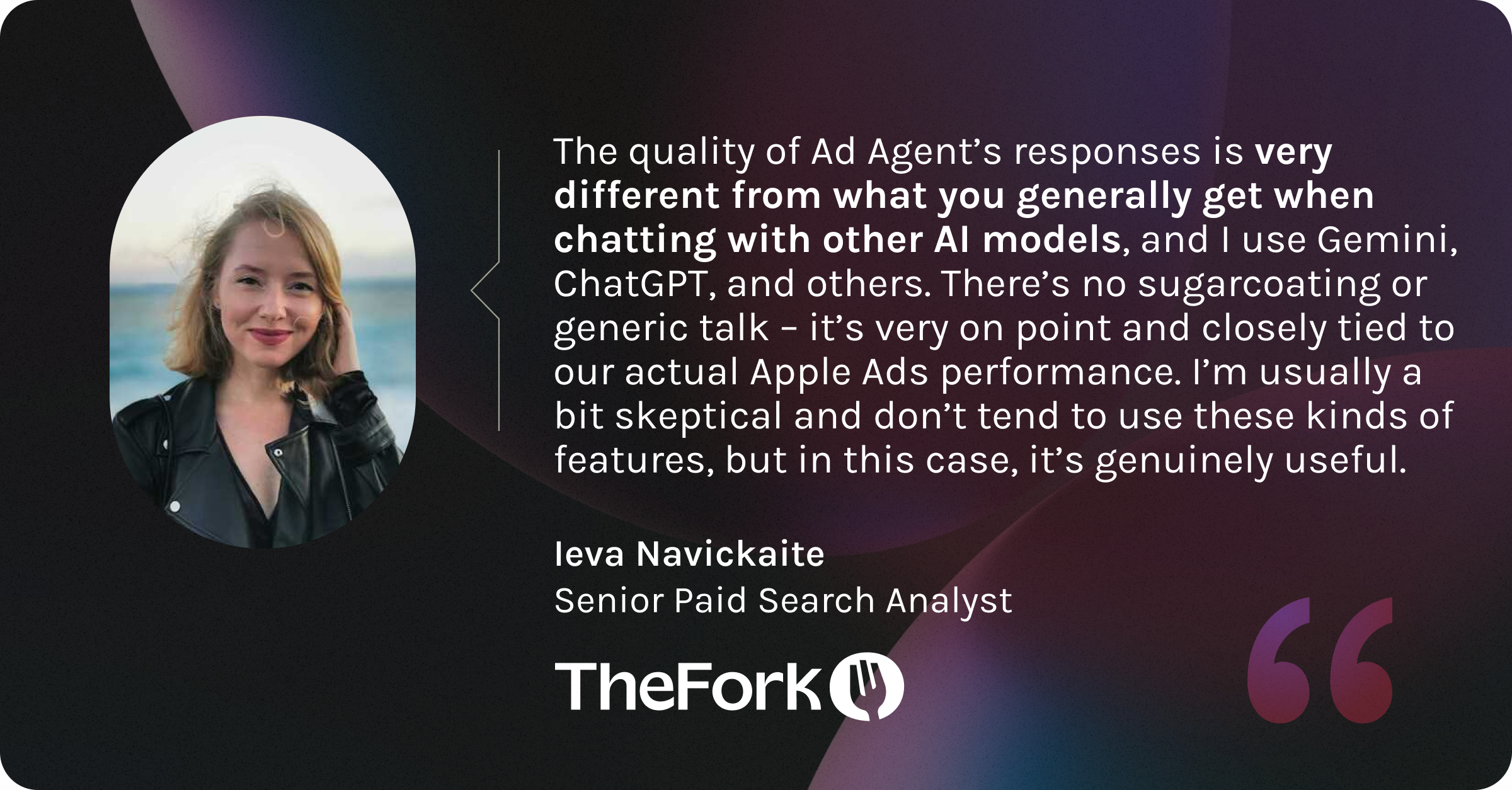
Discover Ad Agent, the world’s first AI agent built to scale your Apple Ads campaigns
4. AI you can trust to deliver accurate, personalized recommendations
Generic AI and some alternative AI tools rely only on market-level estimations.
As AppTweak’s intelligence is built on structured, context-engineered, verified store data, we guarantee fewer hallucinations, fewer inconsistencies, and recommendations tied to real performance patterns.
When budgets or rankings are at stake, accuracy is non-negotiable.
5. Designed to keep you in control
Some tools position AI around fully hands-off automation, especially around bidding. But Apple Ads is nuanced, strategy-sensitive, and highly reactive, making AI-driven bidding risky.
AppTweak takes a different approach, where Atlas AI augments human decision-making with reasoning, not black-box automation.
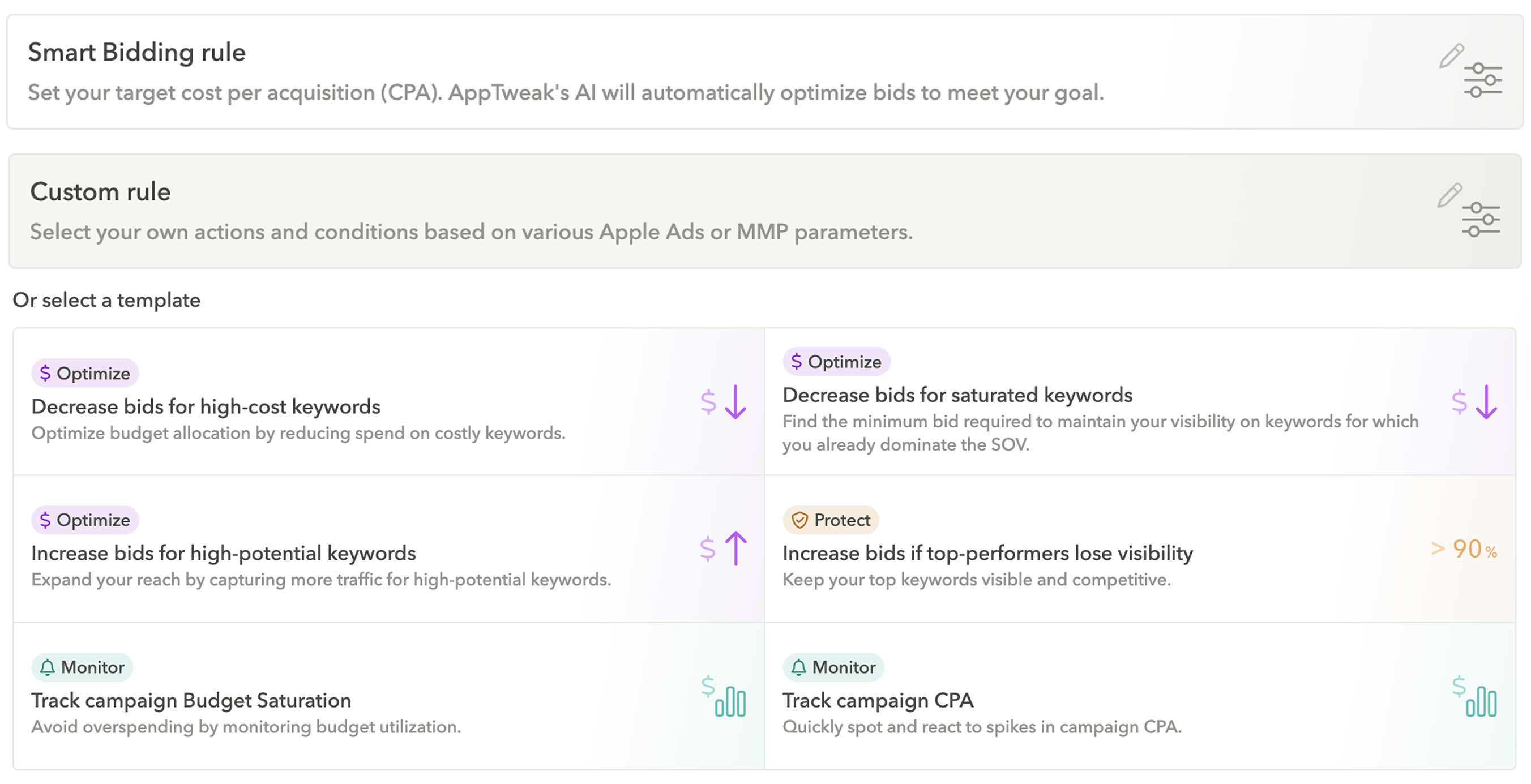
For example, when building our Smart Bidding for Apple Ads, we used AI to develop a complex, strategic set of rules that make small, incremental bid adjustments toward your cost-per-install (CPI) goals instead of drastic, unexplained changes.
This is how we keep you in control—with AI that supports your strategy rather than overriding it, and ensures every recommendation is grounded, explainable, and safe for your budget.
6. Built with complete privacy in mind
Protecting customer data is central to how AppTweak designs its products—including the way Atlas AI works.
AppTweak is ISO 27001 certified, meaning our systems and processes meet one of the highest international standards for information security. In practice, this ensures your data is safeguarded through rigorous policies, audited controls, and industry-leading security practices.
By connecting your account to AppTweak, we guarantee your ASO and Apple Ads data is never used to train AI models or inform insights for other apps. Atlas AI uses only the relevant context it needs to generate actionable recommendations—without compromising confidentiality or compliance.
Expert Tip
As an Apple Ads Partner, AppTweak is committed to empowering app marketers with the best data, tools, and support to improve their organic and paid performance on the App Store.With AppTweak, you get the benefits of AI, backed by the level of privacy and trust required when working with sensitive performance data.
You don’t need more AI. You need the right intelligence behind it
AI is already reshaping app marketing for the better.
But the next wave of impact won’t come from more models or more automation—it will come from better context.
Dashboards show what happened. Agencies give expertise. LLMs boost productivity.
But only AI built on deep app store understanding can help you make confident decisions across ASO and Apple Ads.
AppTweak’s AI isn’t just a feature layer.
Atlas AI is an intelligence layer powered by a decade of contextualized data that strengthens your judgment and helps your team grow with clarity.
If you’re looking to scale your impact with confidence, the AI you choose matters.
Choose one built for the app stores. One that understands your world.
FAQ
Below, we answer the top questions about AI for ASO and Apple Ads.
What type of AI is best for ASO and Apple Ads?
The best AI for ASO and Apple Ads combines accurate app store data, contextual intelligence, and direct access to your app’s ASO and campaign performance. This ensures recommendations are not only reliable but also tailored to your goals and market.
Can AI tools like ChatGPT, Gemini, or Claude improve my ASO or Apple Ads strategy?
AI tools like ChatGPT, Gemini, and Claud can support ideation for ASO or Apple Ads by generating keyword variations, metadata suggestions, or ad copy drafts. But they lack access to real, live performance data or store-specific trends, making them unsuitable for decision-making or optimization. Use them alongside app marketing intelligence platforms like AppTweak for the best results.
Are AI-powered recommendations safe for app marketing?
AI recommendations are safe as long as they’re explainable, rooted in reliable data, and have deep contextual intelligence. Marketers should always retain strategic oversight and avoid full automation without transparency. AI-powered platforms like AppTweak prioritize clarity, so you always understand the “why” behind a suggestion.
How is AppTweak’s AI different from other ASO and Apple Ads tools?
AppTweak’s AI is purpose-built for app growth, combining your app’s real performance data with the most robust and complete dataset in the app marketing industry (500M+ performance signals from 10+ years of data) for precision that no other ASO and Apple Ads tool can match.


More articles in Artificial Intelligence (AI)

 Pierre-Antoine Roy


