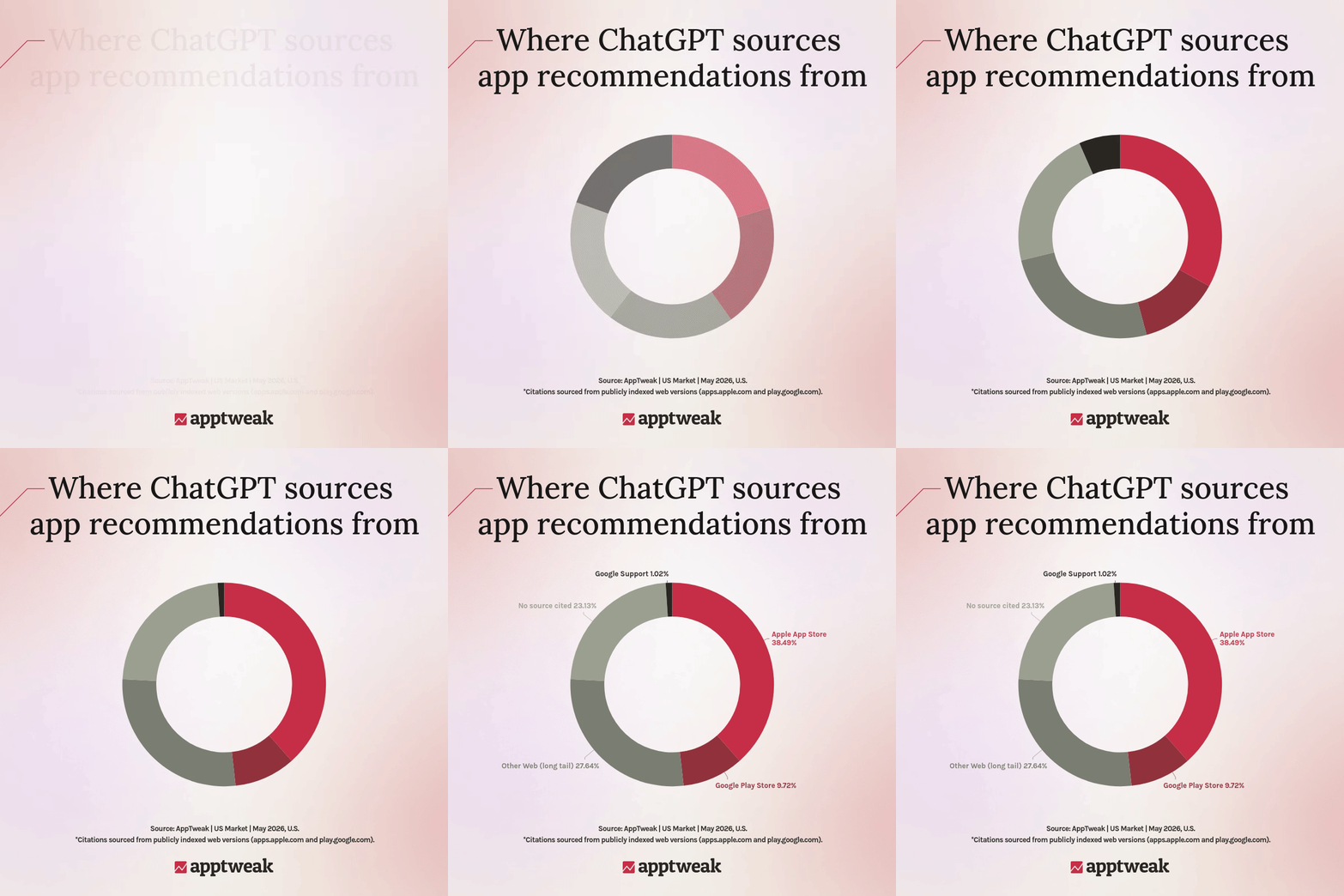
App store listings account for nearly half of all sources ChatGPT cites when recommending apps, 47.5% in total. That makes the listing the single highest-leverage surface to optimize if you want your app to show up in AI-generated recommendations.
“App marketers spend significant time and budget on websites, PR, and content marketing. But the surface ChatGPT relies on most is one ASO teams already own and update regularly.”
Alexandra De Clerck, Chief Marketing Officer at AppTweak
Key takeaways
- App store listings make up 47.5% of all sources ChatGPT draws from when recommending an app, more than any website, PR piece, or content page.
- ChatGPT retrieves publicly indexed listing text because it reads as factual and extractable, unlike brand-heavy homepage copy.
- Most listings answer “why download this app”, while AI is asking “what is this app for and when should I recommend it”. Closing that gap is a rewrite, not a rebuild.
- Audience, outcomes, and fit are the three elements most listings leave vague, and where AI has the least to work with.
Why do app store listings carry so much weight in AI recommendations?
When someone asks ChatGPT for an app recommendation, the model retrieves publicly indexed web versions of app store listings, the apps.apple.com and play.google.com pages that are crawlable, structured, and rich with descriptive text.
To an LLM, the app store page functions as a structured, reliable source defining an app’s purpose, audience, and utility. While homepages often prioritize brand-heavy copy, listings offer the factual, extractable data that AI models prioritize when generating recommendations.
Why aren’t most app store pages optimized for AI search?
Most app store pages aren’t optimized for AI search because they were written to convert someone who had already found the app, not to inform an AI model.
So most app store descriptions are written to answer one question: why should I download this app? AI search engines are asking a different one: what is this app, who is it for, and when should I recommend it?
These questions aren’t in conflict. The same clarity that helps a model extract a confident recommendation (a specific audience, defined use cases, concrete outcomes) is what helps a human reader decide quickly whether the app is right for them.
The gap most listings have isn’t a conversion problem or an AI problem. It’s an ambiguity problem. A description that leads with “the ultimate wellness companion” gives an AI search engine almost nothing to work with, and it doesn’t do much for a human reader either. A more useful opening line for humans and AI follows a simple pattern:
[App name] is a [type of app] that helps [target users] [achieve goal] by [core capabilities].
Six ways to optimize your app store listing for AI retrieval?
These are six ways to make your listing easier for LLMs like ChatGPT or Gemini to read and extract a clear recommendation from. The examples below are pulled from Flo, the period tracking app.
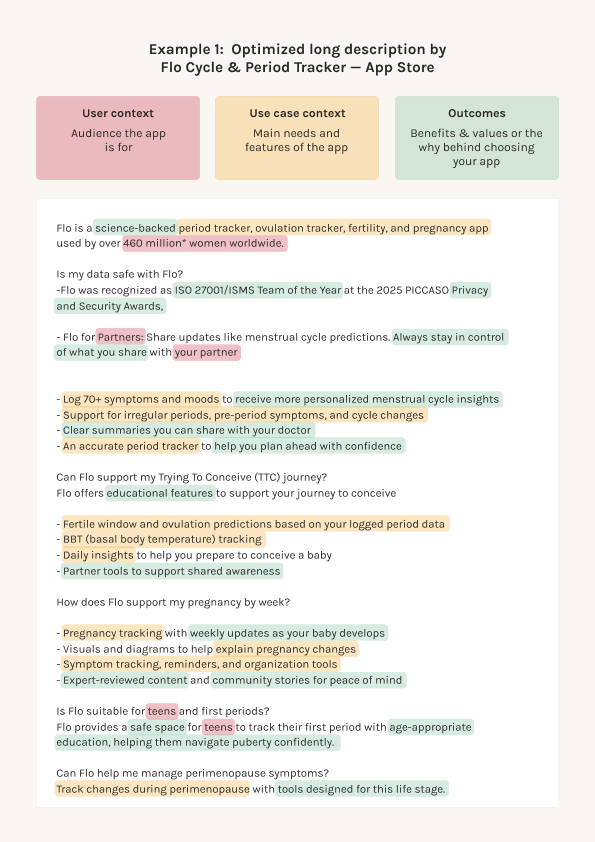
- Define your audience immediately. The opening line should tell AI and users exactly who the app is for. Flo’s opening line: “Flo is a science-backed period tracker, ovulation tracker, fertility, and pregnancy app used by over 460 million women worldwide.”
- Reinforce a focused set of use cases. Claiming every possible use case creates weak associations in AI systems. Pick the three to five use cases that matter most and reinforce them consistently. This is also just good ASO practice.
- Cut vague positioning language. “All-in-one,” “revolutionary,” and “ultimate platform” describe brand perception, not functionality. “Track ovulation, fertility, pregnancy, and cycle symptoms in one app” is more useful to a model than “your complete health companion.”
- Connect features to outcomes. “Track symptoms and moods” tells AI what the app does. “Track symptoms and moods to better understand cycle patterns and predict periods more accurately” tells AI what the app does and why a user needs it.
- Use question-style formatting where it fits. AI search engines retrieve question-and-answer content well because it mirrors how users prompt them. Flo structures its long description around questions like “Can Flo support my Trying To Conceive journey?” followed by a direct answer. Airalo does the same for eSIM FAQs.
- Add specifics that build trust. Certifications, user numbers, and expert-reviewed content help AI build a more confident picture of your app. “Your privacy matters to us” is easy to ignore. “Flo was recognized as ISO 27001/ISMS Team of the Year at the 2025 PICCASO Privacy and Security Awards” is something a model can retrieve and cite.
How can you audit your app store listing for AI optimization?
Before rewriting anything, check your current description against these five elements. For each one, ask whether your app store page answers the question clearly.
| Element | What to clarify | Example |
| Audience | Who the app is for | “Budgeting app for students and young professionals” |
| Use case | What problem it helps solve | “Track subscriptions and recurring expenses” |
| Features | How the app works | “Shared expense tracking, bill reminders, and spending insights” |
| Outcomes | What users gain | “Stay on top of monthly spending and avoid missed payments” |
| Fit | The situation the app is best suited for | “Ideal for roommates, couples, or anyone managing shared finances” |
Most listings handle features well but leave the audience, outcomes, and fit vague. Those are also the elements AI most needs to make a recommendation, so that’s where the biggest opportunity is.
Conclusion
App store listings are where ChatGPT tends to draw information from. Making yours easier to read and extract from is a reasonable first step, and the content likely already exists. It usually just needs to be restructured.
For ASO practitioners, app store listings were already your most important owned surface. They’re now doing a second job most teams haven’t accounted for yet.
The listing is one of four experiments AppTweak recommends for improving AI visibility. The rest cover your website structure, earning citations from sources LLMs trust, and building community presence.
For the full picture, including how your website and external sources factor into AI recommendations, see AppTweak’s AI visibility playbook for apps and games
FAQs
アプリストアの説明文は、AIによるアプリの推奨に影響を与えますか?
Yes. App store listings account for 47.5% of the sources ChatGPT cites when recommending apps, more than any other source type, based on AppTweak’s snapshot analysis of 125,000+ ChatGPT responses across 9,489 app prompts in the US market. A clear, well-structured description directly affects whether and how confidently your app is recommended. AI engines retrieve publicly indexed listing text because it reads as factual and extractable, unlike brand-heavy homepage copy. The App Store contributes 38% of citations and Google Play 9.5%. Structuring your description around audience, use cases, and outcomes gives models more to retrieve and cite.
AI検索向けにアプリの説明文を最適化するにはどうすればよいですか?
モデルが推測することなく、「誰のためのアプリか」「何をするのか」「いつ推奨すべきか」という3つのことを抽出できるように書いてください。AppTweakが米国市場(2026年5月)における9,489件のアプリプロンプトに対する125,000件以上のChatGPTの回答を分析した結果、アプリストアのページはChatGPTがアプリを推奨する際に引用するソースの47.5%を占めているため、これは非常に重要です。
AI検索エンジン向けにアプリの説明文を最適化するために、以下の6つのベストプラクティスを実施してください。
- キャッチコピーではなく、ポジショニングを明確にする一文で始めてください。 次のパターンを使用します: [アプリ名]は、[主要機能]によって[ターゲットユーザー]が[目標を達成]するのを支援する[アプリの種類]です。
- ターゲット層と、そのアプリが適した状況を明記してください。 「ルームメイト、カップル、または共有の家計を管理するすべての人に」は取得可能です。「すべての人に」は取得不可能です。
- 3〜5つのユースケースに絞り込み、それらを繰り返してください。 考えられるすべてのユースケースを主張すると関連付けが弱くなります。焦点を絞ったセットにすることで、強い関連付けが生まれます。
- ポジショニングのための形容詞を機能に置き換えてください。 「排卵、妊活、妊娠、周期の症状を一つのアプリで追跡」は抽出可能です。「あなたの総合的な健康パートナー」は不可能です。
- すべての機能を成果に結びつけてください。 機能はモデルにアプリが何をするかを伝えます。機能に成果を加えることで、なぜユーザーにそれが必要なのかを伝え、それが推奨に必要な要素となります。
- 検証可能な具体的な情報を追加してください。 ユーザー数、認証、専門家が監修した主張は、モデルに引用すべき具体的な材料を与えます。「お客様のプライバシーを重視しています」では何も得られません。
ほとんどの説明文はすでに機能をうまく扱っています。通常、ターゲット層、成果、適合性にギャップがあり、AIが最も情報を得にくい部分となっています。
AIでの認知度において、Apple App StoreとGoogle Playのどちらがより重要ですか?
AppTweakの米国市場分析によると、Apple App Storeの方が比重が大きく、ChatGPTの引用の38%を占めているのに対し、Google Playは9.5%です。両者を合わせると、ChatGPTがアプリを推奨する際に引用される全ソースの47.5%を占めます。どちらも最適化する価値がありますが、現在はAppleのリスティングの方がChatGPTの推奨に大きな影響を与えています。AIエンジンは公開されインデックス化されたリスティングのテキストを取得するため、ターゲット層の定義、焦点を絞ったユースケースの提示、機能と成果の連結という同じ原則が両方のストアに適用されます。両方のリスティングでポジショニングを一貫させることで、モデルが特定のユーザーの意図とアプリをより明確に関連付けるようになります。
AI最適化のためにアプリストアのリスティングを更新する頻度はどのくらいにすべきですか?
There’s no fixed cadence. Treat it the same way you’d treat any ASO asset: review it whenever you update positioning, launch new use cases, or notice ambiguity creeping back into the copy.


人工知能(AI), 高度なASOの他の記事

 Pierre-Antoine Roy