如何让您的应用获得 Google Play 上 Ask Play highlights 的推荐
For as long as ASO has existed, the job has been to win a keyword. Pick the terms with volume, get them into the title and short description, climb the ranking, measure the conversion. That loop still runs, but it’s no longer the whole story.
Google Play now answers some searches before it lists them, through a feature called Ask Play highlights. The apps it names aren’t the same as the apps ranked below it. Here’s what that means for ASO practitioners and what you can do to get your app recommended in Ask Play highlights.
What is Ask Play highlights?
Ask Play highlights is an AI-generated recommendation block that Google Play surfaces above standard search results. It names apps, writes a one-sentence description of it, and does so differently depending on how the search is phrased, rather than matching a fixed keyword.
Google introduced this at I/O 2026, part of a broader push to turn Play Store search into more of a conversation.
We ran a batch of category searches to see what actually shapes which app gets picked in Ask Play highlights and how it gets described and the pattern that emerged wasn’t about ranking. It was about phrasing. The way how searches are phrased, generates different results from Ask Play highlights.
Key Takeaways
- Ask Play highlights picks and describes apps by phrasing, not by keyword match. The same intent, worded two ways, can change which apps show up and how the same app gets described.
- There’s no source shown for any recommendation, and Google’s own disclaimer says the feature can be wrong. You can’t verify or correct what it says, only influence the material it draws from.
- Our testing points to the long description as the main source for Ask Play highlights, with reviews and your own site likely feeding it too.
- App rating doesn’t reliably predict order in this surface. A 4.5 can outrank a 4.8.
- You can’t target Ask Play highlights the way you target a keyword. What you can do is make sure your long description, reviews and website describe your app clearly enough.
What Ask Play highlights recommends when you search for an app (our testing)
We tested how differently worded requests for the same underlying need played out in Ask Play highlights.

| Phrasing tested | App recommended | Description generated |
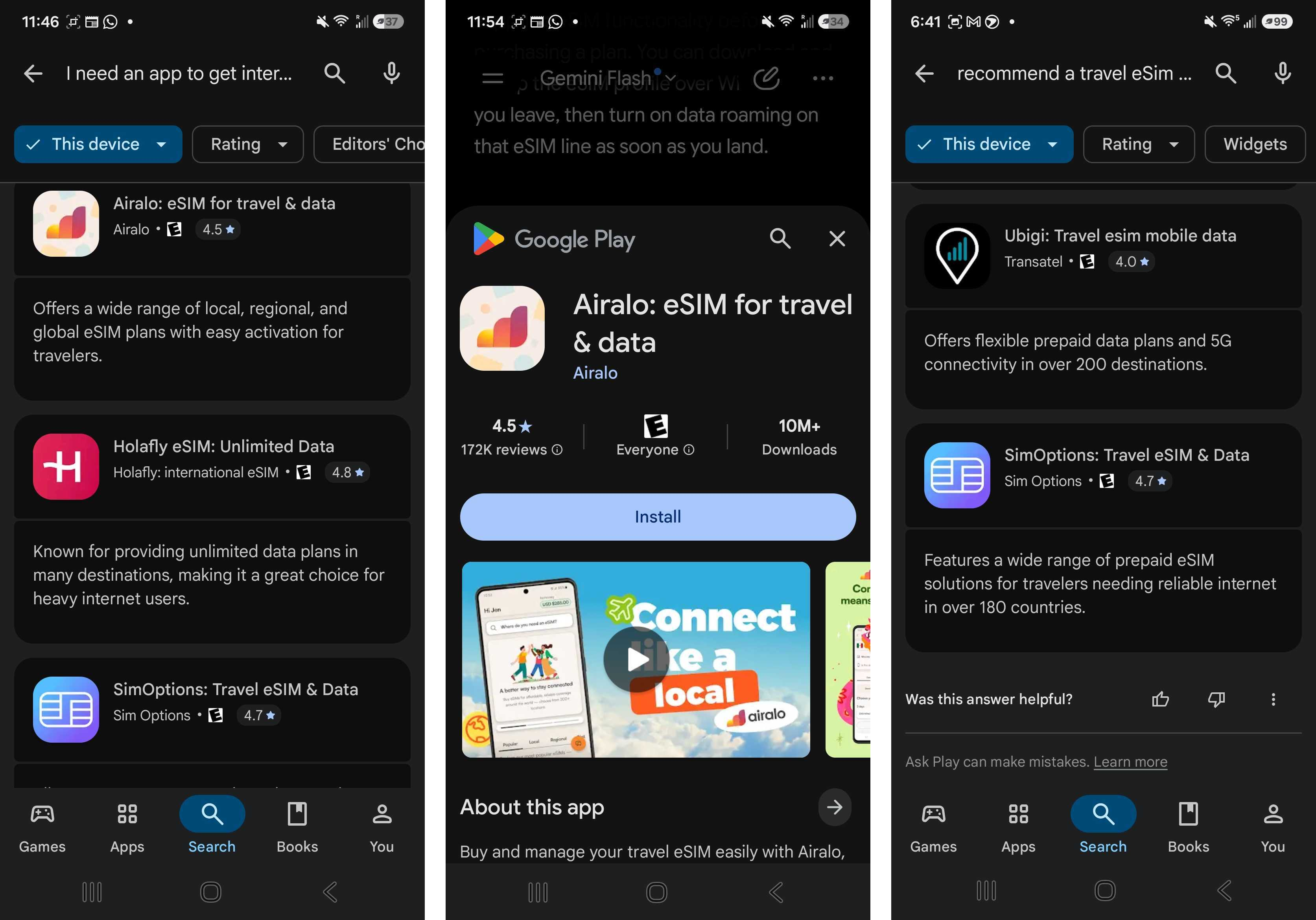
| “what is the best app for reliable mobile data while traveling” | Airalo, Holafly, Saily | “provides a vast marketplace of local, regional, and global eSIM plans for over 200 countries” |
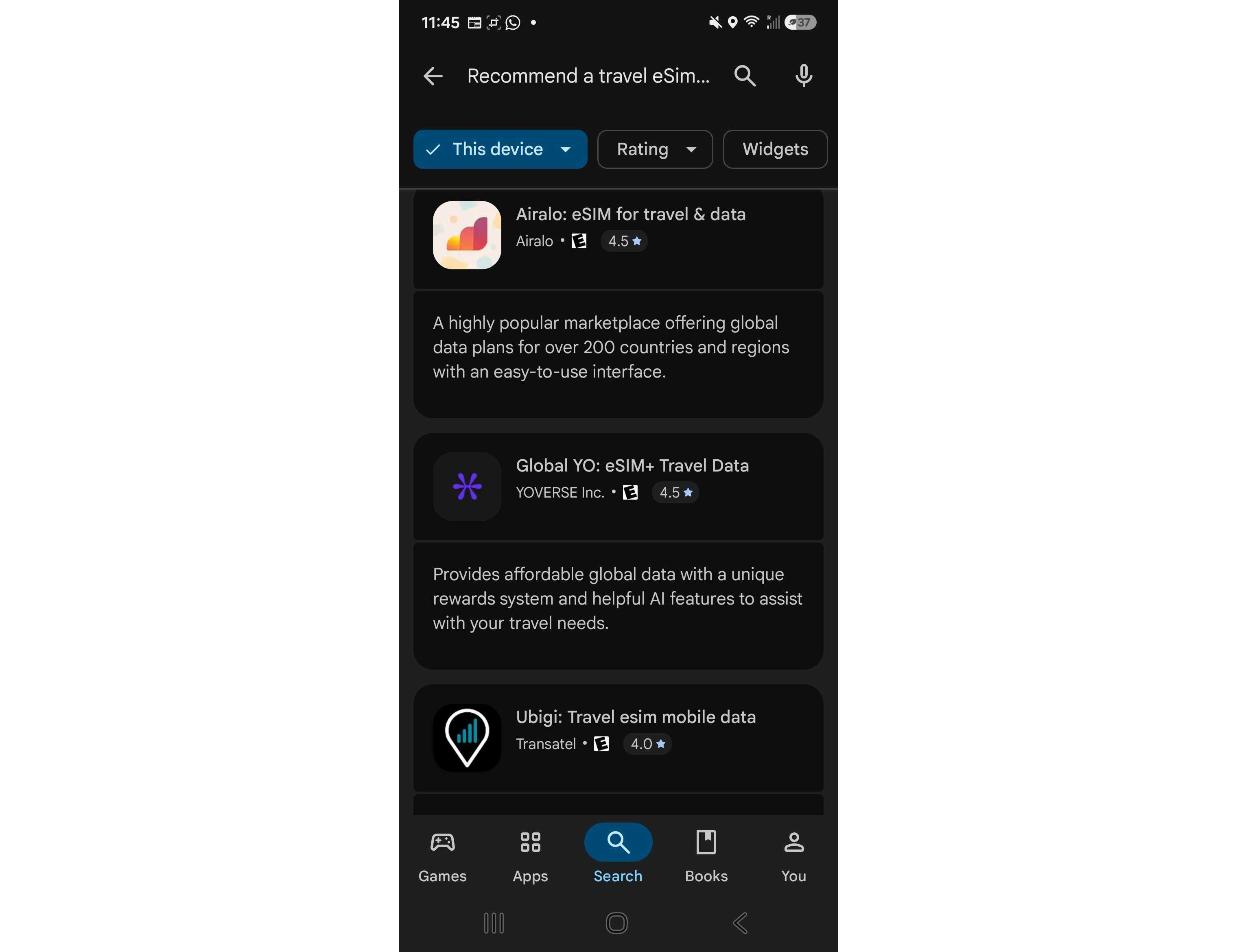
| “recommend a travel eSIM app for staying connected overseas” | Airalo, Global YO, Ubigi | “provides a global marketplace for eSIM data plans across 200+ countries to help you avoid roaming fees” |
| “I need an app to get internet abroad” | Airalo, Holafly, SimOptions | “a wide range of local, regional, and global eSIM plans with easy activation for travelers” |
For an eSIM app, we tried three phrasings of the same intent (eSIM for travel): “what is the best app for reliable mobile data while traveling,” “recommend a travel eSIM app for staying connected overseas,” and “I need an app to get internet abroad.”
Airalo came back first every time. But the one-sentence description generated for it changed with each phrasing. Same app, same rank, three different write-ups pulled from the same underlying listing.
[PLACEHOLDER: Menstruation tracking app screenshots)
| Phrasing tested | App recommended | Description generated |
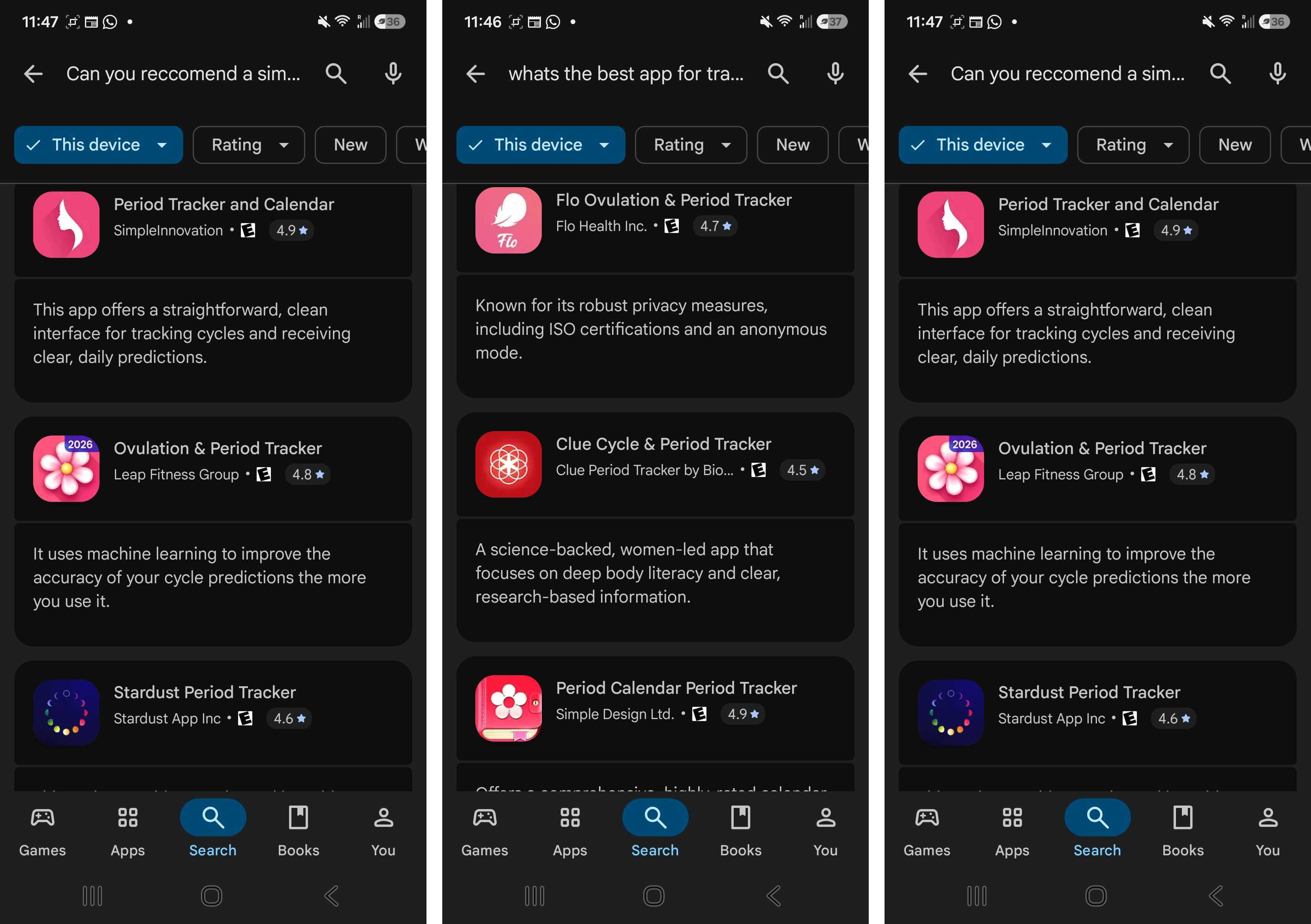
| “what is the best app for tracking my period” | Flo, Clue, Period Calendar | “Known for its robust privacy measures, including ISO certifications and an anonymous mode” |
| “can you recommend a simple period tracking app” | Period Tracker and Calendar, Ovulation & Period Tracker, Stardust | “This app offers a straightforward, clean interface for tracking cycles and receiving clear, daily predictions” |
For period trackers, the way how a search was phrased moved more than the description. It moved the entire list. Two searches for the same underlying need returned six apps with zero overlap.
The second phrasing is worth looking at closely. Adding one word, “simple,” pulled in a completely different set of apps and produced a description built around interface clarity rather than privacy. The model isn’t matching “period tracker.” It’s matching the whole described need.
How Ask Play generates its recommendations


Ask Play highlights doesn’t show where its recommendation or description came from, there’s no source or citation attached to any of the apps it recommends and describes. Second, right below the ranking, Google’s own disclaimer reads “Ask Play can make mistakes.”
One thing we can rule out is rating. Across our eSIM and period tracker example; the order wasn’t sorted by rating. Airalo (4.5) consistently outranked Holafly (4.8) across all three eSIM searches, and the period tracker sets mixed 4.9s, 4.8s and 4.6 with no clear hierarchy.
So what does it read to build those answers? We can’t see inside the model, so the following is what our testing and observation point to, not a method Google has published.
According to our observations, the listing is the main input, the long description in particular. In our tests the one-line write-up is assembled from the listing’s own “About this app” text: the same source copy produces a different sentence each time, so it rewrites your description rather than copying it.
It also appears to reach past the listing, to your website. Ask Play highlights doesn’t cite anything, but its sibling surface does. The “Ask about this app” Q&A shows where its answers come from, and in our tests those sources included the developer’s own website, not only the Play Store listing. Both features run on the same underlying system, so if one treats your website as source material, the other likely does too. It’s an inference, not something we could confirm directly.
Reviews likely feed it as well: Google indexes reviews and generates AI summaries from them, so a review naming a concrete use case gives the model more to work with than “great app.”
We go deeper on reviews as an AI input in our AI Visibility Playbook.
What we can’t determine is the ordering itself. We can see what Ask Play highlights reads, and that it isn’t sorting by rating, but not why one app ranks above another.
How to influence what Ask Play highlights says about your app
Traditional ASO optimizes for a keyword: you choose a term, you rank for it, you get seen. Ask Play highlights breaks that model. It’s not matching your listing against a query, it’s synthesizing an answer to it.
For app marketers, this shifts what “ranking” means for this surface. You can’t target a single phrasing and expect coverage. The practical question becomes: does your listing give the AI enough to work with across the range of ways someone might ask for what your app does, not just the exact keyword you’ve historically ranked for.
This doesn’t replace keyword-level ASO. Your app store listings remain the most direct lever you have over what gets said about you.
Four things you can act on now, to increase your chances of your app being recommended in Ask Play highlights:
1. Cover the range of ways someone might ask, not just your target keyword
Our period tracker test showed one word changing the entire result set. A single exact phrase won’t cover you. Your listing has to state your audience, use cases and outcomes clearly enough that the model connects your app to that need however it’s worded.
Concretely, that means the long description should name who the app is for, the situations it’s used in, and what the user gets, in plain language rather than feature lists.
2. Reviews feed the answer, so they’re worth shaping.
Reviews are one of the inputs Ask Play appears to draw on (see above), and one you can influence directly. Google indexes review content and generates AI summaries from it, so a review that names a concrete use case (“used this for a 2-week trip to Japan, worked without switching plans”) gives the model more to work with than “great app!” Prompt for specific feedback right after a high-value moment rather than nudging for a generic rating, and you’ll surface more of that language.
3. Keep your listing and your website telling the same story
If the model reaches past the Play page to your site, contradictions between the two become a liability. Review your web pages and your Play long description side by side and answer the same questions from each in isolation: what the app is for, who it’s for, what the features are called, what it costs, and what shipped most recently. Are the answers differ, close the gap.
Conclusion
You can’t rank your way into Ask Play highlights the way you rank for a keyword. The same intent, worded two different ways, can pull in different apps and describe the same app differently each time, and the AI shows no source for either.
What you can do is make sure your listing, your reviews, and your website give it enough to work with, across the different ways someone might actually ask.
This surface is still early and unevenly rolled out. The teams paying attention to it now, while most aren’t, are in a better position to understand how it behaves before it matters to their download numbers.
Ask Play 与 Google Play 搜索结果中的 AI 板块是同一个吗?
是的。Ask Play highlights 是 Google 为出现在 Google Play 常规搜索结果上方的 AI 撰写推荐板块所起的名称。它与 Google I/O 2026 发布会中提到的功能以及本文涵盖的行为一致。
我该如何让我的应用获得 Ask Play highlights 的推荐?
目前没有像针对关键词排名那样直接针对 Ask Play highlights 的方法;您只能塑造它读取的素材。 Ask Play highlights 会根据您的应用输入综合生成推荐,因此关键在于使这些输入清晰且一致。影响 Ask Play highlights 对您应用的评价的方法包括:撰写长描述,用通俗易懂的语言而非功能列表来说明应用的适用人群、使用场景及交付成果;引导描述具体使用场景的评论,因为 Google 会索引评论并从中生成 AI 摘要;并保持您的 Google Play 商品详情和网站叙述一致,因为 Ask Play highlights 似乎会同时读取这两者。
应用评分会影响 Ask Play highlights 的排名吗?
不,应用评分并不能可靠地决定应用在 Ask Play highlights 中显示的顺序。 在 AppTweak. 的测试中,在每次 eSIM 搜索中,一款 4.5 星的应用始终排在 4.8 星的竞争对手之前,而经期追踪器的结果中混合了 4.9、4.8 和 4.6 的评分,没有明显的层级关系。仅凭评分无法解释哪款应用排在首位。相反,推荐所依据的似乎是您的应用商店商品详情内容(尤其是长描述),以及评论和可能的网站内容。AppTweak. 无法通过测试确定确切的排序逻辑,且 Google 尚未公布。
Ask Play highlights 会显示其推荐来源吗?
不,Ask Play highlights 不会为其推荐的应用或撰写的描述显示来源或引用。 Google 显示了“Ask Play 可能会犯错”的免责声明,但用户无法看到推荐的依据,您也无法在事后进行更正。唯一的手段是 AI 读取的输入。一个相关的界面有所不同:在 AppTweak. 的测试中,商品详情页面的“询问此应用”问答确实显示了来源,包括开发者自己的网站,这表明即使推荐板块没有引用,同一个系统也会读取您的网站。
我应该多久检查一次 Ask Play highlights 对我应用的描述?
不止一次。描述可能会根据措辞而变化,即使是相同的措辞也会随时间推移而改变,因此在任何商品详情更新后以及随后的几天内都要再次检查,而不要仅依赖一次检查。
Pierre-Antoine Roy
Micah Motta