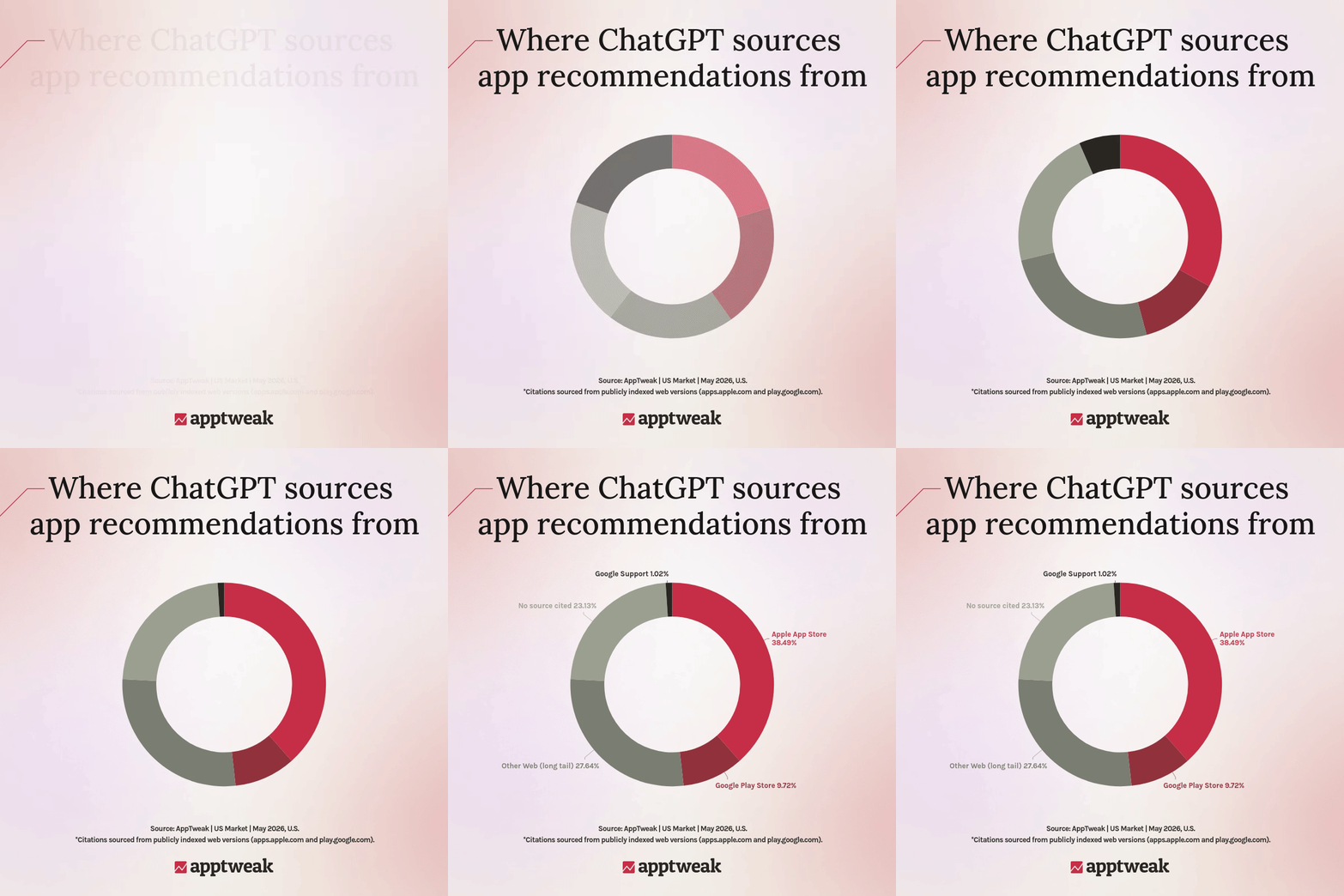
App store listings account for nearly half of all sources ChatGPT cites when recommending apps, 47.5% in total. That makes the listing the single highest-leverage surface to optimize if you want your app to show up in AI-generated recommendations.
“App marketers spend significant time and budget on websites, PR, and content marketing. But the surface ChatGPT relies on most is one ASO teams already own and update regularly.”
Alexandra De Clerck, Chief Marketing Officer at AppTweak
Key takeaways
- App store listings make up 47.5% of all sources ChatGPT draws from when recommending an app, more than any website, PR piece, or content page.
- ChatGPT retrieves publicly indexed listing text because it reads as factual and extractable, unlike brand-heavy homepage copy.
- Most listings answer “why download this app”, while AI is asking “what is this app for and when should I recommend it”. Closing that gap is a rewrite, not a rebuild.
- Audience, outcomes, and fit are the three elements most listings leave vague, and where AI has the least to work with.
Why do app store listings carry so much weight in AI recommendations?
When someone asks ChatGPT for an app recommendation, the model retrieves publicly indexed web versions of app store listings, the apps.apple.com and play.google.com pages that are crawlable, structured, and rich with descriptive text.
To an LLM, the app store page functions as a structured, reliable source defining an app’s purpose, audience, and utility. While homepages often prioritize brand-heavy copy, listings offer the factual, extractable data that AI models prioritize when generating recommendations.
Why aren’t most app store pages optimized for AI search?
Most app store pages aren’t optimized for AI search because they were written to convert someone who had already found the app, not to inform an AI model.
So most app store descriptions are written to answer one question: why should I download this app? AI search engines are asking a different one: what is this app, who is it for, and when should I recommend it?
These questions aren’t in conflict. The same clarity that helps a model extract a confident recommendation (a specific audience, defined use cases, concrete outcomes) is what helps a human reader decide quickly whether the app is right for them.
The gap most listings have isn’t a conversion problem or an AI problem. It’s an ambiguity problem. A description that leads with “the ultimate wellness companion” gives an AI search engine almost nothing to work with, and it doesn’t do much for a human reader either. A more useful opening line for humans and AI follows a simple pattern:
[App name] is a [type of app] that helps [target users] [achieve goal] by [core capabilities].
Six ways to optimize your app store listing for AI retrieval?
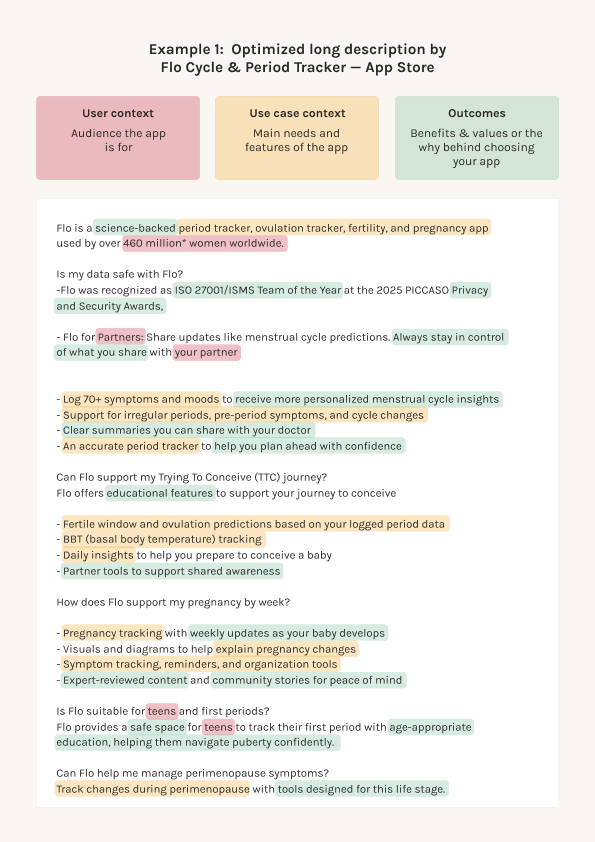
These are six ways to make your listing easier for LLMs like ChatGPT or Gemini to read and extract a clear recommendation from. The examples below are pulled from Flo, the period tracking app.
- Define your audience immediately. The opening line should tell AI and users exactly who the app is for. Flo’s opening line: “Flo is a science-backed period tracker, ovulation tracker, fertility, and pregnancy app used by over 460 million women worldwide.”
- Reinforce a focused set of use cases. Claiming every possible use case creates weak associations in AI systems. Pick the three to five use cases that matter most and reinforce them consistently. This is also just good ASO practice.
- Cut vague positioning language. “All-in-one,” “revolutionary,” and “ultimate platform” describe brand perception, not functionality. “Track ovulation, fertility, pregnancy, and cycle symptoms in one app” is more useful to a model than “your complete health companion.”
- Connect features to outcomes. “Track symptoms and moods” tells AI what the app does. “Track symptoms and moods to better understand cycle patterns and predict periods more accurately” tells AI what the app does and why a user needs it.
- Use question-style formatting where it fits. AI search engines retrieve question-and-answer content well because it mirrors how users prompt them. Flo structures its long description around questions like “Can Flo support my Trying To Conceive journey?” followed by a direct answer. Airalo does the same for eSIM FAQs.
- Add specifics that build trust. Certifications, user numbers, and expert-reviewed content help AI build a more confident picture of your app. “Your privacy matters to us” is easy to ignore. “Flo was recognized as ISO 27001/ISMS Team of the Year at the 2025 PICCASO Privacy and Security Awards” is something a model can retrieve and cite.
How can you audit your app store listing for AI optimization?
Before rewriting anything, check your current description against these five elements. For each one, ask whether your app store page answers the question clearly.
| Element | What to clarify | Example |
| Audience | Who the app is for | “Budgeting app for students and young professionals” |
| Use case | What problem it helps solve | “Track subscriptions and recurring expenses” |
| Features | How the app works | “Shared expense tracking, bill reminders, and spending insights” |
| Outcomes | What users gain | “Stay on top of monthly spending and avoid missed payments” |
| Fit | The situation the app is best suited for | “Ideal for roommates, couples, or anyone managing shared finances” |
Most listings handle features well but leave the audience, outcomes, and fit vague. Those are also the elements AI most needs to make a recommendation, so that’s where the biggest opportunity is.
Conclusion
App store listings are where ChatGPT tends to draw information from. Making yours easier to read and extract from is a reasonable first step, and the content likely already exists. It usually just needs to be restructured.
For ASO practitioners, app store listings were already your most important owned surface. They’re now doing a second job most teams haven’t accounted for yet.
The listing is one of four experiments AppTweak recommends for improving AI visibility. The rest cover your website structure, earning citations from sources LLMs trust, and building community presence.
For the full picture, including how your website and external sources factor into AI recommendations, see AppTweak’s AI visibility playbook for apps and games
FAQs
应用商店描述对 AI 应用推荐有影响吗?
Yes. App store listings account for 47.5% of the sources ChatGPT cites when recommending apps, more than any other source type, based on AppTweak’s snapshot analysis of 125,000+ ChatGPT responses across 9,489 app prompts in the US market. A clear, well-structured description directly affects whether and how confidently your app is recommended. AI engines retrieve publicly indexed listing text because it reads as factual and extractable, unlike brand-heavy homepage copy. The App Store contributes 38% of citations and Google Play 9.5%. Structuring your description around audience, use cases, and outcomes gives models more to retrieve and cite.
我该如何针对 AI 搜索优化我的应用描述?
编写描述时,要让模型无需猜测就能提取三件事:应用是为谁准备的、它是做什么的以及何时推荐它。这很重要,因为根据 AppTweak 对美国市场(2026 年 5 月)9,489 个应用提示的 125,000 多条 ChatGPT 回复的分析,应用商店页面占 ChatGPT 推荐应用时引用的来源的 47.5%。
实施这 6 个最佳实践来针对 AI 搜索引擎优化您的应用描述:
- 以定位行而非标语开头。 使用以下模式:[应用名称] 是一款 [应用类型],通过 [核心功能] 帮助 [目标用户] [实现目标]。
- 指明受众和应用适合的情况。 “面向室友、情侣或任何管理共同财务的人”是可检索的。“面向所有人”则不是。
- 致力于三到五个使用场景并重复它们。 声称涵盖所有可能的使用场景会产生微弱的关联;一组集中的场景则会产生强关联。
- 将定位形容词替换为功能。 “在一个应用中追踪排卵、生育、怀孕和周期症状”是可提取的。“您的完整健康伴侣”则不是。
- 将每个功能与结果联系起来。 功能告诉模型应用做了什么。功能加结果告诉模型用户为什么需要它,而这正是推荐所需要的。
- 添加可验证的具体细节。 用户数量、认证和专家评审的声明为模型提供了具体的引用内容。“您的隐私对我们很重要”则什么也没提供。
大多数描述已经很好地处理了功能。受众、结果和契合度通常是差距所在,也是 AI 最缺乏参考信息的地方。
对于 AI 可见度而言,哪个更重要:Apple App Store 还是 Google Play?
根据 AppTweak 的美国市场分析,Apple App Store 的权重更高,占 ChatGPT 引用的 38%,而 Google Play 为 9.5%。 它们共同构成了 ChatGPT 推荐应用时所有引用来源的 47.5%。两者都值得优化,但 Apple 的列表目前对 ChatGPT 推荐的影响更大。由于 AI 引擎检索公开索引的列表文本,同样的原则适用于这两个商店:定义受众,致力于一组集中的使用场景,并将功能与结果联系起来。保持两个列表的定位一致,可以加强模型将您的应用与特定用户意图联系起来的清晰度。
我应该多久更新一次应用商店列表以进行 AI 优化?
There’s no fixed cadence. Treat it the same way you’d treat any ASO asset: review it whenever you update positioning, launch new use cases, or notice ambiguity creeping back into the copy.


更多人工智能 (AI), 高级 ASO相关文章

 Pierre-Antoine Roy