AI in ASO (2026): Your burning questions. Answered.
 by Micah Motta
Senior Content Marketing Manager
— 15 min read
App store search still looks familiar on the surface. Underneath, how stores decide which apps to show is beginning to shift.
Many ASO teams have noticed the same pattern recently: keyword coverage looks solid …and yet rankings feel more fluid, more fragmented, harder to pin to a single cause. Not because the rules disappeared, but because the stores are getting better at inferring user intent, not just matching the words typed into search.
In our recent webinar How AI is changing the app stores: what ASO teams should do now, we unpacked the underlying changes shaping the app store discovery—from intent diversity in search results to why cluster-level performance now matters more than individual keyword wins. If you haven’t watched it yet, it’s worth doing so before diving in.
This article breaks down the questions ASO teams are struggling to answer, and reframes them around what can be done as app store relevance becomes more intent-driven
Key takeaways
- App metadata and stable conversion rates no longer guarantee stable rankings as app stores interpret searches in more nuanced ways.
- ASO performance should be evaluated at the semantic keyword cluster level, using metrics like average cluster ranking, total reach, and volatility rather than isolated keyword movements
- Intent decisions must be made before metadata changes, as intent is a strategic choice about which user motivations an app chooses to compete for, not a field-level optimization
- App keyword density is becoming less critical than semantic coverage, where supporting terms, features, and related concepts collectively signal relevance to an intent theme
- App descriptions and store messaging should focus on a limited number of priority intents, typically three to five, and explain how app features fulfill those user needs
- For apps serving many use cases, sustainable growth comes from reinforcing existing intent traction first, then expanding into new intents one cluster at a time based on performance signals
How is AI changing app store optimization (ASO)?
No, AI isn’t “replacing” ASO. It’s making it more important for app marketers to define the user intents they want to pursue, and then optimize keywords in support of those intents.
The simplest way to say it: app stores are getting better at interpreting meaning, not just matching exact keywords. That means two things can be true at once:
- Keywords still matter (they’re still a core way stores understand what you’re about).
- Individual keyword rankings can become less predictable when a single query maps to multiple plausible user intents.
A clear example of this shift is the keyword “bacon.” After a major algorithm update last year, the App Store changed how it handles ambiguous searches like this one. “Bacon” in the U.S. App Store can refer to a popular game, a specific app brand, or other related concepts. So, instead of committing to a single interpretation, the store now surfaces multiple intents within the top results.
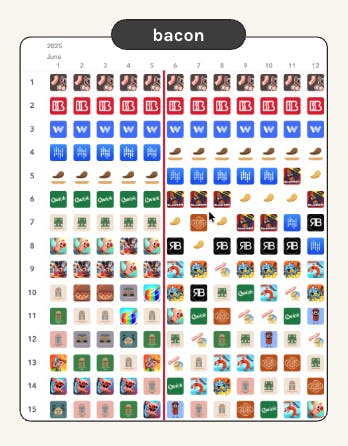
This is why ASO can feel less predictable. If you want the deeper “why,” we unpack that in How AI is reshaping app store relevance. This piece focuses on what teams can do about it.
What parts of ASO are actually impacted by AI today?
The biggest shift in ASO due to AI isn’t that the components of ASO have changed; it’s that they are increasingly evaluated together.
App keyword strategy, creatives, localization, and conversion are no longer assessed independently. Instead, they act as connected signals that reinforce each other and help algorithms understand your app’s intent.
This changes how teams should think about ASO in 2026:
- Keywords should be evaluated by topic and intent, not individually.
- Creatives should reinforce your app’s positioning.
- Before localizing with semantic intent in mind, check the markets you wish to target to ensure the app stores there have achieved semantic maturity as these changes are still being rolled out globally.
- Conversion optimization remains central.
- App reviews are likely being read by store algorithms to better understand your app in order to best match it with the right intent.
The common thread: the less clear your brand’s positioning is and who it’s for, the more expensive user acquisition becomes in AI-driven app stores.
Is AI lowering the bar for ASO quality?
No, AI is raising the bar for ASO quality. While AI can make it easier to generate large volumes of content, generic or unfocused optimization becomes more fragile in a relevance system that prioritizes meaning. Apps that rely on surface-level keyword coverage without clear positioning are more likely to see unstable performance.
The advantage increasingly goes to teams that are deliberate about what they want to be relevant for and communicate that consistently.
How should ASO teams adapt their ASO keyword strategy in an AI-driven app store?
The most AI-driven approach to ASO in 2026 is to shift from targeting individual keywords to building semantic keyword clusters that map to an intent theme. The goal isn’t to rank for one spelling of a concept—it’s to be recognized as relevant to a user’s need, even when that need is expressed in different ways.
Building semantic keyword clusters simply means creating separate keyword lists per intent theme, tracking performance at the cluster level (not just keyword by keyword), and then making deliberate decisions about which themes to reinforce or expand upon.
This is the heart of “intent-informed ASO.” It doesn’t discard app store keyword research, but rather upgrades how you use it.
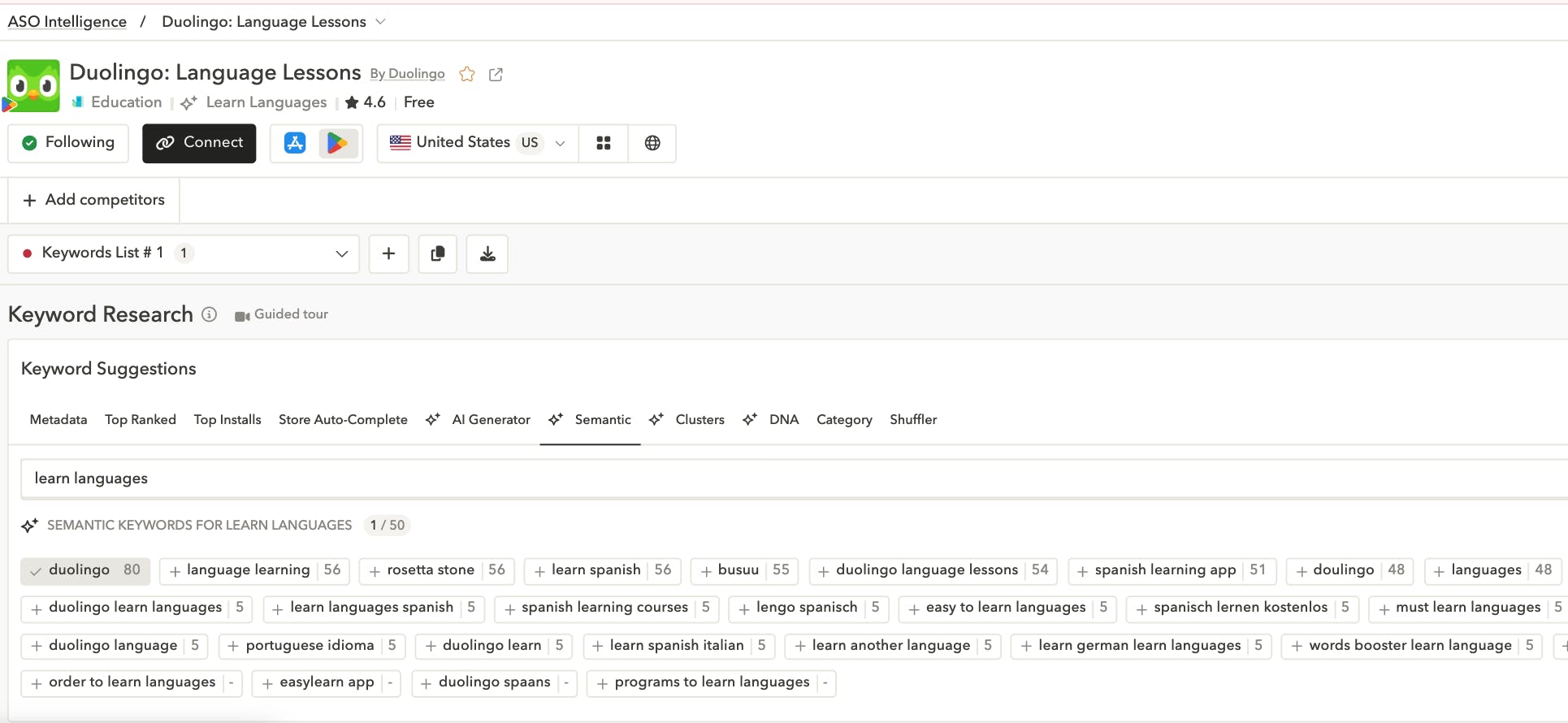
You can see this approach in action with Duolingo. Using AppTweak’s semantic keyword suggestions, ASO teams can group related queries around a core intent like “language learning,” instead of treating each keyword as an isolated opportunity.
How do I start introducing intents rather than keywords in my app’s metadata?
Intent should guide decisions, not replace keywords.
Before you touch your metadata, decide which intent you’re trying to win. Intent something you choose to compete for, and then reinforce consistently in your metadata.
Here’s your step-by-step guide to optimizing your metadata for intent:
- Identify the main themes your app is already positioned for on the app stores.
- Build semantic keyword clusters for each theme.
- Assess cluster performance using average ranking across the group, total monthly reach driven by that cluster, and consistency or volatility
- Decide whether you want to reinforce that position or expand into another intent where you’re currently underrepresented.
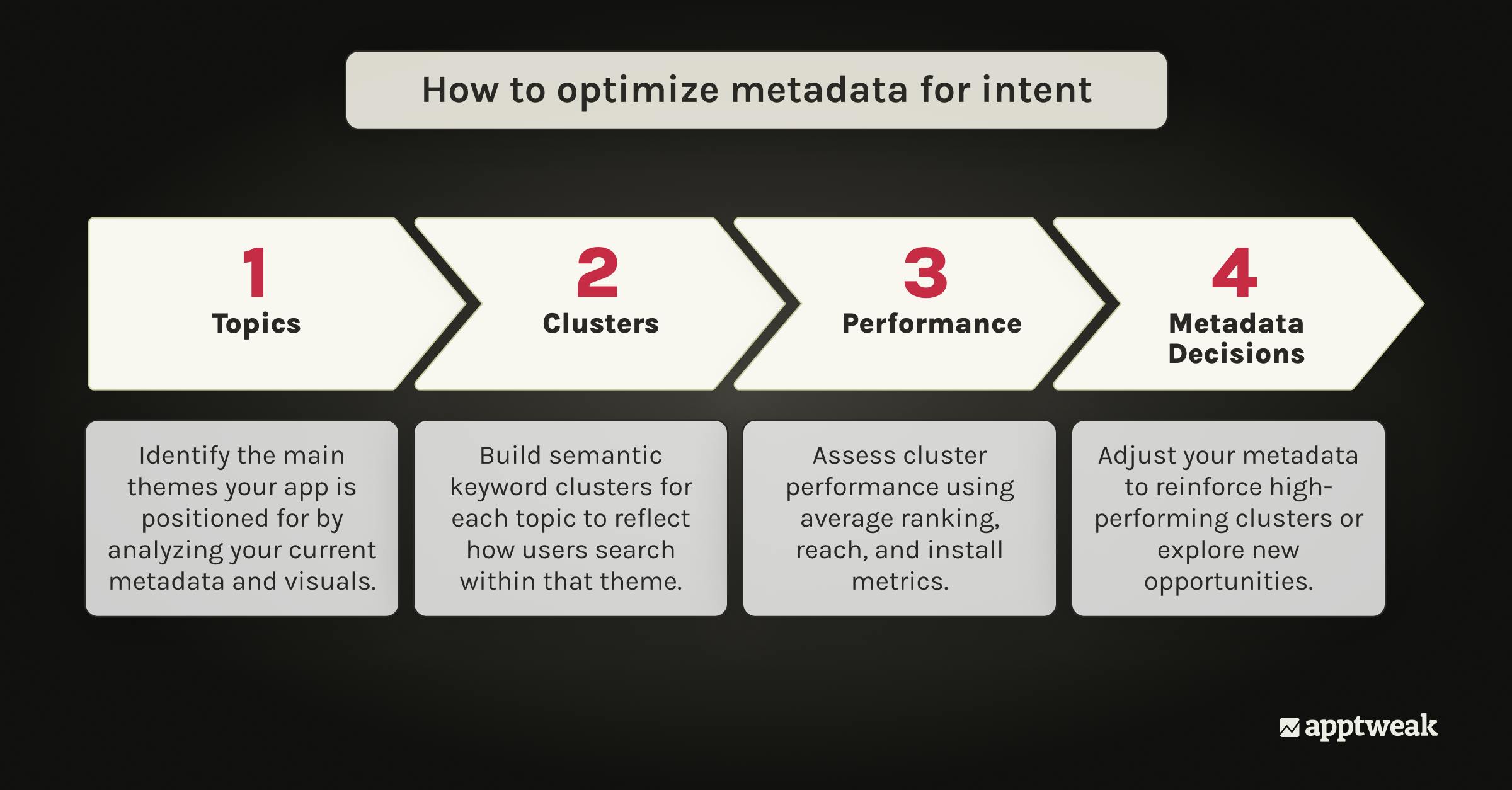
The four steps you can use to optimize your metadata for intent. Once that decision is made, metadata becomes much easier. You’re no longer asking, “Which keywords can we squeeze in?” You’re asking, “Does our metadata clearly communicate the meaning we want the store (and users) to associate with us?”
Then, you make sure creatives support the same intent. Otherwise, you win visibility and lose the user.
Should ASO teams reinforce or diversify their metadata in 2026?
Most teams should reinforce before they diversify.
Diversifying too early is how apps become broadly relevant in theory, but weakly relevant in practice. In semantic systems, breadth without clarity can dilute signals and make it harder for stores to confidently associate an app with a specific user intent.
A more reliable approach to app store metadata in 2026 looks like this:
- Reinforce the intent cluster where you already have traction.
Focus first on the user motivation your app is already being surfaced for and converting on, rather than chasing new intents prematurely. - Ensure performance is stable at the cluster level.
This means confirming that your app ranks consistently across the group of keywords tied to that intent and converts users who arrive through those discovery paths. - Then diversify intentionally by adding one new intent cluster at a time.
Expansion should be deliberate. Each new intent introduces a new positioning choice that needs to be clearly supported across metadata, creatives, and messaging.
The key is making these choices based on product direction, semantic coverage, and cluster-level performance and not by chasing individual keyword movements.
In practice, teams should evaluate intent performance at the cluster level rather than keyword by keyword. This typically means:
- Tracking average ranking across the full set of keywords tied to one intent
- Monitoring total monthly reach for that cluster, not just individual high-volume terms
- Watching for volatility or consistency across related queries over time
At this stage, semantic keyword clusters are no longer just research artifacts. They become decision tools, guiding which user motivations an app chooses to compete for, how it positions itself in the store, and which intents it reinforces across metadata, creatives, and store pages.
This approach is especially important for apps that could legitimately serve many intents, such as e-commerce, fintech, or marketplace apps. ASO isn’t about optimizing for everything your product can do. ASO in 2026 about prioritizing what you want to be chosen and surfaced for, and communicating that choice clearly and consistently.
In the context of intent, is keyword density still important in ASO?
For pursuing user intents, keyword density matters less than semantic coverage for ASO. Your goal for your app store page should be to communicate the full meaning behind your chosen intent so that the app store can match you to different ways a user might express the same need.
To do this, include the main keyword naturally but strengthen relevance by utilizing supporting terms that sit in the same semantic cluster (features, synonyms, and related concepts). This helps improve your app’s ability to surface for a broader set of queries tied to the same intent, without spamming one term.
This is what intent-based optimization looks like in practice. Instead of optimizing around a single phrase like “home workout,” ASO teams for fitness apps can account for the different ways users express or refine the same core need in their searches.
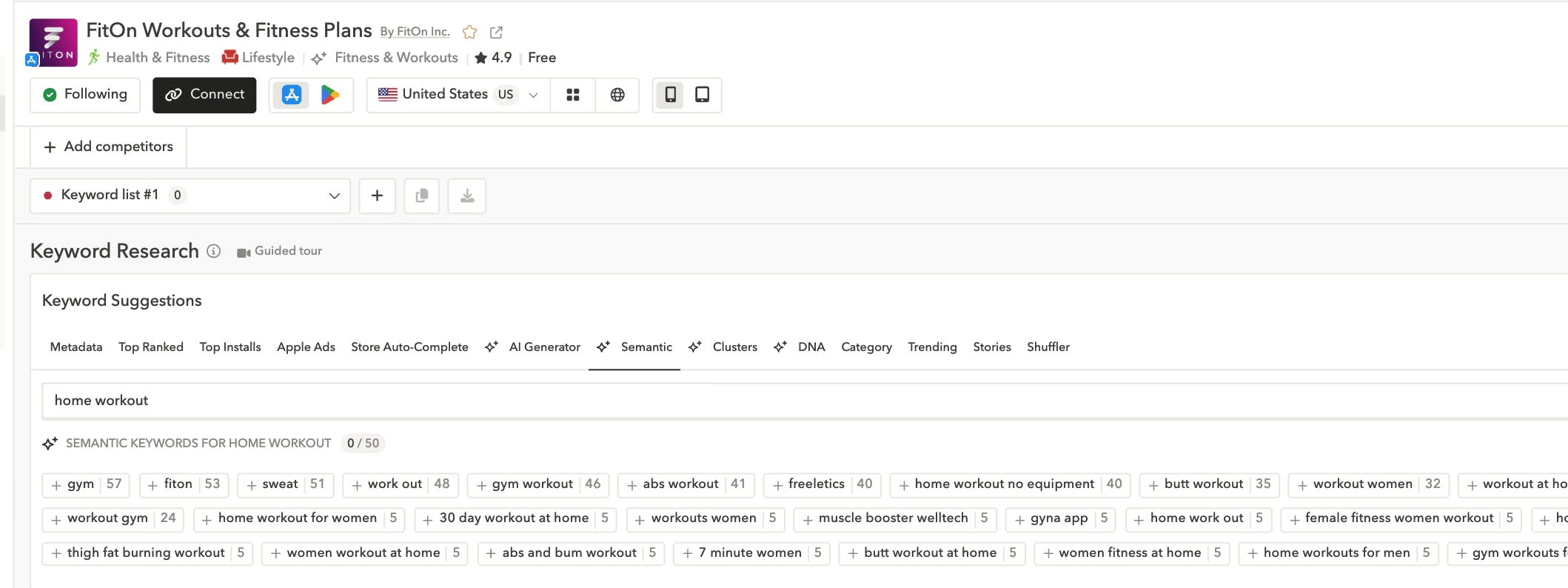
Example illustrating how fitness app FitOn can research “home workout” intent in AppTweak to understand the different ways users express the same core need. The goal is to be relevant to the intent theme and not to over-optimize for a single keyword variant.
How should we write app descriptions for semantic search in app stores?
Write app descriptions to maximize semantic clarity, not keyword repetition.
In practice, the strongest descriptions don’t try to cover everything. They make the top intents explicit—usually three to five—and explain them in the app description in messaging that mirrors how users think.
So, for each intent, explain what the user can achieve and which feature supports it. Keep the language simple and structured so the meaning is clear at a glance, then monitor whether those changes translate into better conversion and stronger rankings across the related keyword clusters.
If you do this well, improvements tend to show up in the places that matter: conversion, and ranking breadth across the related cluster—not necessarily a single overnight keyword jump.
For apps with 10+ intents, how do you manage organic growth when the keyword field is limited?
If your app serves many needs and you try to pursue all 10 intents in the keyword field, you risk becoming too broad and diluting relevance. Use this constraint as an opportunity to clarify the intents you wish to pursue.
Choose the few intent clusters that matter most, optimize app metadata and creatives around those, and measure performance at the cluster level. Once you can see which themes you’re strongest in, you can decide whether to reinforce them further or expand into a new intent, rather than trying to represent all 10 intents in your limited keyword field.
Expert tip: Utilize Apple Ads and custom product pages to test intents you don’t yet win organically on the App Store. Apple Ads can accelerate exposure to a specific intent, while custom product pages help validate whether that intent drives quality installs before you commit scarce metadata real estate to it.
Do App Store and Play Store have features to measure and optimize by intent?
Not directly. While there is no dedicated intent reporting layer today in the App Store or Google Play, features like custom product pages and custom store listings allow teams to align messaging with different user contexts and acquisition sources—making them the closest practical tools for intent-based optimization.
However, today teams can build (and later monitor performance across) keyword-cluster semantic lists in AppTweak using app keyword suggestions from Semantic and Clusters within our Keyword Research section.
What is and isn’t indexed in ASO today?
Here’s the honest answer about what’s indexed in ASO today: we can observe ranking outcomes, but we can’t always definitely prove which individual inputs were indexed or how heavily they were weighted. App store algorithms don’t expose a full list of indexed fields or ranking factors, and semantic systems make cause-and-effect harder to isolate.
What is clear and widely accepted are these 3 things:- Core metadata fields still play a major role in app store search visibility.
- Keyword usage remains a foundational signal for understanding what an app is about.
- Conversion performance is a strong downstream signal, reinforcing or weakening relevance over time
App stores clearly have the technical ability to interpret far more language than what’s explicitly labeled as “keyword fields,” but whether a specific asset is directly indexed is often less important than how it contributes to overall relevance.
That’s why, in practice, the most effective ASO strategy in 2026 is to move away from asking “Is this indexed?” and instead ask:
- Does this asset clearly communicate what the app is for?
- Does it reinforce the same user intent as the rest of the store page?
- Does it reduce ambiguity at the moment a user decides whether to install?
Because even when something isn’t a confirmed ranking input, it can still influence conversion, engagement, and semantic coherence—which in turn affects how confidently app stores surface an app for a given intent.
For a clear overview of foundational ranking factors that still matter today, check out our articles on known App Store ranking factors and Google Play ranking factors.
Does the App Store search algorithm take the app description into account?
It’s reasonable to expect Apple can read app store descriptions and extract entities or themes with natural language processing (NLP). However, there is no conclusive proof that app descriptions are directly indexed as a deterministic ranking factor—because ranking outcomes are the only fully observable signal, and we only see a limited portion of ranked results for any given query.
Does Google Play index an app’s long description?
Yes, Google Play does index an app’s long description as part of how it understands and matches your app to search queries. Keywords in the long description are read and used by the Play Store algorithm to help determine relevance for search terms, although placement and context matter for how strongly they influence relevance and rankings.
Are replies to app reviews indexed by Google and Apple?
While there isn’t conclusive evidence that app reviews are indexed as direct ranking inputs, it is reasonable to expect reviews and potentially replies to be read and processed by Google And Apple.
That being said, app marketers should act as though replies to app reviews matter for discovery and conversion as they shape user expectation. Your replies to app review influence how users interpret your app’s purpose, and can reveal where your positioning is misaligned with what users think they’re getting.
Treat replies as part of an intent feedback loop: a way to reinforce clarity, correct misunderstandings, and learn which language users naturally use to describe your value.
Does localization matter more for ASO as app store search becomes more semantic?
As app store search becomes more semantic, localization becomes less about swapping keywords and more about aligning with how people in each market express intent at a local level. The same user need will be phrased differently across languages and cultures, and literal translation often misses the intent nuance that drives relevance and conversion.
This is also where uneven rollout matters: semantic interpretation can be stronger in some languages than others, and teams that assume “our English strategy will scale” often leave growth on the table.
At minimum, localization strategy should consider:
- intent phrasing (what users actually say in that local market)
- cultural expectations (what “good” looks like for that use case)
- competitor language norms (what users are trained to expect)
Closing: what to do for ASO in 2026
ASO in 2026 is not about abandoning fundamentals. It’s about expanding beyond traditional app keyword research while staying grounded in what still drives results: relevance, clarity, and conversion.
Teams that align app keywords, creatives, and metadata around clear intents, and revisit those decisions as semantic behavior evolves, will be best positioned as app store discovery continues to change.
Remember, as app stores become increasingly more semantic in how they surface apps, clarity compounds. The apps that communicate one clear story, consistently, are the ones most likely to be surfaced, chosen, and installed.
- Reinforce the intent cluster where you already have traction.
More articles in Advanced ASO, Artificial Intelligence (AI)

 Alexandra De Clerck

 Simon Thillay