ASO Conference 2023 Part 1 Recap: ASO Fundamentals
On June 1, 2023, growth agency Phiture hosted the 6th ASO Conference in Berlin, an annual event dedicated to advanced ASO and gathering many of the top ASO practitioners. As such, the AppTweak team was not only in attendance but also a proud sponsor of the event. We were delighted to meet with other members of the ASO community and discuss the recent evolutions in ASO. Impressed by the quality of presentations and conversations all day long, we thought to share our summary of the various interventions that took place on the main stage.
Staples for impactful App Store Optimization
With 14 different presentations on the main stage, the conference was a great opportunity to hear about both recurring topics at the core of ASO, and new stories that developed since the last ASO conference. In this first blog of our two-part series, we have shared a few highlights of the 7 presentations that touched on ASO fundamentals – A/B testing, alignment with paid UA, Apple Search Ads, localization, and prioritization.
Prioritization
Identify & plan an ASO strategy
The day began with a presentation from Anton Tatarynovich, Senior ASO Manager at Freelytics and former ASO strategist at Phiture, who shared advice on how to organize and plan an ASO roadmap based on his experience.
Having transitioned from a consultant role among a large team with many resources to a role as a single operator dedicated to growing one specific app, Anton pointed to how a prioritization framework is essential to avoid lacking focus or investing in low-impact projects. Quickly after starting at Freelytics, he applied the following 5-step process to identify and report where the early focus should be put:
- Looking inward: After identifying key markets that deserve early attention based on the user base size and revenue share, Anton advised to start with a health check of store pages per market to see which ones have been left unattended the longest and/or have the worse-looking creatives, metadata, and reviews & ratings. His advice was also to consider the app’s category ranking, not so much for ASO performance purposes, but rather as a soft signal of where your app sits in the market and items that can help grab top executive’s attention.
- Localization overview: Anton’s second step was to review in more details what localization efforts had already been made. This step is a good complement to the first one, and again focuses on research rather than immediate action. That’s because identifying areas with strong localization potential can shift priorities from bigger markets to smaller ones, where your app is further from reaching its maturity.
- Marketing benchmark: Only after doing a thorough inner review comes the time to look at competition. Anton warned the audience of how being aware of competitors is essential, but looking into them too early can bias your own efforts and lead you to prioritize changes that are less relevant for your particular app. Discussing further the challenges of reviewing the competitive landscape, Anton recommended reducing your list of competitors from 10+ to only 3 to 5 based on comparative shares of downloads. Smaller apps should not follow market leaders too closely, but focus first on competitors in similar notoriety and ASO effort ranges.
- Visibility analysis: The fourth step Anton shared is to analyze your traffic by source type in each key market to understand which items matter most. Especially when it comes to keyword optimization, he underlined that it’s important to understand the share Search traffic holds for your app and your category, as well as breaking down how much of search traffic comes from brand keywords compared to generic. This is to avoid lengthy keyword optimization cycles when consumers are not used to search for your type of product.
- Conversion analysis: Finally, reviewing differences in conversion rates per traffic source to identify where the biggest gaps are is key to determine where to start with conversion optimization efforts. Keyword-level data available in Google Play Developer Console as well as Apple Search Ads campaigns statistics can also help further break down your app’s conversion rate per search term or keyword type.
At the end of this process, Anton’s methodology is to finalize the audit with a color coding system, which helps visualize which areas to tackle first.
Apple Search Ads
The second presentation of the day was delivered by independent growth expert Thomas Petit, who offered to share his “hard truths” about Apple Search Ads (ASA). While Thomas shared many specific insights about Apple Search Ads, one of his observations particularly stood out to us – due to the differences in user behavior measurement between Apple Search Ads and other ad networks, he underlined that Apple Search Ads should be set aside from other paid UA channels as comparisons cannot fully take those into account.
More practically, Thomas also shared many useful observations regarding Apple Search Ads targeting challenges, budget management, and specificities of ASA:
Targeting
- Avoid using Search Ads basic and monitor any broad match campaigns by checking on search terms.
Thomas illustrated examples of campaigns meant to target the keyword “Shazam” that led to bids on search terms relating to a TV guide app instead.
He underlined how even exact match campaigns can lead to surprising bids due to the “close variants” rule, sharing an instance of a campaign for the keyword “diet app” that ended up placing some bids on “diy app.” In all these cases, he highlighted how such issues cannot be avoided but should be corrected quickly and easily by adding negative keywords in your campaign settings.
- Search result campaigns are, by nature, likely to spend the vast majority of your budget on only a small number of keywords.
Thomas pointed out that this is because the App Store search essentially focuses on the “short tail,” while broad match and discovery campaigns can serve more as insights providers, with discovery campaigns potentially informing developers of how the App Store algorithm perceives their apps.

- Limitations of Apple’s campaigns audience settings.
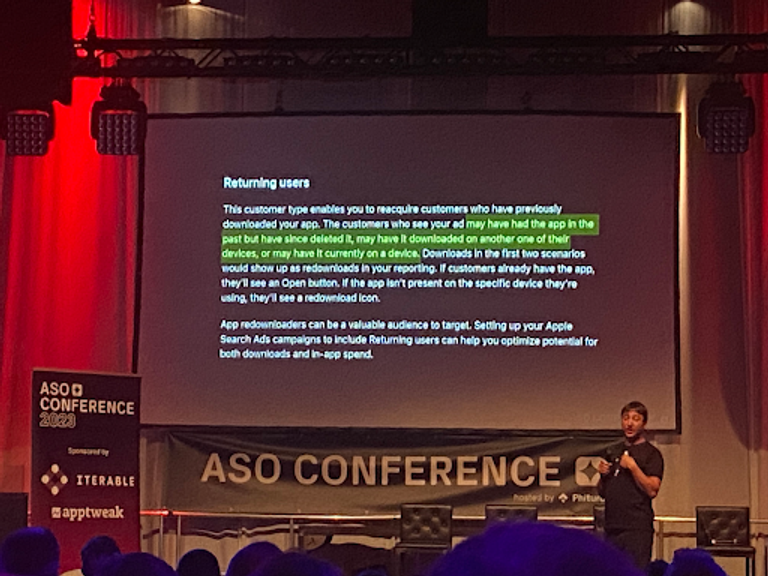
Last but not least, Thomas warned that with only 22% of users opting in for personalized advertising on iOS, most gender-based or age-specific campaigns actually exclude more than three quarters of traffic.
On the other hand, the notion of new and returning users don’t offer enough clarity, and campaigns targeted at new users can still end up delivering redownloads. Even country targeting can sometimes create surprises (especially when analyzing campaign performances through the lens of MMP data), as Apple considers the App Store country selected by a user rather than the location of their IP address.
Budget management
When it comes to budget management, Thomas highlighted several times the reality-check that is sometimes needed with Apple Search Ads budgets. With the intense competition, auction system, and opportunity to access a very large pool of consumers, it’s only logical that costs per install can be higher than with other ad networks. With that being said, he advised to not blindly trust Apple’s bid recommendations (especially with a few examples of fanciful figures), but also debunked the idea of Apple Search Ads working as a simple second-bidder price setting system.
With examples of campaigns providing very similar numbers of impressions and installs after drastically increasing or decreasing bids, Thomas indicated that the relevancy of the bidding app is also a key factor. He recommended apps with high tap-through-rates and share of voice for particular keywords test reducing their bids.
Specificities of Apple Search Ads
Finally, Thomas identified some of the specificities of Apple Search Ads in the overall paid UA mix.
- His biggest advice was to always separate brand from non-brand keywords in campaigns, both when piloting budget and analyzing performances.
- He encouraged ASO practitioners to analyze the lift and cannibalization effect of campaigns by pausing campaigns every once in a while. He also asked not to shy away from the cannibalization question, which is a cost that can be worth paying for the other insights you can get from your Apple Search Ads campaigns.
- Somewhat along the lines of this topic, Thomas also insisted that while search is a limited channel because of how hard it is to drive more people to search for a specific term, the size of Apple Search Ads and success from certain advertisers prove that it is possible to scale with the channel, provided you accept that the biggest limit to scaling is your own return goals.
Discover what cannibalization is in Apple Search Ads
Alignment with paid UA
Throughout the day, two more speakers added notes to how ASO and paid UA can and should work together:
Measure & predict the organic lift from paid UA campaigns
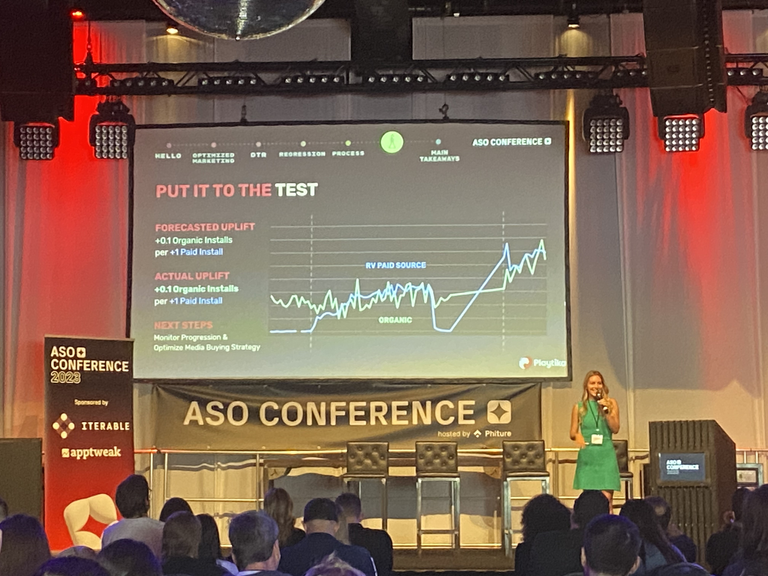
Talia Hermesh from Playtika first underlined how marketers can identify if paid UA impacts Browse traffic (store featurings as well as traffic coming from similar apps), generic search, or brand search, before highlighting how statistical regression can help forecast the organic lift from different types of paid UA campaigns.

She recommended running these analyses in countries where apps have high traffic, a strong K factor between organic and paid downloads, and good user quality, reminding audience members that “we cannot all spend our money in the US.”
Walking the audience through her methodology, Talia shared case studies from two Playtika games:
- A rewarded video campaign in Brazil delivered a +0.1 organic download lift per paid download to Bingo Blitz
- A native ads campaign in France helped House of Fun get 0.5 organic download per paid download thanks to a surge in brand search
She suggested marketers to get used to adding organic uplift to the KPIs of their paid campaigns. Whenever apps scale down on paid UA, they do so progressively to limit the impact on organic traffic.
Best practices for aligning ASO and paid UA
Later on, Luca Stefanutti from Adidas took to the stage to share a few best practices and observations for how ASO and paid UA campaigns can better work together:
- His first piece of advice was to address how ASO is not always meant to only focus on the long-term aspect of user acquisition, but can also make timely changes to support the short time nature of paid UA campaigns. To that end, the first tactic he presented regarded the amplification of paid UA campaigns, which can be done through in-app events and promotional content, adding a promotional text, running Today Tab campaigns in Apple Search Ads, and reaching out to Apple and Google for featurings in their respective stores.
Leverage data on in-app events & promotional content in AppTweak to boost your app visibility
- Regarding events, Luca noted that in his experience, promotional content on Google Play is about four times more effective than in-app events on the App Store. A second tactic Luca shared was to improve conversion through the use of store ads, events, and custom pages. He was also quick to warn that the latter do not always have a high impact, and need to be made a priority for qualified users and touchpoints.
- Finally, Luca shared a few formulas that ASO practitioners should use to calculate the impact of ASO on paid UA campaigns in order to more easily show value to top stakeholders who do not realize how ASO interacts with paid UA.
A/B testing
The afternoon at the conference began with a presentation by Mateusz Wrzeszcz (Klarna) who covered in riveting details some of the crucial yet rarely known considerations for efficient store A/B testing.
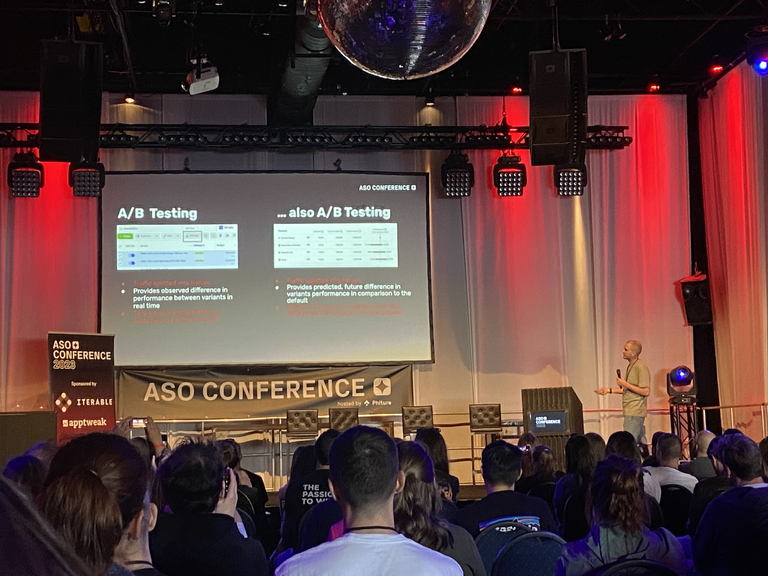
As an introduction, Mat underlined how A/B testing using tools such as Google Play store listing experiments or App Store product page optimization differs from A/B testing creatives with Facebook ads. This is because contrary to Facebook ads, store A/B testing focuses on predicting future differences rather than “merely” comparing real time data.
- Consequently, Mat’s first piece of advice was to give research the same importance as testing itself, as a test can only be as good as the hypothesis it is trying to prove. This should translate in experiments’ prioritization, which should focus first on hypotheses based on internal data and insights, second on best practices, benchmarks and heuristics, and third on what-ifs and creative adjustments.

These prioritization principles should also help favor bolder tests with better Minimum Detectable Effect. Without going too deep into statistics, Mateusz explained how experiments reach better statistical power when they run for longer, working like nets that become tighter as the sample size grows and can, therefore, catch smaller changes in conversion. As many apps don’t necessarily have that much time available to run a single test, it’s important to test first the experiments that have the best chances to deliver a conversion change that can be caught early by an A/B test.
- So Mat’s second key piece of advice is for every ASO practitioner to identify what is the Minimum Detectable Effect they should go after per app, country and storefront. They should also use sample size calculators to make sure they avoid testing hypotheses that would take too long to be properly validated to make the test worth the investment. To that end, Mat made his own sample size calculator and recommended ASO practitioners group their markets into three tiers for traffic and for CVR levels to easily visualize the markets where all, some, or no experiments are worth it.
- Finally, Mat recommended that all ASO practitioners take the habit of testing radical changes at least once per quarter, and aim to test one hypothesis at a time rather than only one visual change at a time.
- He also reminded the audience to prioritize changing assets that appear in the first impression frame, and don’t systematically test the same change in all markets as markets are not all equal to one another. Once again, everyone should remember that test results are only directional and matter less than the quality of the hypothesis that led to the creative changes.
Localization
Last but not least, when it comes to fundamentals of ASO, Davronbek Makhkamov (Ulysses) and Anastasiia Baranchikova (Prequel) each came to the stage to share insights and recommendations for how to address the topic of localization in the app industry.
A clear roadmap for successful localization
Davronbek emphasized on how localization is an extremely impactful area for growing your apps, as it requires comparatively fewer tech resources than adding new features or porting your product on more platforms. For this reason, he elaborated a very simple visual framework to help him formulate his own roadmap to taking any app international:
| Level 0 = globalization | Country A | Country B | Country C |
| Level 1 = translation | |||
| Level 2 = localization | |||
| Level 3 = culturalization |
Simply by comparing the level of localization of an app in the various countries it is available in, you can quickly identify areas of improvement. You can also factor in whether you prefer to further improve your localization quality in a given country, or prefer starting from scratch in a new one – the ultimate goal being to take the app to the highest level of localization in each of the countries where it is available.
To facilitate the decision between improving localization and expanding to another language, Davronbek advised to consider the resources needed for specific action items corresponding to a deeper-level localization. Also important to evaluate is how sensitive a certain population may be to localized products vs. global products. Specifically, he suggested the following action items when tackling proper localization and culturalization:
- Localization action items: Researching local keyword search patterns and implementing them in your app store metadata, translating your website in the local language, testing localized pricing, and translating your support materials and FAQs.
- Culturalization action items: Adjusting your app title to include a local name extension or even transcribing your brand (for instance, in languages using different alphabets), testing and implementing culturally appealing creatives, featuring local content in your app and website, hiring a local to handle all communication channels and community platforms, setting up a local marketing plan, and offer full customer support in the local language.
Importance of recognizing cultural differences
Right after Davronbek’s presentation, Anastasiia took to the stage and expanded on the theories that can be used to power better culturalization and more efficient marketing.
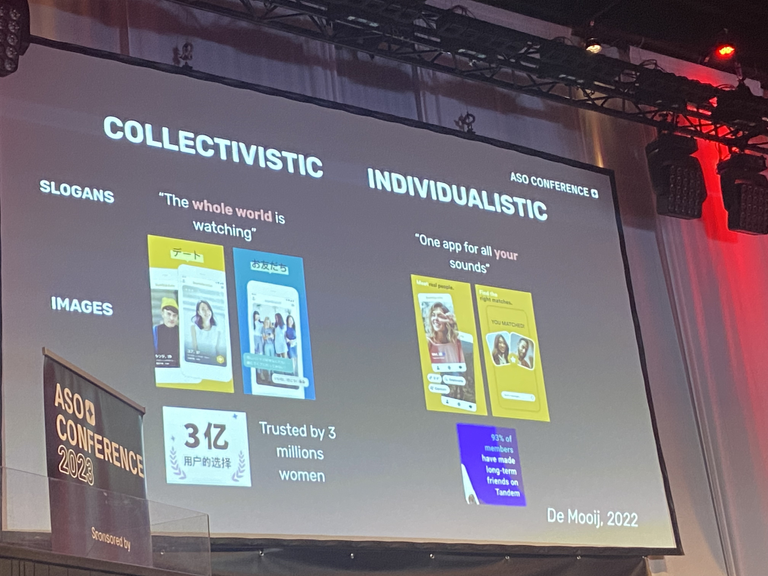
She first identified a challenge in how the Internet has led to a belief about an emerging “global culture,” when, in reality, cultural differences remain very real. It needs to be understood that different cultures do not experience values the same way, instead of thinking different cultures necessarily promote different values.
- As a result, Anastasiia recommended that ASO practitioners learn about multiple culture differences frameworks to better understand how to tailor their messages to key markets based on dimensions that change how particular values apply in different cultures. As a concrete example, she illustrated how messages like “the whole world is watching” and “one app for all your sounds” are likely to resonate better respectively in cultures that are more collectivistic or individualistic.

To properly leverage cultural differences in ASO, she recommended the given process:
- Select a value that can be connected to the use of your app, particularly via the needs and pains consumers experience before using it. For instance, the need to belong being a strong motivator for using a photo editing app like Prequel.
- Research cultural differences models that can help measure the different attitudes towards the value you have selected. In the case of Prequel, the need to belong may be expressed differently according to gender roles and/or power distance.
- Identify which elements in your store creatives can be used to display the user benefit (depending on context intensity, you may turn to text in your screenshots, real life imagery, subtle highlights, etc). Draft a backlog of hypotheses for what kind of creative experiments to conduct and where to conduct them, while being sensitive to the fact that some markets may require you to go for a different core value that your product addresses.
Understand the importance of creative optimization & localization for your app
- Finally, Anastasiia proposed to push the application of cultural differences frameworks in ASO. Sharing her own experience with localization in South America, she highlighted how it is important to create creatives that reflect how local consumers see themselves rather than how you may see them.
For Prequel, that meant understanding that consumers in Brazil don’t see themselves through the lens of carnival, despite it being an important seasonal event. Furthermore, she suggested that apps can also attempt to leverage clichés to take a more personal tone. They can mix elements of their own culture and cliché about it with illustrations of how the product addresses a particular value.
Stay tuned for more!
We’ve divided this lengthy blog post into two separate articles in order to effectively communicate the insights and key takeaways from the ASO Conference. The second part will explore the emerging topics in ASO, where we’ll touch upon interesting talks on artificial intelligence (AI), ASO for crypto platforms, third-party app stores in iOS, and much more. So don’t forget to check out the second part of the series!
ASOカンファレンス2023 パート1まとめ:ASOの基礎
2023年6月1日、グロースエージェンシーPhitureは、高度なASOに特化し、多くのトップASO実務家が集まる年次イベントである第6回ASOカンファレンスをベルリンで開催しました。AppTweakチームは、このイベントに参加しただけでなく、誇り高いスポンサーでもありました。私たちはASOコミュニティの他のメンバーと会い、ASOにおける最近の進化について議論できたことを大変嬉しく思いました。終日行われたプレゼンテーションと会話の質の高さに感銘を受け、メインステージで行われた様々な発表の要約を共有することにしました。
効果的なアプリストア最適化のための重要な要素
メインステージでの14の異なるプレゼンテーションにより、このカンファレンスは、ASOの中核となる繰り返し登場するトピックと、前回のASOカンファレンス以降に発展した新しい話の両方について聞く絶好の機会でした。この2部構成シリーズの最初のブログでは、ASOの基礎(A/Bテスト、有料UAとの連携、Apple Search Ads、ローカライゼーション、優先順位付け)に触れた7つのプレゼンテーションのハイライトをいくつか共有しました。
優先順位付け
ASO戦略の特定と計画
この日は、FreelyticsのシニアASOマネージャーであり、Phitureの元ASOストラテジストであるアントン・タタリノビッチ氏によるプレゼンテーションから始まり、彼は自身の経験に基づいたASOロードマップの構成と計画方法についてアドバイスを共有しました。
多くのリソースを持つ大規模チームのコンサルタントの役割から、特定のアプリの成長に専念する単独オペレーターの役割に移行したアントン氏は、集中力の欠如や影響の少ないプロジェクトへの投資を避けるために、優先順位付けのフレームワークがいかに不可欠であるかを指摘しました。Freelyticsで働き始めてすぐに、彼は初期の焦点をどこに置くべきかを特定し報告するために、以下の5段階プロセスを適用しました。
- 内部の調査:ユーザーベースの規模と収益シェアに基づいて早期の注目に値する主要市場を特定した後、アントン氏は、各市場のストアページの健全性チェックから始めることを推奨しました。これにより、最も長く放置されている、または見栄えの悪いクリエイティブ、メタデータ、レビュー、評価を持つページを特定できます。彼の助言は、ASOパフォーマンスのためというよりも、アプリのカテゴリランキングを考慮することでもありました。これは、市場におけるアプリの位置付けや、経営幹部の注意を引くのに役立つ項目を示すソフトなシグナルとしてです。
- ローカライゼーションの概要:アントン氏の2番目のステップは、これまでに行われたローカライゼーションの取り組みをより詳細にレビューすることでした。このステップは最初のステップを補完するものであり、即座の行動よりも調査に焦点を当てています。なぜなら、ローカライゼーションの可能性が高い領域を特定することで、アプリが成熟度に達するまでにはまだ遠い、より大きな市場からより小さな市場へと優先順位をシフトさせることができるからです。
- マーケティングベンチマーク:徹底的な内部レビューを行った後に初めて、競合他社を調査する時が来ます。アントン氏は、競合他社を認識することが不可欠である一方で、
時期尚早に競合他社を調査すると、自身の取り組みに偏りが生じ 、特定のアプリにとって関連性の低い変更を優先してしまう可能性があると聴衆に警告しました。競合状況をレビューする上での課題についてさらに議論し、アントン氏はダウンロード数の比較シェアに基づいて競合リストを10社以上から3~5社に絞ることを推奨しました。小規模なアプリは、市場のリーダーにあまり密接に追従するのではなく、まず同様の知名度とASOの取り組み範囲を持つ競合他社に焦点を当てるべきです。
- 可視性分析:アントン氏が共有した4番目のステップは、各主要市場でトラフィックをソースタイプ別に分析し、どの項目が最も重要かを理解することです。特にキーワード最適化に関しては、アプリとカテゴリにおける検索トラフィックの割合を理解し、ブランドキーワードと一般キーワードからの検索トラフィックの量を分解することが重要であると強調しました。これは、消費者があなたの種類の製品を検索することに慣れていない場合に、長期間にわたるキーワード最適化サイクルを避けるためです。
- コンバージョン分析:最後に、トラフィックソースごとのコンバージョン率の違いをレビューし、最大のギャップがどこにあるかを特定することは、コンバージョン最適化の取り組みをどこから始めるかを決定する上で重要です。Google Play Developer Consoleで利用可能なキーワードレベルのデータやApple Search Adsキャンペーンの統計も、検索語句やキーワードタイプごとのアプリのコンバージョン率をさらに細分化するのに役立ちます。
このプロセスの最後に、アントン氏の方法論は、最初に取り組むべき領域を視覚化するのに役立つ色分けシステムで監査を完了することです。
Apple Search Ads
この日の2番目のプレゼンテーションは、独立系グロースエキスパートのトーマス・プティ氏によって行われ、彼はApple Search Ads(ASA)に関する自身の「厳しい真実」を共有しました。トーマス氏はApple Search Adsに関する多くの具体的なinsightsを共有しましたが、彼の観察の一つは特に私たちの目を引きました。Apple Search Adsと他の広告ネットワーク間のユーザー行動測定の違いにより、比較ではそれらを完全に考慮できないため、Apple Search Adsは他の有料UAチャネルとは別に扱うべきであると彼は強調しました。
より実用的な観点から、トーマス氏は、Apple Search Adsのターゲティングの課題、予算管理、およびASAの特性に関して、多くの有用な観察結果も共有しました。
ターゲティング
- Search Ads Basicの使用を避け、検索語句をチェックして、すべての部分一致キャンペーンを監視する。
トーマス氏は、「Shazam」というキーワードをターゲットとするキャンペーンの例を挙げましたが、それは代わりにTVガイドアプリに関連する検索語句への入札につながりました。
彼は、厳密一致キャンペーンでさえ「類似パターン」ルールにより予期せぬ入札につながる可能性があることを強調し、例えば「ダイエットアプリ」というキーワードのキャンペーンが「DIYアプリ」に一部入札されたケースを共有しました。これらのすべてのケースにおいて、彼はそのような問題は避けられないものの、キャンペーン設定に除外キーワードを追加することで迅速かつ容易に修正できることを強調しました。
- 検索結果キャンペーンは、その性質上、予算の大部分をごく少数のキーワードに費やす傾向があります。
トーマス氏は、これはApp Storeの検索が本質的に「ショートテール」に焦点を当てているためだと指摘しました。一方、部分一致キャンペーンや発見キャンペーンは、よりinsightsの提供者として機能し、発見キャンペーンはApp Storeのアルゴリズムがアプリをどのように認識しているかを開発者に知らせる可能性があります。
- Appleのキャンペーンオーディエンス設定の制限。
最後に重要な点として、トーマス氏は、iOSでパーソナライズされた広告をオプトインしているユーザーがわずか22%であるため、ほとんどの性別ベースまたは年齢層別キャンペーンは、実際にはトラフィックの4分の3以上を除外してしまうと警告しました。
一方で、新規ユーザーとリピーターの概念は十分な明確さを提供せず、新規ユーザーをターゲットとしたキャンペーンでも、再ダウンロードにつながる可能性があります。国ターゲティングでさえ、AppleがユーザーのIPアドレスの場所ではなく、ユーザーが選択したApp Storeの国を考慮するため、予期せぬ結果を生むことがあります(特にMMPデータを通じてキャンペーンパフォーマンスを分析する場合)。
予算管理
予算管理に関して、トーマス氏は、Apple Search Adsの予算で時として必要となる現実的な確認を何度か強調しました。激しい競争、オークションシステム、そして非常に大規模な消費者層にアクセスする機会があるため、インストールあたりのコストが他の広告ネットワークよりも高くなるのは当然です。とはいえ、彼はAppleの入札推奨を盲目的に信用しないよう助言しました(特に、いくつかの架空の数字の例を挙げて)。また、Apple Search Adsが単純なセカンドビッダー価格設定システムとして機能するという考えも否定しました。
入札額を大幅に増減させた後でも、非常に似たインプレッション数とインストール数を提供するキャンペーンの例を挙げ、トーマス氏は、入札するアプリの関連性も重要な要素であると指摘しました。彼は、タップスルー率の高いアプリや特定のキーワードでのシェアオブボイスが高いアプリが、入札額を減らすテストを行うことを推奨しました。
Apple Search Adsの特性
最後に、トーマス氏は、有料UAミックス全体におけるApple Search Adsのいくつかの特性を特定しました。
- 彼の最大のアドバイスは、予算を管理する際とパフォーマンスを分析する際の両方において、キャンペーンにおいてブランドキーワードと非ブランドキーワードを常に分離することでした。
- 彼はASO実務家に対し、時折キャンペーンを一時停止することで、キャンペーンのリフト効果とカニバリゼーション効果を分析するよう促しました。また、カニバリゼーションの問題から目を背けないようにとも述べました。これは、Apple Search Adsキャンペーンから得られる他のinsightsのために支払う価値のあるコストであるとしました。
- このトピックに関連して、トーマス氏は、特定の用語を検索するようより多くの人々を誘導することがいかに難しいかという点で、検索は限られたチャネルであるとしながらも、Apple Search Adsの規模と一部の広告主の成功は、スケーリングの最大の制限が自身のリターン目標であることを受け入れる限り、このチャネルで規模を拡大することが可能であることを証明していると主張しました。
Apple Search Adsにおけるカニバリゼーションとは何かを発見する
有料UAとの連携
終日、さらに2人の講演者が、ASOと有料UAがどのように連携できるか、また連携すべきかについて補足しました。
有料UAキャンペーンによるオーガニックリフトの測定と予測
Playtikaのタリア・ハーメッシュ氏はまず、マーケターが有料UAがブラウズトラフィック(ストアでの特集や類似アプリからのトラフィック)、一般検索、またはブランド検索に影響を与えるかどうかを特定できる方法を強調し、その後、統計的回帰が異なる種類の有料UAキャンペーンからのオーガニックリフトを予測するのに役立つ方法を説明しました。
彼女は、アプリが高いトラフィック、オーガニックダウンロードと有料ダウンロード間の強力なKファクター、そして良好なユーザー品質を持つ国でこれらの分析を実行することを推奨し、聴衆に「全員が米国でお金を使うわけにはいかない」と念を押しました。
聴衆に彼女の方法論を説明しながら、タリアはPlaytikaの2つのゲームのケーススタディを共有しました。
- ブラジルでのリワードビデオキャンペーンは、Bingo Blitzに対し、有料ダウンロードあたり+0.1のオーガニックダウンロードリフトをもたらしました。
- フランスでのネイティブ広告キャンペーンは、ブランド検索の急増により、House of Funが有料ダウンロードあたり0.5のオーガニックダウンロードを獲得するのに役立ちました。
彼女はマーケターに対し、有料キャンペーンのKPIにオーガニックアップリフトを追加することに慣れるよう提案しました。アプリが有料UAを縮小する際は、オーガニックトラフィックへの影響を抑えるために段階的に行います。
ASOと有料UAを連携させるためのベストプラクティス
その後、Adidasのルカ・ステファヌッティ氏が登壇し、ASOと有料UAキャンペーンがより良く連携する方法に関するいくつかのベストプラクティスと観察結果を共有しました。
- 彼の最初のアドバイスは、ASOが常にユーザー獲得の長期的な側面にのみ焦点を当てることを意図しているわけではなく、有料UAキャンペーンの短期的な性質をサポートするためにタイムリーな変更を行うこともできるという点でした。そのために彼が提示した最初の戦術は、有料UAキャンペーンの増幅に関するものでした。これは、アプリ内イベントやプロモーションコンテンツ、プロモーションテキストの追加、Apple Search AdsでのTodayタブキャンペーンの実施、そしてAppleとGoogleにそれぞれのストアでの特集を依頼することによって行うことができます。
AppTweakのアプリ内イベントとプロモーションコンテンツのデータを活用して、アプリの可視性を高める
- イベントに関して、ルカ氏は、彼の経験上、Google PlayのプロモーションコンテンツはApp Storeのアプリ内イベントよりも約4倍効果的であると述べました。ルカ氏が共有した2番目の戦術は、
ストア広告 、イベント 、カスタムページ の利用を通じてコンバージョンを改善することでした。彼はまた、後者は常に高い影響力を持つわけではなく、適格なユーザーとタッチポイントにとって優先事項とする必要があるとすぐに警告しました。
- 最後に、ルカ氏は、ASOが有料UAとどのように相互作用するかを認識していない主要なステークホルダーに対して、より簡単に価値を示すために、ASO実務家が有料UAキャンペーンに対するASOの影響を計算するために使用すべきいくつかの公式を共有しました。
A/Bテスト
カンファレンスの午後は、マテウス・ヴジェシュチ氏(Klarna)によるプレゼンテーションから始まり、彼は効率的なストアA/Bテストにおける重要でありながらあまり知られていない考慮事項のいくつかを魅力的な詳細で説明しました。
はじめに、マテウス氏は、Google Playストアリスティング実験やApp Store製品ページ最適化のようなツールを使用したA/Bテストが、Facebook広告でのクリエイティブのA/Bテストとどのように異なるかを強調しました。これは、Facebook広告とは異なり、ストアA/Bテストが「単に」リアルタイムデータを比較するのではなく、将来の違いを予測することに焦点を当てているためです。
- その結果、マテウス氏の最初のアドバイスは、テストはそれが証明しようとしている仮説と同じくらいしか良くならないため、調査自体にテストと同じ重要性を与えることでした。これは実験の優先順位付けに反映されるべきであり、まず内部データとinsightsに基づいた仮説に焦点を当て、次にベストプラクティス、ベンチマーク、ヒューリスティクス、そして3番目に仮定とクリエイティブな調整に焦点を当てるべきです。
これらの優先順位付けの原則は、より良い最小検出可能効果を持つ大胆なテストを支持するのにも役立ちます。統計に深く立ち入ることなく、マテウス氏は、実験はより長く実行されると統計的検出力が高まることを説明しました。これは、サンプルサイズが大きくなるにつれて網目がきつくなり、より小さなコンバージョンの変化を捉えることができる網のようなものです。多くのアプリは単一のテストを実行するのにそれほど多くの時間をかけられないため、A/Bテストで早期に捉えられるコンバージョンの変化をもたらす可能性が最も高い実験を最初にテストすることが重要です。
- したがって、マテウス氏の2番目の重要なアドバイスは、すべてのASO実務家がアプリ、国、ストアフロントごとに追求すべき最小検出可能効果を特定することです。また、
サンプルサイズ計算ツール を使用して、テストが投資に見合うものとなるように、適切に検証するのに時間がかかりすぎる仮説のテストを避けるべきです。そのために、マテウス氏は自身のサンプルサイズ計算ツールを作成し、ASO実務家に対し、すべての実験が価値がある、一部の実験が価値がある、または実験が価値がない市場を簡単に視覚化できるように、市場をトラフィックとCVRレベルで3つの階層にグループ化することを推奨しました。
- 最後に、マテウス氏は、すべてのASO実務家が少なくとも四半期に一度は抜本的な変更をテストする習慣を身につけることを推奨し、一度に一つの視覚的変更だけでなく、一度に一つの仮説をテストすることを目指すべきだと述べました。
- 彼はまた、聴衆に対し、最初のインプレッションフレームに表示されるアセットの変更を優先するよう促し、市場はすべてが同じではないため、すべての市場で同じ変更を体系的にテストしないようにとも述べました。繰り返しになりますが、テスト結果はあくまで方向性を示すものであり、クリエイティブな変更につながった仮説の質よりも重要ではないことを誰もが覚えておくべきです。
ローカライズ
最後に、ASOの基本に関して、Davronbek Makhkamov(Ulysses)とAnastasiia Baranchikova(Prequel)がそれぞれ登壇し、アプリ業界におけるローカライゼーションの取り組み方についてのinsightsと推奨事項を共有しました。
成功するローカライゼーションの明確なロードマップ
Davronbekは、新機能の追加や他のプラットフォームへの移植に比べて技術的リソースが少なくて済むため、ローカライゼーションはアプリの成長に非常に大きな影響を与える分野であると強調しました。そのため、彼はアプリの国際展開のためのロードマップを策定する際に役立つ、非常にシンプルな視覚的フレームワークを作成しました:
| レベル0 = グローバリゼーション | 国A | 国B | 国C |
| レベル1 = 翻訳 | |||
| レベル2 = ローカライゼーション | |||
| レベル3 = カルチャライゼーション |
アプリが利用可能な各国でのローカライゼーションレベルを比較するだけで、改善が必要な領域を素早く特定できます。特定の国でのローカライゼーションの品質をさらに向上させるか、新しい国で一から始めるかを検討することもできます。最終的な目標は、アプリが利用可能な各国で最高レベルのローカライゼーションを達成することです。
ローカライゼーションの改善と他言語への展開の選択を容易にするため、Davronbekは、より深いレベルのローカライゼーションに対応する具体的なアクション項目に必要なリソースを考慮することを推奨しました。また、特定の地域の人々がローカライズされた製品とグローバル製品にどの程度敏感であるかを評価することも重要です。具体的に、適切なローカライゼーションとカルチャライゼーションに取り組む際の以下のアクション項目を提案しました:
- ローカライゼーションのアクション項目:現地のキーワード検索パターンを調査し、アプリストアのメタデータに実装する、ウェブサイトを現地言語に翻訳する、ローカライズされた価格設定をテストする、サポート資料とFAQを翻訳する。
- カルチャライゼーションのアクション項目:アプリのタイトルに現地の名称拡張を含めるか、ブランドを転写する(異なるアルファベットを使用する言語の場合など)、文化的に魅力的なクリエイティブをテストし実装する、アプリとウェブサイトに現地のコンテンツを掲載する、すべてのコミュニケーションチャネルとコミュニティプラットフォームを管理する現地スタッフを雇用する、現地のマーケティングプランを策定する、現地言語での完全なカスタマーサポートを提供する。
文化的な違いを認識することの重要性
Davronbekのプレゼンテーションの直後、Anastasiiaが登壇し、より良いカルチャライゼーションとより効果的なマーケティングを実現するために活用できる理論について詳しく説明しました。
彼女はまず、インターネットが「グローバル文化」の出現について信じさせているという課題を指摘しましたが、実際には文化的な違いは依然として非常に現実的なものです。異なる文化が必ずしも異なる価値観を推進するのではなく、異なる文化が価値観を同じように経験しないということを理解する必要があります。
- その結果、Anastasiiaは、ASO実践者が複数の文化的差異フレームワークについて学ぶことを推奨しました。これは、異なる文化において特定の価値観がどのように適用されるかを変える次元に基づいて、主要市場向けのメッセージをどのように調整するかをより良く理解するためです。具体例として、「世界中が見ている」や「すべてのサウンドに1つのアプリ」といったメッセージが、より集団主義的または個人主義的な文化でそれぞれよりよく共鳴する可能性が高いことを説明しました。
ASOで文化的な違いを適切に活用するために、彼女は以下のプロセスを推奨しました:
- アプリの使用に関連付けられる価値を選択する。特に、使用前に消費者が経験するニーズや課題を通じて。例えば、Prequelのような写真編集アプリを使用する強い動機となる帰属意識のニーズなど。
- 選択した価値に対する異なる態度を測定するのに役立つ文化的差異モデルを研究する。Prequelの場合、帰属意識のニーズは性別役割や権力格差によって異なる形で表現される可能性があります。
- ストアのクリエイティブのどの要素を使用してユーザーベネフィットを表示できるかを特定する(文脈の強度に応じて、スクリーンショットのテキスト、実生活のイメージ、微妙な強調表示などを使用する)。どのようなクリエイティブ実験を行うか、どこで実施するかについての仮説のバックログを作成する。その際、一部の市場では製品が対応する異なる中核的価値を選択する必要がある可能性があることに注意する。
アプリのクリエイティブ最適化とローカライゼーションの重要性を理解する
- 最後に、AnastasiiaはASOにおける文化的差異フレームワークの適用を推進することを提案しました。南米でのローカライゼーションの経験を共有し、現地の消費者が自分たちをどのように見ているかを反映したクリエイティブを作成することの重要性を強調しました。
Prequelの場合、それはブラジルの消費者が、カーニバルが重要な季節イベントであるにもかかわらず、自分たちをカーニバルのレンズを通して見ていないことを理解することを意味しました。さらに、アプリは固定観念を活用してよりパーソナルなトーンを取ることも試みることができると提案しました。製品が特定の価値にどのように対応するかを示す際に、自分たちの文化の要素とそれに関する固定観念を組み合わせることができます。
続報をお待ちください!
このブログ投稿は長文のため、ASOカンファレンスからのinsightsと主要な学びを効果的に伝えるために2つの記事に分けました。第2部では、人工知能(AI)、暗号通貨プラットフォームのASO、iOSのサードパーティアプリストアなど、ASOにおける新しいトピックについて探っていきます。シリーズの第2部もお見逃しなく!
Micah Motta
Oriane Ineza