An effective ASO strategy goes beyond metadata updates. It aligns search intent, product positioning, and conversion optimization within a measurable growth framework. When executed correctly, app store optimization (ASO) improves keyword rankings, strengthens product page performance, and reduces reliance on paid acquisition.
As of 2026, both the App Store and Google Play each host millions of apps, making discoverability one of the primary growth challenges for publishers. In this environment, structured ASO strategies become essential to improve visibility, increase conversion, and drive sustainable organic growth.
In this guide, you’ll learn how to build a high-impact ASO strategy in 2026 using a step-by-step framework designed for app marketers and growth teams seeking sustainable organic growth.
Key takeaways
- ASO is a continuous growth framework, not a one-time update. Sustainable results come from structured iteration, measurable KPIs, and cross-team alignment.
- Start with clear goals, then audit before optimizing. Define visibility and conversion targets, benchmark competitors, and identify keyword gaps before changing metadata.
- Optimize for both ranking and conversion. High-intent keyword targeting must be paired with strong first-impression creatives and localized messaging.
- Follow a structured update cadence. Separate keyword and creative changes and allow 3–4 weeks between major updates to accurately measure impact.
- Adapt to each platform’s algorithm. The App Store prioritizes structured metadata, while Google Play emphasizes semantic relevance and broader experimentation—making store-specific strategies essential.
What is an ASO strategy?
An ASO strategy is a structured, long-term plan to improve an app’s visibility and conversion rate in the App Store and Google Play. It combines ASO keyword research, app metadata optimization, creative testing, ratings management, and performance tracking to systematically grow organic app downloads.
Why is an ASO strategy important?
A well-defined app store optimization strategy and process are essential for success. Rather than relying on sporadic updates or guesswork, a strong ASO strategy establishes a data-driven process for continuous improvement. With clear goals and measurable outcomes, you can track what works, and make informed decisions.
In highly competitive categories, discoverability is constrained by algorithmic ranking signals and conversion performance. With millions of apps competing for limited search visibility, structured optimization becomes a measurable growth lever rather than an optional tactic. AppTweak’s ASO benchmarks have shown for example that apps with higher average ratings consistently outperform lower-rated competitors in conversion rate benchmarks, making app rating and review management a core ASO driver.
A successful mobile app strategy is built on a solid foundation, including clear goals, thorough audits, competitor analysis, metadata updates, and continuous monitoring.
Below, we outline six steps to building your app store optimization strategy.
How to build an effective ASO strategy step-by-step
A successful ASO strategy can be broken down into six clear, actionable steps:
Step 1: Define clear ASO goals and KPIs
An effective ASO strategy starts with clearly defined growth objectives and measurable KPIs, to provide direction and track progress. Without defined targets, it becomes difficult to evaluate the impact of your ASO efforts or justify ongoing investment.
Your goals should guide your ASO strategy and align it with broader business objectives (such as user acquisition, revenue growth, or market expansion).
Common ASO goals include:
- Increasing keyword visibility by 20–30% within three months.
- Improving product page conversion rate by 5%.
- Maintaining a 4.5+ star rating while increasing app review volume.
- Ranking in the top 10 for target keywords in specific markets through localization.
AppTweak’s ASO benchmarks report (2025) shows that improving conversion rate by just 3–5% can materially increase organic installs without additional traffic acquisition. Small efficiency gains compound at scale.
Defining these ASO metrics and KPIs ensures your strategy focuses on what matters most for growth. For new apps, initial goals emphasize visibility and downloads. Established apps might focus on improving retention or expanding into new markets.
Setting goals also supports cross-team alignment, ensuring coordinated product, marketing, and UA efforts. With clear goals, your strategy will have a strong foundation for long-term optimization and measurable results.
Step 2: Audit your current app keyword performance
Before diving into optimization, evaluate where your app stands today. An ASO metadata audit helps identify what’s working, what needs improvement, and where opportunities lie.
Start by analyzing your current app keyword rankings and performance:
- Which keywords currently drive impressions and installs?
- Where do you rank for high-intent search terms?
- Are high-performing keywords at risk of being removed?
Next, benchmark competitors:
- Where do competitors outrank you?
- Which keyword clusters are they dominating?
- Are they targeting terms you are not?
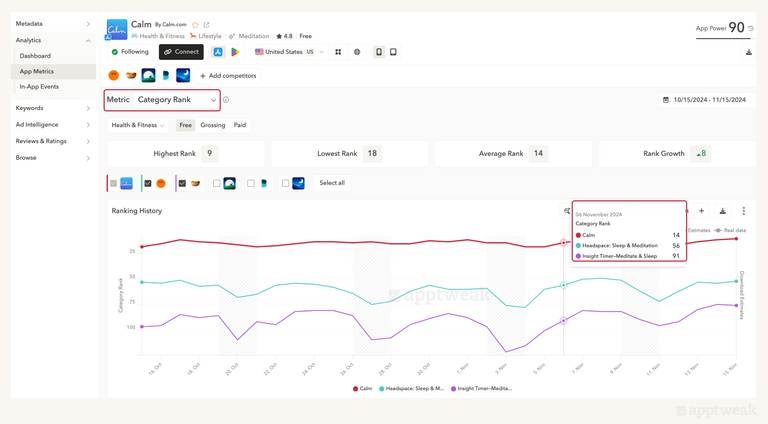
Finally, analyze conversion and engagement metrics:
- App download velocity
- Product page conversion rate
- App rating trends
- Retention indicators
An audit also ensures you avoid costly mistakes, such as replacing effective app keywords or overlooking areas where competitors outperform you.
Example:
Vinted used app keyword research, competitor monitoring, and impact measurement to rank in the Top 10 for 210 new keywords across 6 European markets within six months.
Build intent-informed semantic keyword clusters
ASO has evolved beyond optimizing isolated keywords in metadata fields. While keywords remain foundational, both the App Store and Google Play increasingly evaluate semantic relevance, contextual relationships, and how clearly an app aligns with inferred user intent .
Instead of treating keywords as standalone ranking targets, group them into intent-driven semantic clusters based on:
- Core user intent themes (what the user is trying to accomplish)
- Feature sets and use cases
- Category-specific terminology
- Competitive positioning within a given problem space
Track performance at the cluster level using metrics such as average ranking, total cluster reach, and volatility rather than relying on isolated keyword movements .
This approach strengthens topical authority, reinforces semantic clarity, and improves ranking stability across related queries.
For a deeper breakdown of how AI is reshaping app store relevance and semantic ranking signals, read our vision on how AI is reshaping app store relevance.
Step 3: Analyze app competitor positioning & creative strategy
Competitor analysis reveals market standards and differentiation opportunities. It helps you understand not only what competitors rank for, but how they convert users.
Evaluate:
Keyword positioning
- Which semantic clusters do competitors prioritize?
- Are they targeting feature-based, brand-based, or problem-based queries?
Creative assets
- How do they communicate value in the first three screenshots?
- What messaging hierarchy do they use?
- Are they emphasizing social proof, features, or outcomes?
A/B testing patterns
- What visual or messaging elements are being tested?
- How frequently do competitors update assets?
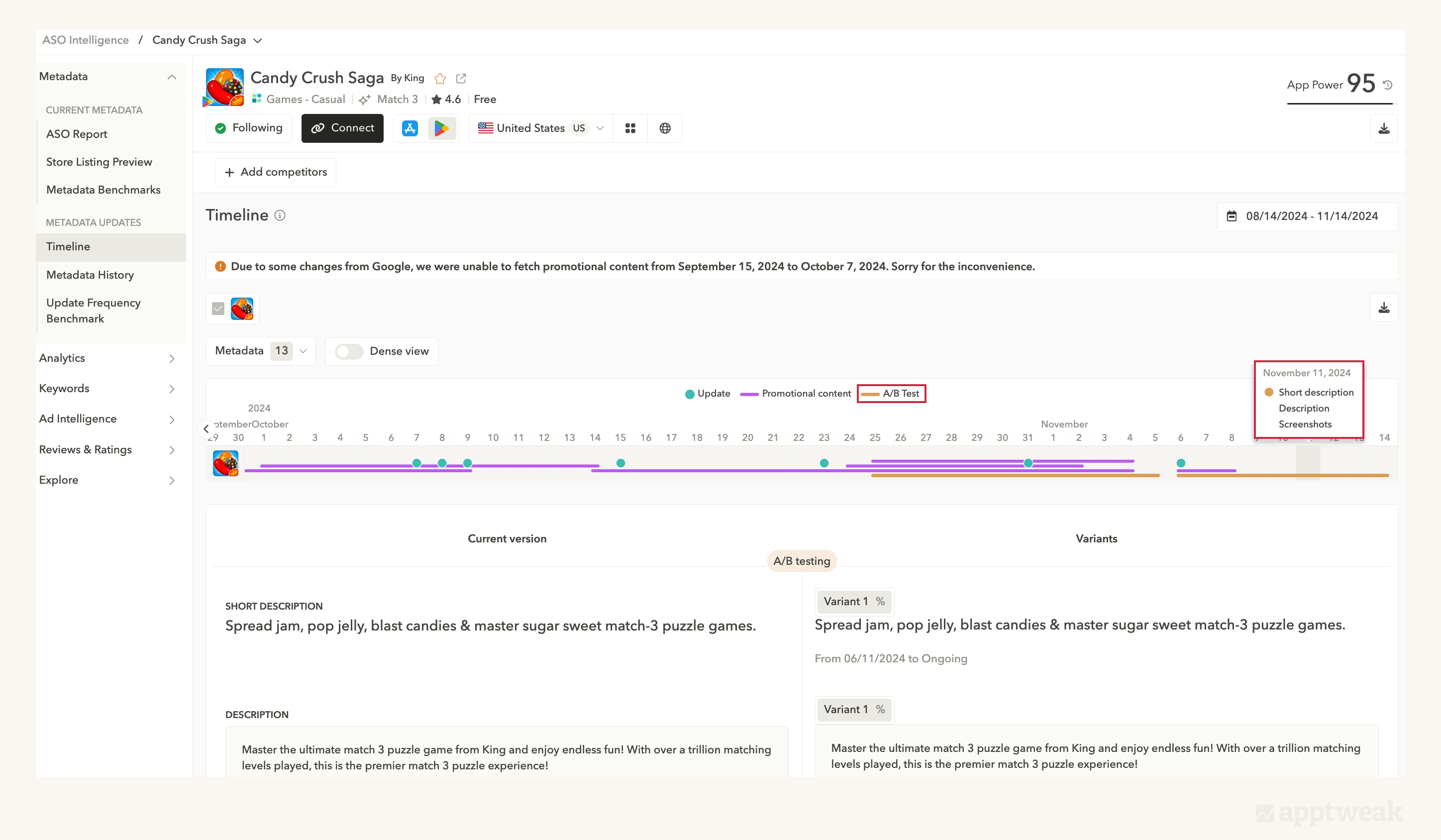
App competitor research provides a roadmap for improving your app store presence, but testing is critical to validate assumptions. A/B testing allows you to test variations of your metadata and creative assets, ensuring changes are backed by data.
Regularly monitor competitors’ updates and user feedback. Staying informed helps you adapt to evolving trends and maintain a competitive edge.
Step 4: Optimize app metadata and creative assets
Visual and textual metadata are the cornerstone of ASO. Every element must be optimized for visibility and conversions, from titles and keywords to screenshots and descriptions.
Key considerations for metadata updates:
Keyword optimization
- Prioritize high-volume, relevant terms aligned with user intent
- Avoid redundant keyword targeting
- Map keywords to core features and differentiators
Creative optimization
- Highlight primary value propositions in the first three screenshots
- Ensure visual hierarchy communicates benefits quickly
- Align messaging with search intent
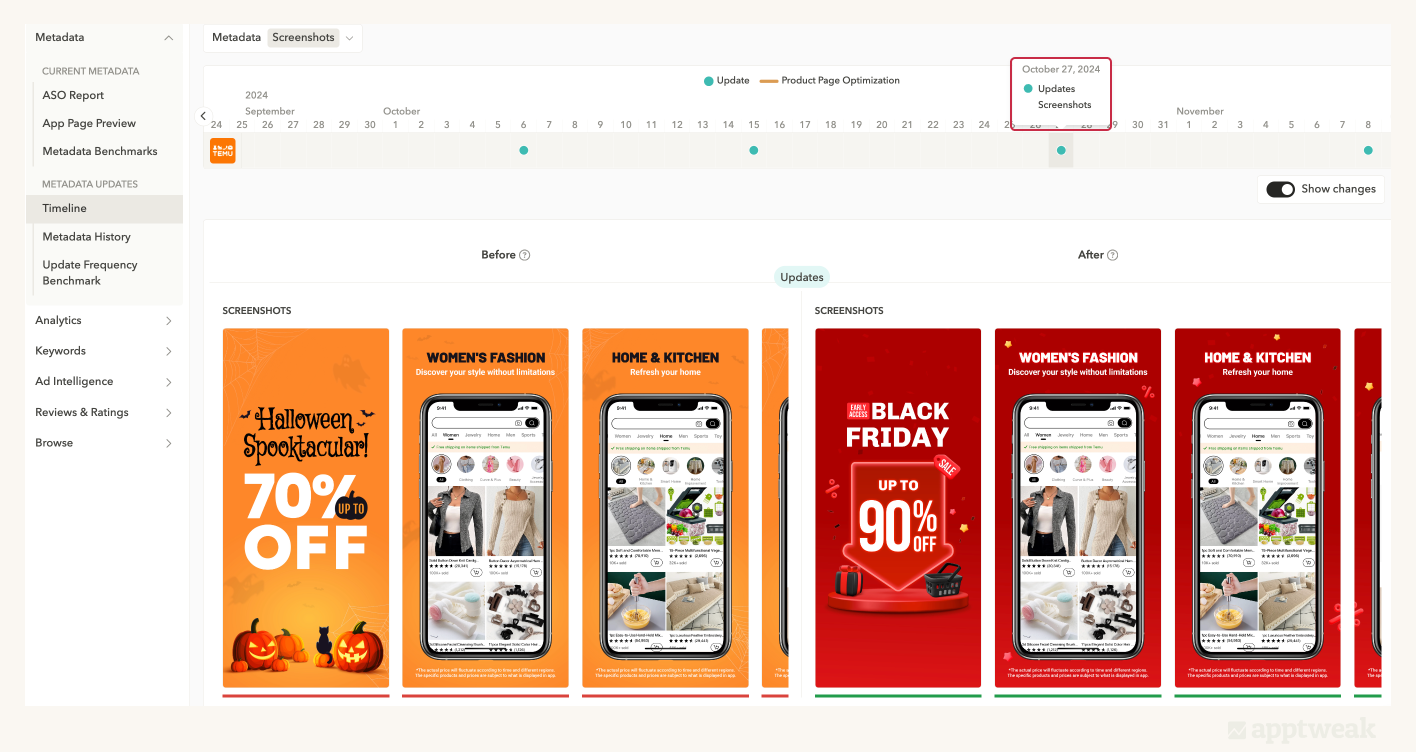
Localization
- Translate and adapt metadata for each market
- Adjust app screenshots to reflect cultural and linguistic expectations
- Reassess keyword demand regionally
Regular app metadata and creatives updates ensure your app remains competitive and aligned with user expectations. However, avoid making all changes simultaneously, as this makes it difficult to isolate the impact of each update. Instead, stagger updates to collect meaningful performance data.
Apps that update metadata consistently (rather than sporadically) show stronger long-term keyword stability. Internal trend analyses indicate that iterative updates outperform infrequent, large-scale changes.
Step 5: Define a structured ASO update timeline
An effective ASO strategy requires a structured timeline to track the impact of updates and allow algorithms to adjust. Without a clear timeline, you risk making changes that cannot be properly measured.
Follow these principles:
- Sequential changes: Implement keyword changes first, then test visual updates separately to isolate impact.
- Testing windows: Allow 3–4 weeks between significant updates to collect stable ranking and conversion data (ranking stabilization commonly requires multiple indexation cycles).
- Cross-department coordination: Align with UA, marketing, and product teams to align ASO updates with campaigns, feature releases, or app launches.
A well-defined timeline ensures your strategy remains focused and measurable. It also prevents overlapping efforts that could obscure results.
Step 6: Measure ASO performance and iterate continuously
ASO is an ongoing process that requires consistent evaluation and adjustment. After implementing updates, measure results against predefined KPIs.
Here’s how to approach this:
- Track performance: Monitor app keyword rankings, impressions, app downloads, and conversion rates.
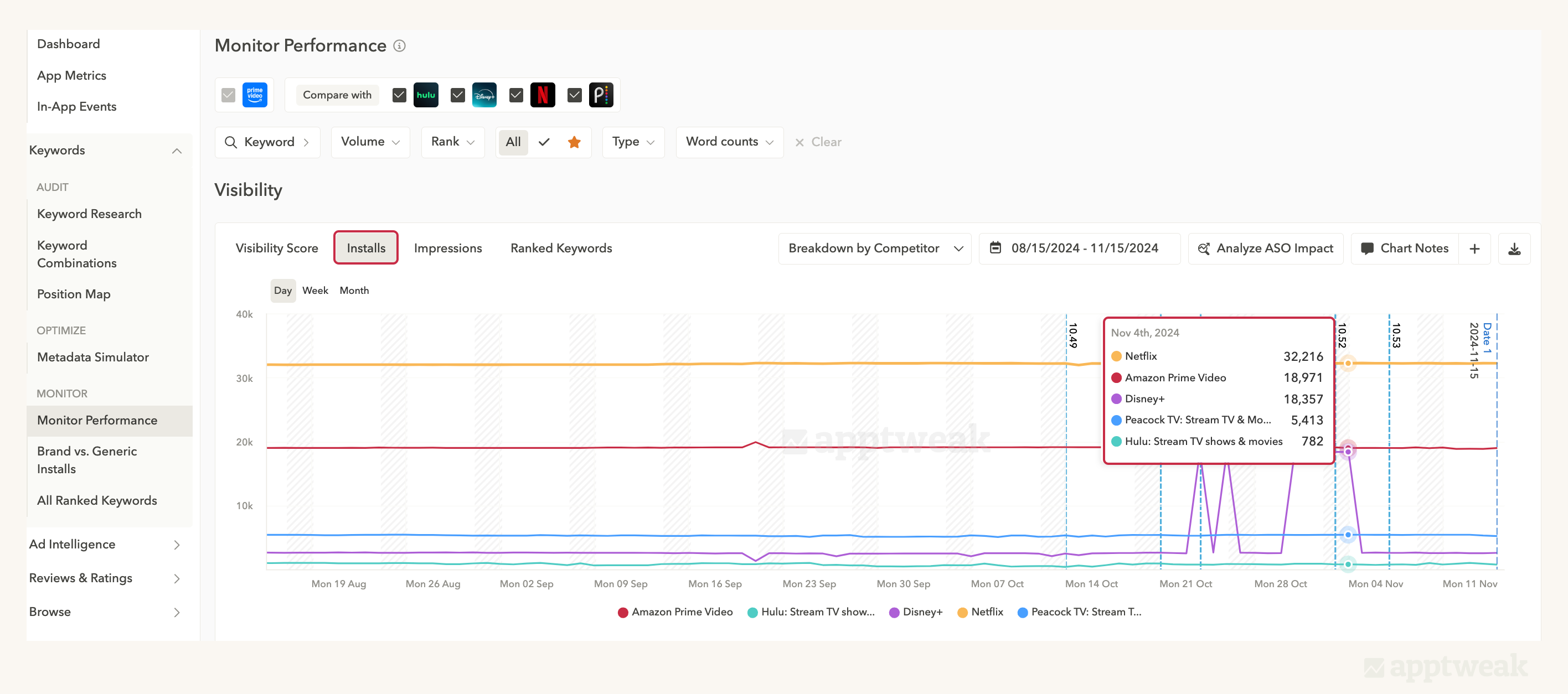
- Analyze results: Evaluate which updates worked and why. Did keyword ranking improvements translate into app download growth? Did creative changes improve conversion rate?
- Iterate regularly: Make incremental updates based on performance data. For example, if certain keywords underperform, consider replacing them with alternatives.
ASO isn’t a one-time effort; it’s a cycle of optimization. Continuously refine your strategy to adapt to algorithm changes, user behavior, and market trends. By committing to regular checks and iteration, you ensure your app stays visible, competitive, and aligned with user expectations and market trends.
Does an ASO strategy differ between the App Store and Google Play?
Yes. An ASO strategy differs significantly between the App Store and Google Play because each platform uses distinct ranking algorithms, metadata structures, and testing capabilities. Effective ASO requires adapting keyword targeting, creative strategy, and experimentation frameworks to each platform’s algorithmic structure.
Keyword optimization differences
App Store
- Uses a dedicated 100-character keyword field
- Emphasizes precise keyword selection
- Relies heavily on structured metadata (title, subtitle, keyword field)
Google Play
- Does not use a separate keyword field
- Relies on keywords embedded naturally within the title and long description
- Places greater weight on semantic relevance and contextual signals
As a result, the App Store requires concise keyword targeting, while Google Play favors descriptive, semantically rich content.
Creative and A/B testing differences
App Store
- Highlights autoplay app preview videos in search results
- Offers Product Page Optimization (PPO) for limited A/B testing
- Custom Product Pages allow traffic segmentation
Google Play
- Offers Store Listing Experiments with broader A/B testing capabilities
- Allows testing of icons, screenshots, descriptions, and feature graphics
- Supports ongoing creative experimentation
Google Play generally provides more flexible testing infrastructure, while the App Store emphasizes visual impact in search results.
Ratings, reviews, and update responsiveness
Both platforms factor ratings and reviews into ranking and conversion performance. However, Google Play places greater emphasis on recent ratings velocity and engagement signals, making continuous review management particularly impactful for maintaining visibility.
The App Store, while influenced by ratings, relies more heavily on structured metadata for keyword discoverability.
In summary
An effective ASO strategy must be platform-specific. Treating the App Store and Google Play as interchangeable environments limits visibility potential and reduces conversion efficiency.
Read our full breakdown of the 10 key ASO differences between the App Store and Google Play.
What are some advanced ASO strategies to boost your app growth?
Advanced ASO strategies extend beyond foundational keyword optimization and creative updates. They focus on segmentation, timing, and platform-specific features to unlock incremental visibility and improve conversion efficiency at scale. These tactics are particularly impactful in competitive categories where baseline optimization is already mature.
Below are high-impact advanced strategies:
App store localization at scale
Localization expands keyword coverage and improves conversion by aligning messaging with local language and cultural expectations. Beyond simple translation, effective app store localization adapts keywords, screenshots, value propositions, and in-app messaging to regional search behavior.
According to AppTweak’s ASO Benchmarks report (2025), subtitles (88%) and descriptions (82%) saw the highest localization rates on the App Store.
Strategic impact:
- Unlocks incremental visibility in new markets
- Diversifies traffic sources
- Reduces dependency on a single primary region
Seasonal and trend-based optimization
Search volume for seasonal keywords typically begins increasing several weeks before major retail or cultural events. Apps that update creatives and metadata ahead of peak demand are better positioned to capture high-intent traffic during these spikes.
Strategic impact:
- Captures short-term visibility surges
- Improves relevance during high-intent periods
- Reinforces freshness signals through timely updates
In-app events and promotional content
In-app events (App Store) and promotional content (Google Play) create additional discovery surfaces beyond standard search results. Featuring time-sensitive events, feature launches, or limited offers can improve browse visibility and re-engage existing users.
Strategic impact:
- Increases exposure beyond keyword rankings
- Supports feature launches and seasonal campaigns
- Strengthens user engagement signals
Custom Product Pages (CPP) and Custom Store Listings (CSL)
Custom Product Pages (Apple) and Custom Store Listings (Google Play) allow you to create segmented versions of your app listing tailored to specific audiences, campaigns, or keyword clusters. Segmented product pages aligned with specific user intent frequently outperform generic listings in conversion benchmarks. Intent-matched creatives can produce measurable uplifts compared to default product pages, particularly for paid traffic campaigns.
Strategic impact:
- Enhances relevance for paid and organic traffic
- Supports campaign segmentation
- Enables intent-based creative optimization
Example:
SoundCloud leveraged custom product pages to better match ad intent, increasing Apple Ads conversion rate by 58% while reducing CPI by 39%.
ASO and Apple Ads (ASA) synergy
Apple Ads provides real-time keyword performance data that can inform ASO prioritization. High-performing paid keywords often signal strong user intent. Incorporating proven ASA keywords into organic metadata strategies can strengthen long-term visibility and improve overall acquisition efficiency.
Strategic impact:
- Improves keyword prioritization
- Aligns paid and organic growth strategies
- Increases return on acquisition spend
Advanced ASO strategies focus on segmentation, timing, and cross-channel integration. When layered on top of strong foundational optimization, these tactics create sustainable competitive advantage in crowded app marketplaces.
Read these key ASO tips and best practices to further strengthen your app growth strategy.
What are the most common ASO mistakes?
Even strong ASO strategies can underperform if avoidable mistakes undermine visibility or conversion.
Below are the most common missteps that limit organic growth:
Skipping structured ASO keyword research
Relying on guesswork reduces visibility. Without data-driven app keyword research, you miss high-intent search terms and risk targeting low-impact queries.
Keyword duplication or stuffing
Repeating keywords across metadata wastes character space and harms readability. Over-optimization can reduce conversion performance without improving rankings.
Ignoring app competitor intelligence
Failing to benchmark competitors limits strategic insight. Monitoring competitor rankings, creative updates, and keyword shifts helps identify opportunities and emerging trends.
Weak app store creative assets
Low-quality or cluttered screenshots reduce conversion rates. The first three screenshots must communicate value clearly and immediately.
Not testing app metadata and creatives
Skipping A/B testing prevents structured learning. Without experimentation, optimization decisions rely on assumptions rather than performance data.
Neglecting app ratings and reviews
Poor rating management directly impacts both conversion performance and ranking signals. App review velocity and average rating influence user trust, visibility, and install likelihood.
According to AppTweak’s ASO Benchmarks study (2025), apps with ratings above 4.0 stars convert significantly better than lower-rated competitors — reinforcing that reputation management is a measurable growth lever, not just a branding concern.
Neglecting or overreacting to algorithm shifts
App store algorithms evolve regularly, and they can result in variations in app and keyword rankings, leading to losses in visibility and downloads. Reacting impulsively to ranking fluctuations without verifying broader algorithm changes can worsen performance. If you believe your app was affected by an algorithm change, check for any algorithm updates using AppTweak’s App Store Algorithm Change Detector.
Failing to localize
Launching an app globally without localized metadata limits keyword reach and reduces relevance in international markets.
Ignoring seasonal demand spikes
Neglecting opportunities from peak periods like Black Friday means missing out on powerful surges in user interest. Seasonal events often generate high traffic on the app stores with store visitors actively searching for relevant solutions.
Treating ASO as a one-time task
ASO requires continuous iteration. Static listings lose competitiveness as markets, algorithms, and user behavior evolve.
Avoiding these mistakes protects ranking stability, improves conversion efficiency, and strengthens long-term organic growth.
What are the most important tools to help you build a scalable ASO strategy?
Building a strong App Store Optimization (ASO) strategy requires more than keyword research alone. As app store ecosystems evolve, successful teams rely on a combination of tools that support visibility, conversion, competitive intelligence, and paid acquisition alignment.
In practice, most mature ASO strategies rely on 4 core categories of tools:
- ASO intelligence tools: for app store keyword research, metadata optimization, creative monitoring, and visibility tracking.
- App market intelligence tools: for app expansion strategy, competitor benchmarking, and app downloads & revenue estimation.
- App review management tools: for improving app ratings, conversion rate, and user sentiment insights.
- Apple Ads management tools: for scaling paid acquisition and aligning ASO with Apple Ads.
Why leading teams consolidate these tools
Historically, ASO, app market research, app review management, and paid acquisition tools operated separately. Today, many mobile leaders prefer unified platforms that connect organic and paid insights in one environment.
AppTweak brings all 4 capabilities together in one unified App Store Marketing & Intelligence platform. With a dataset of 20M+ keywords and 6M+ apps across 100+ countries, and AI trained on 10+ years of ASO and Apple Ads expertise, AppTweak enables mobile teams to connect organic visibility, app market trends, user sentiment, and paid performance — all in a single environment designed to drive sustainable app growth.
Instead of optimizing in isolation, teams can move from insight to execution seamlessly.
Conclusion
Building an effective app store optimization strategy requires more than isolated keyword updates. It demands continuous app keyword research, metadata refinement, competitor benchmarking, creative testing, and alignment with paid acquisition efforts.
As app store algorithms evolve and competition intensifies, sustainable growth comes from combining data-driven insights with ongoing iteration. Teams that consistently monitor rankings, analyze market shifts, and optimize conversion elements are better positioned to increase organic downloads, reduce acquisition costs, and strengthen long-term app performance.
ASO is not a one-time project, it’s a continuous growth engine.
If you’re ready to take your app store optimization strategy further, explore AppTweak with a 7-day free trial and discover the insights you need to scale visibility, conversion, and revenue with confidence.
[Start free trial]
FAQs
What is an ASO strategy?
An ASO strategy is a structured, long-term framework designed to improve an app’s visibility and conversion rate in the App Store and Google Play. It combines app keyword research, app metadata optimization, creative testing, ratings management, competitor benchmarking, and performance tracking to systematically increase organic app downloads and reduce dependency on paid acquisition.
Unlike isolated metadata updates, a true ASO strategy operates as a measurable growth system with defined KPIs and continuous iteration.
What are the key elements of an ASO strategy?
The key elements of an effective ASO strategy include:
- Clear growth goals and KPIs
- Structured app keyword research and prioritization
- Metadata optimization (title, subtitle, descriptions)
- Creative optimization (icons, screenshots, videos)
- App competitor benchmarking
- App ratings and review management
- Continuous performance measurement and iteration
Together, these elements create a repeatable optimization framework rather than one-off updates.
How long does it take to see results from an ASO strategy?
Most ASO changes require 3–4 weeks to show measurable impact, as app store algorithms need time to re-index metadata and stabilize rankings.
Keyword updates typically influence visibility within a few weeks, while creative changes may impact conversion rate more immediately depending on traffic volume.
However, meaningful strategic impact (e.g., sustained ranking improvements or organic growth trends) usually becomes visible over a 2–3 month optimization cycle.
ASO should be evaluated over quarters, not days.
What KPIs should you track in an ASO strategy?
The most important ASO KPIs include:
- App keyword rankings
- Visibility score / search impressions
- Product page conversion rate
- Organic app downloads
- App download velocity
- Average app rating and review volume
- Retention indicators
Conversion rate is especially critical. Even a 3–5% improvement can materially increase organic installs without additional traffic acquisition.
How does ASO strategy differ between the App Store and Google Play?
ASO differs significantly between app stores due to algorithm and metadata differences:
App Store:
- Uses a 100-character keyword field
- Relies heavily on structured metadata (title, subtitle)
- Does not use keyword density in descriptions
- Strong visual emphasis in search results
Google Play:
- No dedicated keyword field
- Relies on keywords in title and long description
- Weighs semantic relevance and contextual signals
- Offers broader A/B testing infrastructure
Because of these structural differences, keyword strategy and experimentation frameworks must be platform-specific.
How often should I update my app’s metadata?
Metadata updates should follow a structured, iterative cycle rather than sporadic large-scale changes.
Based on AppTweak’s ASO Benchmarks Report (2025), nearly 50% of top apps on iOS updated their screenshots more than twice within a year, while a significant portion of apps rarely update their titles, despite titles having the strongest impact on keyword rankings. This highlights a common imbalance: creatives are updated more frequently than high-impact keyword fields.
For most apps, a structured cadence works best:
- App Store (iOS): Review and optimize metadata every 4 weeks
- Google Play: Review and optimize every 4–6 weeks
How can A/B testing improve my ASO strategy?
A/B testing improves ASO by validating creative and messaging decisions with real user behavior.
Testing different icons, screenshots, descriptions, or feature graphics helps identify:
- Which value propositions drive higher conversion
- Which visual hierarchy captures attention faster
- Which messaging resonates with specific audiences
According to AppTweak’s ASO Benchmarks report (2025), 57% of top games A/B tested their screenshots and icons twice or more per year on Google Play.
Does ASO impact paid acquisition performance?
Yes. ASO directly impacts paid acquisition efficiency.
A higher product page conversion rate reduces Cost per Install (CPI), improving return on ad spend. Additionally, high-performing Apple Ads keywords often reveal strong user intent signals that can inform organic keyword prioritization.
When ASO and paid acquisition strategies are aligned, overall acquisition efficiency improves and dependency on increasing ad spend decreases.


More articles in Start ASO

 Georgia Shepherd

 Oriane Ineza