Custom product pages (CPPs) remain one of the most underutilized tools in mobile marketing. At AppTweak, we’ve worked closely with top apps and games to understand why adoption is still lagging despite the clear value custom product pages bring in personalizing for user intent.
The reality? Most teams still treat custom product pages as one-off experiments instead of scaling them as a strategic growth lever. In this blog, we share a practical Custom Product Page Framework to help teams move from isolated tests to a cross-functional custom product page strategy—one built to maximize performance across Apple Ads.
Key takeaways
- Custom product pages are not just experiments—treat them as a strategic lever that spans teams and channels.
- Adoption remains low, so building internal alignment and processes is as important as the creative work.
- Prioritize custom product page ideas using a structured framework (e.g., R.I.C.E) to maximize impact with the traffic you can drive.
- Traffic source and user journey matter: tailor the custom product page to where users land and what they expect to see.
- Measurement must go beyond surface metrics: compare like‑for‑like, link custom product page performance to campaign traffic and business outcomes.
- Once a custom product page works, scale it: reuse templates for adjacent segments and markets to multiply impact.
The gap between custom product page potential and real-world adoption
Ever since their release in December 2021, custom product pages have been heralded as one of the most significant game changers for App Store Optimization. Their core value proposition: allowing app developers to build alternative App Store “landing” pages to better highlight specific benefits of their apps to certain segments of their audience. This meant developers were no longer limited to a “one-size-fits-all” product page.
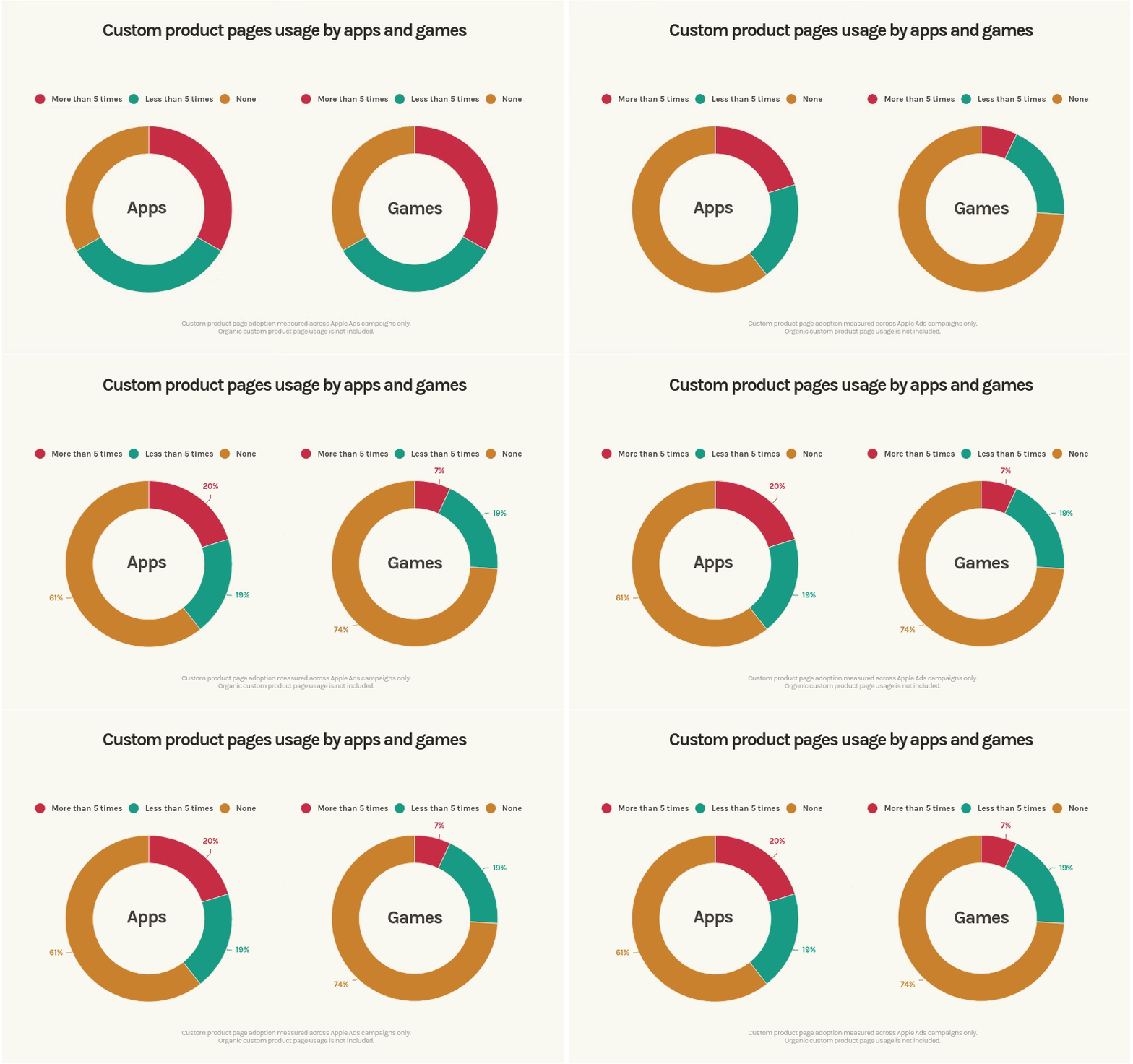
However, almost four years later, AppTweak’s ASO trends and benchmarks data reveals that a vast majority of apps still don’t use custom product pages: in fact, 61% of the top 1000 apps and 74% of the top 1000 games in the U.S. App Store in 2025 did not have a single Apple Ad campaign leveraging custom product pages.
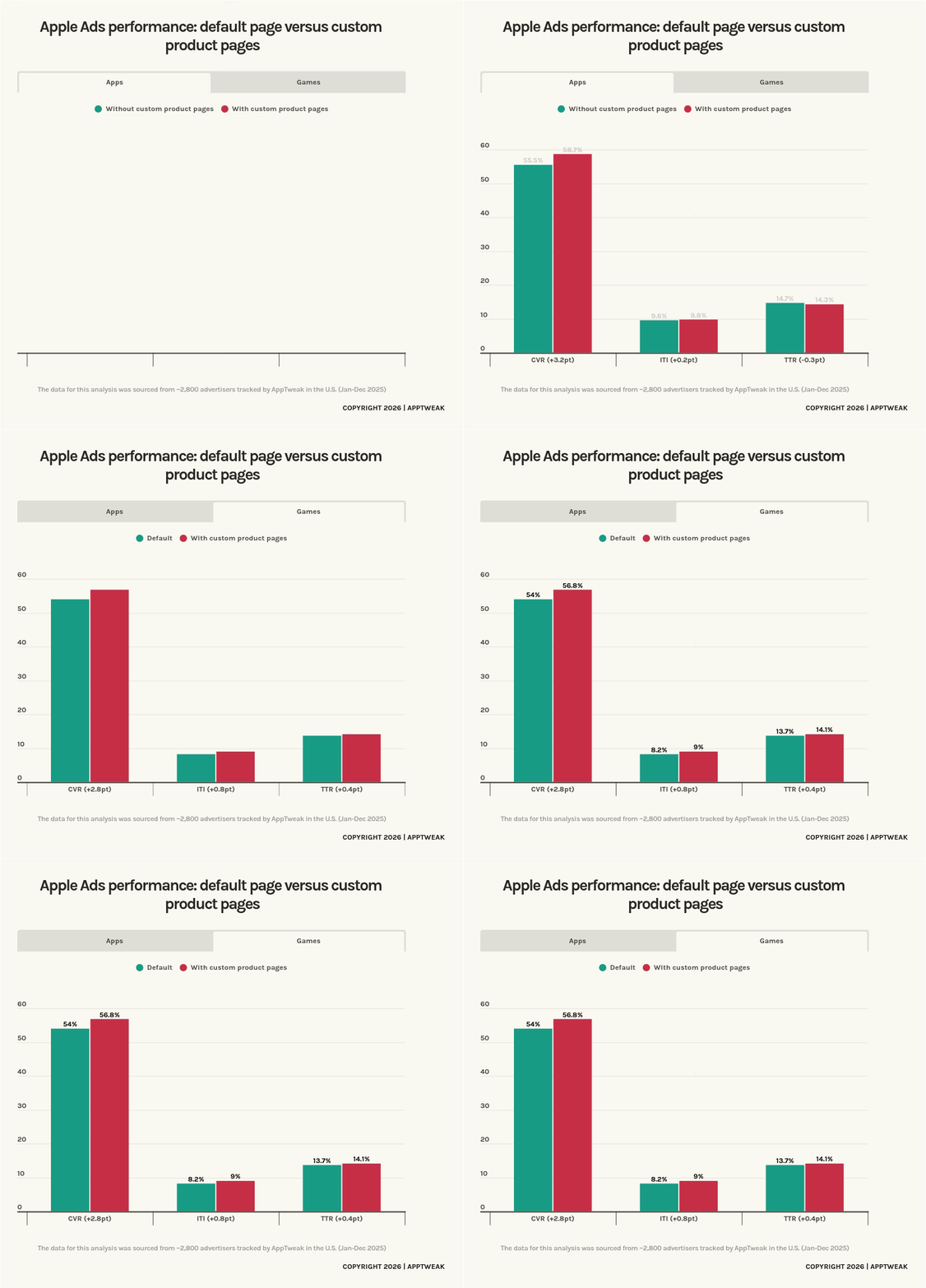
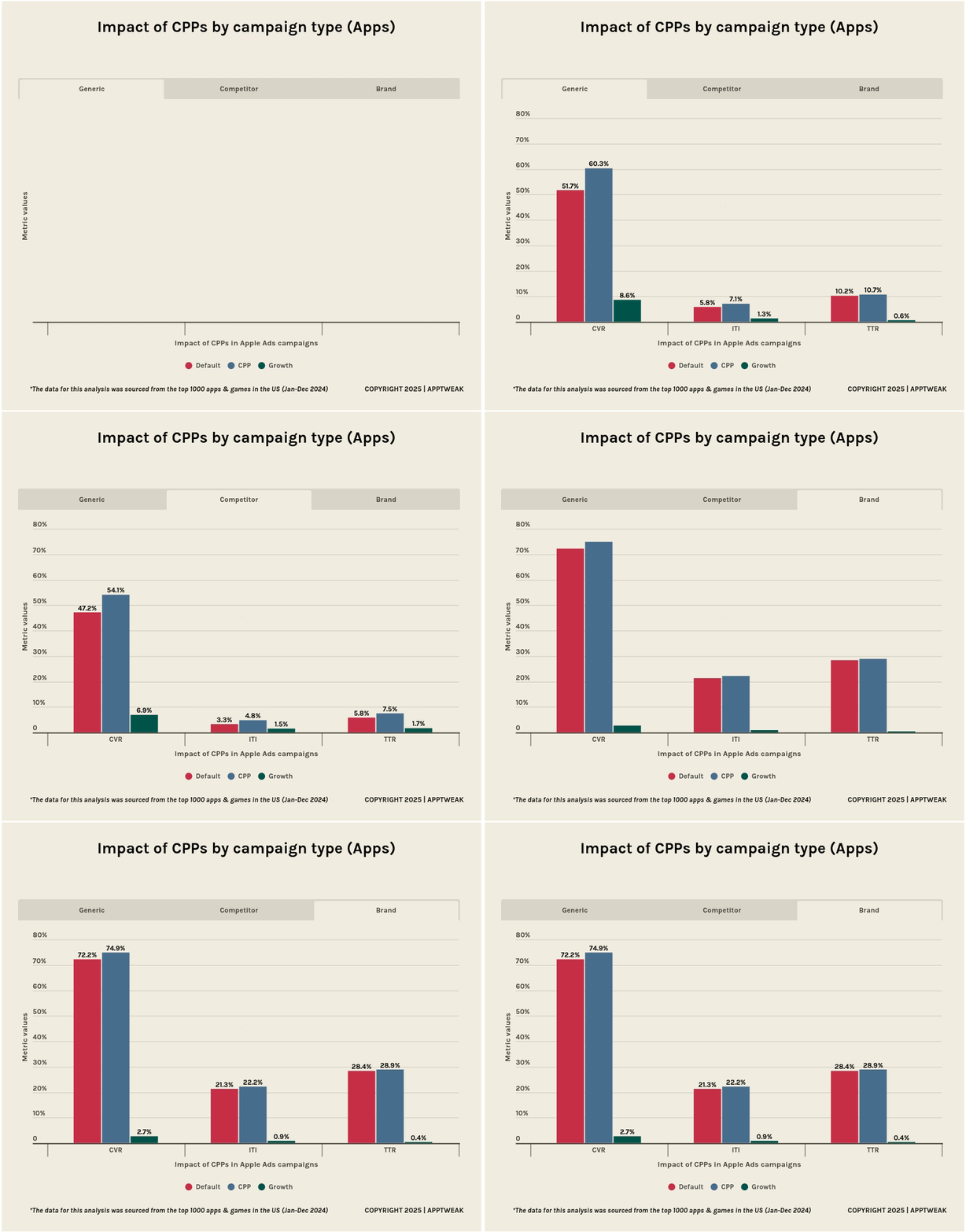
Such limited adoption first came as a surprise to our team, particularly as we observed in the same AppTweak study that ads linking to a custom product page tend to convert better than when relying on the default product page, no matter the type of keyword (brand, competitor or generic) targeted by your Apple Ads search result campaign.
Why are apps not taking advantage of custom product pages?
Our team of consultants reviewed recent experiences with AppTweak clients and analyzed what may hinder the adoption of custom product pages in marketing processes.
What we learned is that despite growing awareness of custom product pages, many ASO teams are still limiting their usage of custom product pages to specific cases that serve as proofs of concept to encourage other marketing teams to collaborate with them. As a result, many marketing teams still don’t integrate custom product pages as part of their “institutional” practices. This means ASO teams are left hearing about certain marketing initiatives late and offering to create a custom product page at the last minute, instead of collaborating early with various teams on a backlog of custom product pages to build.
AppTweak’s CPP Framework
Our team therefore built the following CPP Framework to help our clients address the recurring issue of custom product pages being used only as one-off experiments rather than integrated into broader marketing processes.
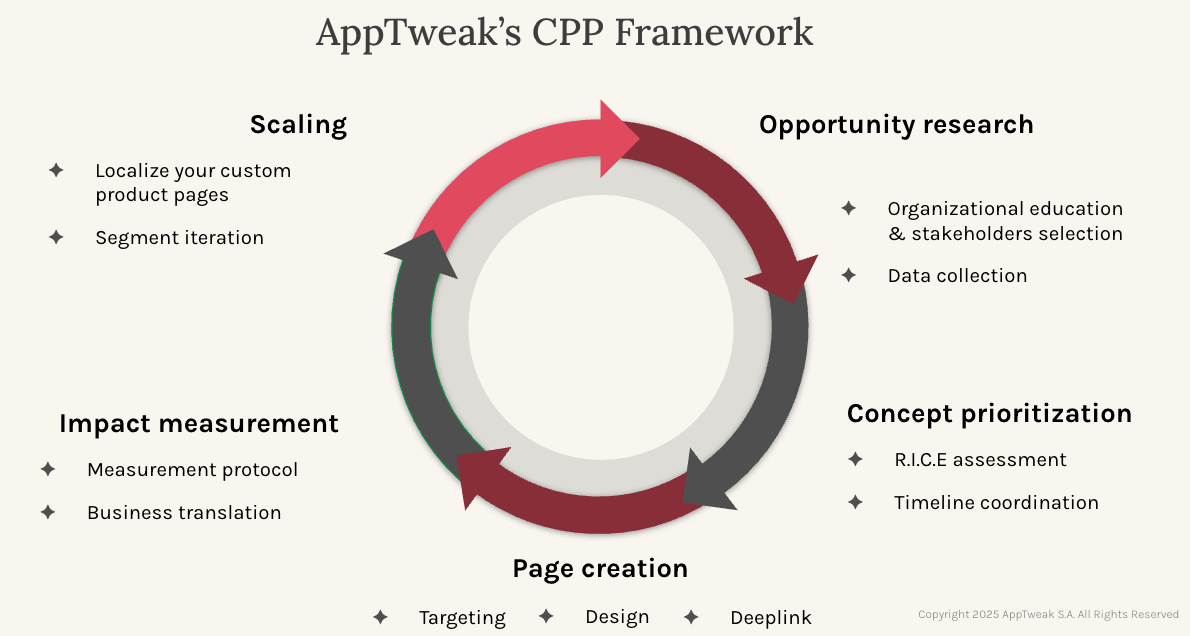
The 2026 CPP Framework follows the same steps as many creative optimization frameworks: opportunity research (ideation) is followed by a prioritization exercise to arbitrate which ideas to execute first, before measuring impact and scaling successful results to their full potential. However, what separates this framework from an overall App Store Optimization creatives framework is how each phase takes into consideration the specificities of custom product pages compared to other ASO tools.
Step 1: Research opportunities with cross-team alignment
Traffic management is probably the most significant differentiator between an app’s default product page and its various custom product pages from a developer’s perspective. As a result, the success of a custom product page always requires attention to be given to how consumers may land on the custom product page.
Consequently, if we assume an ASO team is in charge of the production of all custom product pages, the only traffic source the team oversees and can expect to drive traffic to their custom product pages is organic search, which limits the custom product pages they can build to keywords in the app metadata.
Educate stakeholders early
Educating other marketing teams early about the opportunities offered by custom product pages is therefore an integral part of the process to maximize chances that any custom product page that is built can receive as much traffic as possible:
- Collaborating with the team overseeing Apple Ads campaigns allows the ASO team to build custom product pages for any search query (provided UA budget can be invested) by opposition to only the keywords targeted in the 160 characters of the app title, subtitle and keyword field, and possibly expand to App Store Browse traffic.
- Collaborating with the paid User Acquisition team at large means opportunities to maximize conversion for traffic coming from the web or other apps
- Collaborating with CRM, Growth or even the product team then allows the ASO team to leverage custom product pages as a way to impact not only first-time app installs, but also boost retargeting campaigns and product feature adoptions, particularly when using the deeplinking option available in every custom product page.
For more on this, check out Boosting brand visibility with custom product pages and deep linking.
Expert Tip
While a theoretical presentation about the benefits of custom product pages may not be enough to sway every team to collaborate immediately, we recommend planning a session at least once per year to account for turnover in various teams and opportunities to share success stories and raise interest over time.Map out potential custom product page concepts
Any educational session should be followed by a dedicated moment for stakeholders to express their interest in custom product pages, share future use cases of theirs as well as internal data to help evaluate the priority degree to give their particular need. However, before turning to prioritization, it’s important to map all opportunities within the agreed upon scope for custom product pages. For this remember, there are two ways to identify custom product page opportunities:
- Based on theoretical user segmentation
The most frequent ways to divide an audience according to marketing theory include geographical breakdown (sometimes relevant for custom product pages, though in many cases playing on localization of default product pages should be enough), demographic studies, app usage studies (whether in terms of product feature preferences or content preferences), and psychographics (the study of user internal motivations and drivers to use an app or play a game). - Based on performance data from existing campaigns and traffic sources
Using an ASO tool can help evaluate the size of organic traffic coming from a particular keyword (based on its search volume AND the app organic rank in search results), while current conversion metrics measured by ad networks and MMPs can help confirm whether certain campaigns are under-performing (be mindful to consider particularly when your volume of clicks and not only impressions is indicative of interest, but clicks to installs suggest a failure in converting that interest).
Expert Tip
With AppTweak’s CPP Explorer, you can now view paid custom product pages and the keywords associated with them. This tool gives ASO teams a competitive edge in identifying how top apps leverage custom product pages across markets and keyword strategies, making it easier to uncover opportunities, benchmark your own presence, and maximize visibility of paid strategies.Step 2: Prioritize concepts that will deliver impact
Quarterly data deep-dives are likely to reveal many opportunities to improve performances with the introduction of a Custom Product Page, however not all opportunities are equal in the improvement they may induce. However, with a maximum of 70 custom product pages per app, it is important to prioritize ideas based on their expected outcome before going to the page creation phase.
Try the RICE framework to guide prioritization
To that end, many product management frameworks such as the R.I.C.E framework (Reach, Impact, Confidence, Effort) can help. For instance, when assessing which keywords placed in the app’s metadata may benefit from a custom product page, consider a composite score of:
- Reach: how many impressions can reasonably be expected from linking the target keyword to a custom product page based on its search volume (or maximum reach) as well as the app’s current organic rank
- Impact: what could be the increase in conversion rate after the default page is replaced with a custom product page, and how many incremental installs does this represent? (AppTweak’s conversion rate improvement benchmarks from custom product pages in Apple Ads may help anchor your hypotheses)
- Confidence: how likely is it that the new custom product page will increase conversion (you may consider your app’s current organic rank as an indication of how well it converts compared to current competitors and extrapolate from there)
- Effort: does the creation of a custom product page require a complete overhaul of current product page creatives, or would mere adjustments (such as a simple swap in the order of screenshots in the creative gallery) suffice?
Don’t forget to factor in team constraints and seasonality
Two extra considerations when establishing your priority list for the quarter we advise our clients to always keep in mind are
- How the different factors to a R.I.C.E score can change depending on teams and companies. For example, certain teams are extremely skewed towards impact, even if the effort requested is high, while others may prefer giving extra weight to the effort score and prioritize custom product page concepts that will have short turnarounds.
- It’s important to note that certain custom product page concepts can be tied to specific activation periods and seasonalities.
Step 3: Build custom product pages with traffic and user experience in mind
Building effective custom product pages requires more than strong creatives — it also means ensuring each page aligns with the traffic it will receive and the experience users have after tapping through.
Align traffic sources with each custom product page
As already mentioned in previous paragraphs, the benefits drawn from creating custom product pages are closely tied to the traffic that lands on each custom product page. As a result, this means that whenever a custom product page concept is selected for creation, the creation process not only includes the upload of new videos, screenshots or promotional texts, but also requires all involved stakeholders to make the necessary adjustments to drive traffic to it.
Concretely, this means that a new custom product page focusing on recently released in-app content needs not only specifically-made store assets to highlight it, but also could benefit from ad campaigns or other marketing efforts that are ready in time (and may require extra design efforts).
To make sure no opportunity is missed, we recommend “working backwards” and go back towards the upper part of your acquisition funnel to map all entry points that would be relevant to link to the custom product page.
Use deeplinks to improve post-install experience
Last but not least, while most ASO teams are well aware of design pitfalls to avoid when creating custom product pages (such as the importance to keep store UI best practices for custom product pages user contexts in mind), a specificity of custom product pages to not forget about is the opportunity to deeplink from the store to a particular section of your app.
Because deeplinks often represent extra technical requirements, they appear to still be under-used by most apps that have adopted custom product pages. Nevertheless their value can be substantial as they help ensure users are directed to the most relevant section of the app, thus boosting retention, and often revenue or monetization.
Step 4: Measure custom product page impact the right way
Measuring the true impact of a custom product page requires avoiding common pitfalls and focusing on the right comparison points.
Avoid misleading default-page comparisons
As with most ASO efforts, a frequent challenge to convince multiple stakeholders to incorporate custom product pages in their processes is proving their impact. One of the most frequent mistakes made when attempting to do so is comparing their conversion rates to various other custom product pages or the default page.
While such comparisons are easy to visualize in App Store Connect, they can provide counterfactual data as they do not factor in the weight of traffic quality in the measured conversion rate. In other words, comparing the conversion rate of a custom product page served as the landing page for a new ad campaign launched recently with the conversion rate of the default page does not inform on the actual impact of the custom product page for the campaign in question, and is much more likely to put the focus on the gap in traffic quality between the new ad campaign and the overall traffic arriving on the default page (often heavily driven by brand searches) instead.
How to actually prove the impact of a custom product page
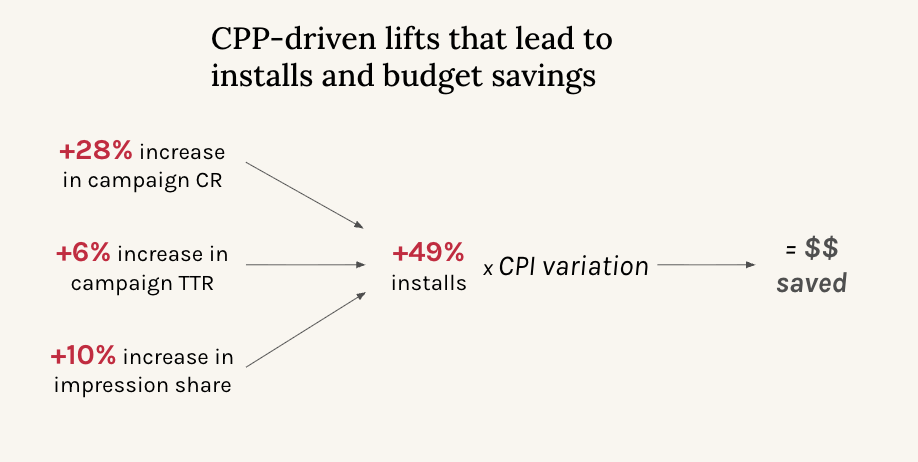
This means that to prove the impact of a custom product page, you will need to conduct a sequential test on the conversion rate for the audience segment being targeted and measure the lift in conversion only for that traffic source before and after the custom product page was released.
While this is easy for Apple Ads campaign (with tap through rate, pageview to install, and impression to install rates all measurable in the Apple Ads console), measuring impact for other sources will often require creating an extra Custom Product Page replicating your default page in order to first measure a conversion rate baseline, before switching to the intended custom product page and measuring the lift it induces.
Last but not least, keep in mind that while this method is more complex, it allows you to measure the impact of a custom product page not only on store-conversions, but also its potential impact on post-install conversions in your MMP. This can help align stakeholders on post-mortem analyses, and help you establish a best practice of communicating the impact of a custom product page not only in terms of team-specific metrics, but also as on core business KPIs.
Step 5: Scale custom product pages to their full potential
Finally, once a custom product page is proven to have a positive impact, it’s important to maximize them before turning to the next experiment.
1. Adjust winning custom product pages to similar segments
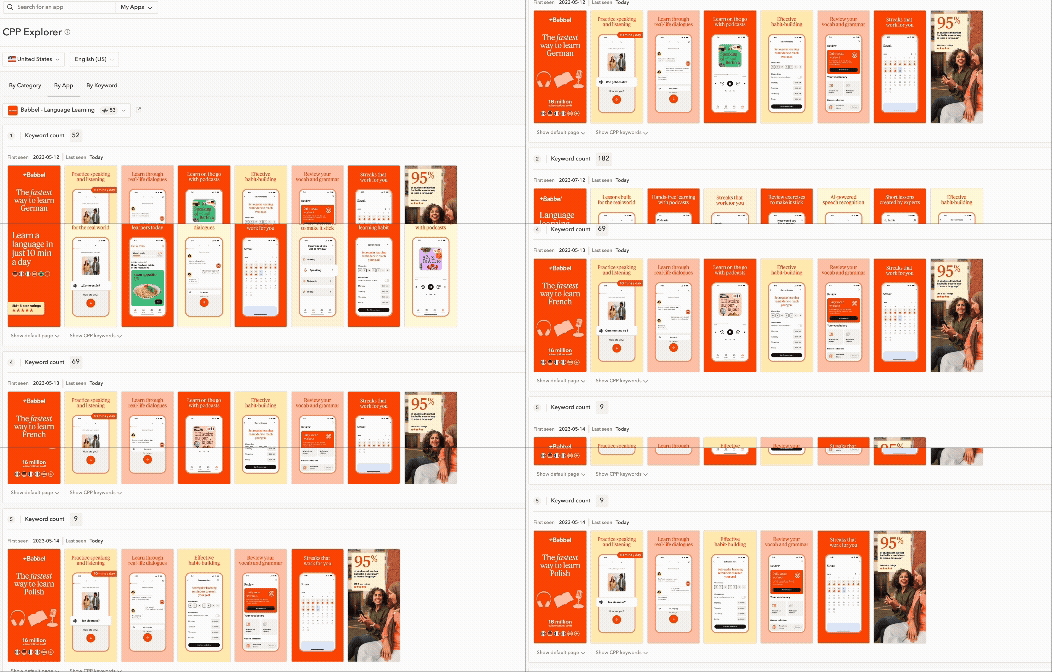
A popular way to do so is to re-use the successful custom product page as a template and adjust it to adjacent segments. This is something done efficiently by language learning app Babbel, which uses multiple variations of the same custom product page concept in Apple Ads, targeting search queries that follow the structure “learn [language name]”. While such strategy can seem quite evident, it has allowed Babbel to build not 1 but 14 different custom product pages and customize screenshots in search results for maximize relevancy.
2. Take winning custom product pages to other markets and languages
A second way to scale custom product pages is to publish them in multiple languages. Whenever a custom product page delivers a performance increase for a particular audience segment, chances are the segment in question exists across multiple markets (and languages).
As a result, building multiple language variants for a single custom product page can be an easy win, and one that will not even take from your maximum amount of custom product pages available in App Store Connect as you will only need to add a language version for the same custom product page when uploading it to App Store Connect.
Expert Tip
See how the top apps are localizing their custom product pages for other markets and segments in AppTweak’s CPP Explorer.Conclusion
Although custom product pages have proven their potential in the four years since their release, their adoption remains a challenge for many organizations that have still to adjust their processes to leverage them to the fullest. Nevertheless, we remain convinced they are a great tool for growth in 2026 and beyond, and one that will only gain in value as advertisers face rising CPIs and campaign optimization challenges with the shifting privacy landscape. Align your teams this quarter with the 2026 Custom Product Page Framework.


More articles in App Marketing, Apple Ads

 Micah Motta