Users are no longer just browsing the app stores or typing keywords into search. More and more, they’re asking AI tools like ChatGPT, Gemini, or Claude what app or game they should download.
That creates a new layer of discovery that app marketers need to understand and optimize for.
But you can’t optimize what you don’t measure.
If you don’t know whether your app shows up in AI-generated answers, how often it’s recommended, or how it’s positioned, you can’t improve it.
In this guide, we’ll break down why you should measure AI visibility for your app, how to measure it in a structured way, and how to connect it to real business impact.
Key takeaways
- AI is becoming a new discovery layer: Users are increasingly asking AI tools what to download instead of browsing app stores. If your app isn’t mentioned, it’s not part of the decision.
- AI visibility is about being recommended, not ranked: Success is no longer about position in a list. It’s about whether your app is included in the answer and how it’s described.
- You need structured measurement, not manual checks: AI visibility must be tracked across a large set of prompts and intents over time. Single prompt checks are not reliable. AI Visiblity platforms like AppTweak are necessary to monitor your progress over time.
- There is no clean attribution model: AI often influences decisions before users reach the app store. You need to combine visibility data with indirect signals like branded search and search-driven installs.
- Start early to build an advantage: The space is still evolving. Teams that begin measuring now will build understanding faster and be better positioned as AI-driven discovery grows.
What is AI visibility for apps
At its core, AI visibility is how often and how well your app appears in AI-generated answers.
In AI-generated answers, your app can show up in two main ways:
- Mentions: your app is named as a recommendation
- Citations: your app, website, or content is referenced as a source
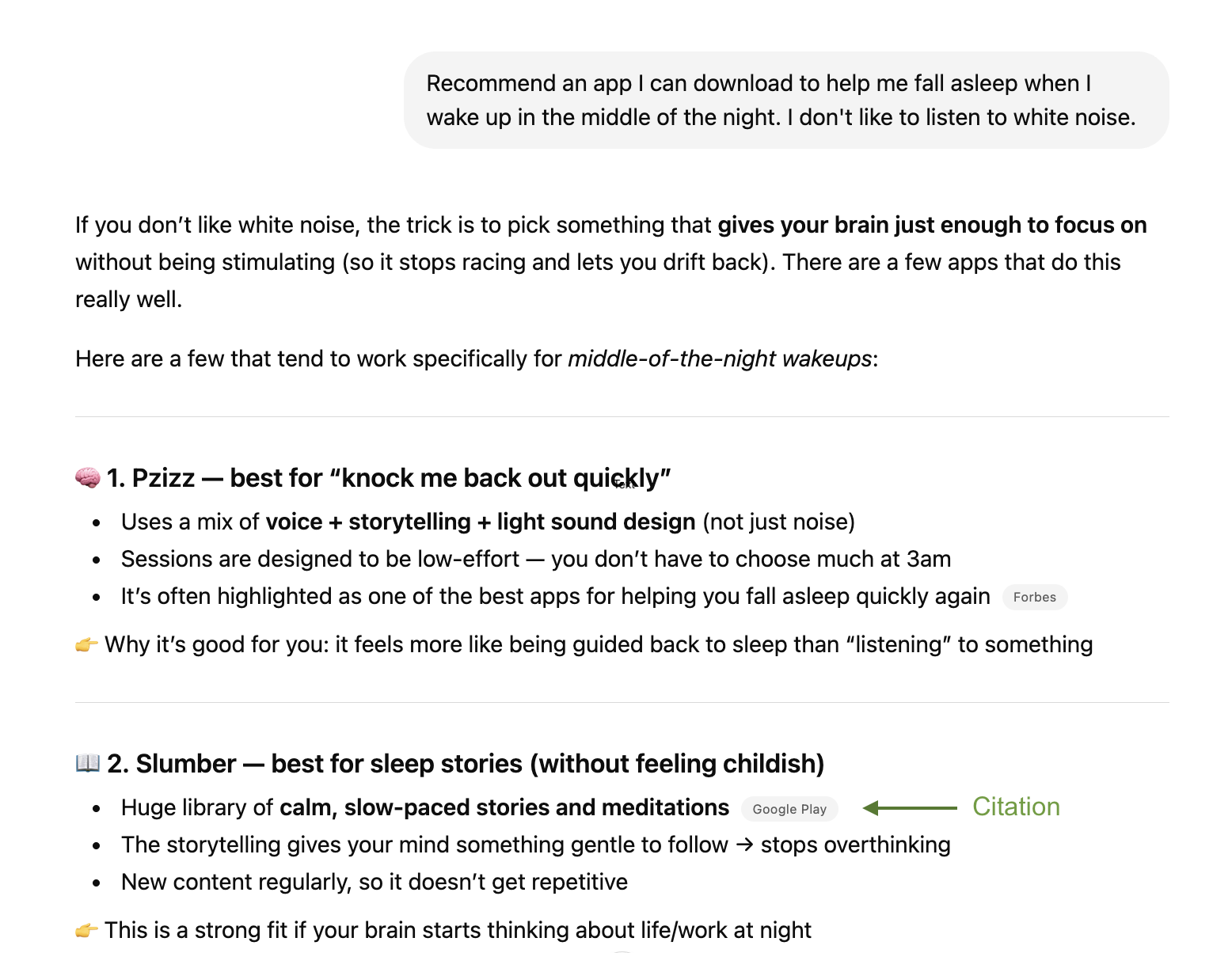
Mentions are what drive awareness. If your app is included in the answer, you’re part of the consideration set. If you’re not mentioned, you’re invisible.
Citations, on the other hand, are what can drive traffic. They give users a way to click through and learn more. But unlike traditional app store search, users often don’t click anything. They read the answer, ask follow-up questions, and shape their understanding within the AI chat. Once they have made up their mind, they open the app stores and download the recommended app.
That is what we call a zero-click environment. That means visibility is no longer just about driving traffic. It’s about winning the mention and ensuring your app is described correctly and positively.
Why you should measure AI visibility for your app
AI is becoming a key part of how people discover apps, which makes it essential to understand where and how your app shows up.
- Discovery is evolving beyond the app stores. People are increasingly asking ChatGPT and other AI tools for recommendations instead of browsing app stores or search results.If your app isn’t surfaced in those answers, you’re invisible in a growing discovery channel.
- It’s not just about ranking anymore, it’s about being recommended. In traditional channels like ASO or SEO, you compete for position. Ranking higher increases your chances of being seen, but even if you’re not at the top you still have a chance to get discovered.AI doesn’t work that way. Instead of showing a long list of options, AI tools usually recommend just a few apps. So the question shifts from: “How high do we rank?” to “Are we included at all?” Being part of the answer matters far more than marginal improvements in position.
- AI shapes perception, not just traffic. AI doesn’t just recommend apps; it describes them. These descriptions shape how users perceive your app before they even engage with it.
This means AI is not only driving visibility, it’s also actively shaping what your app is known for and how you compare to others.
The early mover advantage: why now is the right time to start
AEO (Answer Engine Optimization) or GEO (Generative Engine Optimization) is still in its early stages. Especially for app marketers.
We’ve asked 200 app marketers during a recent webinar where they stand today when it comes to optimizing their apps visibility in AI search:
- 34% haven’t started
- 31% are still researching
- 29% are building a strategy
- Only 6% have something in place
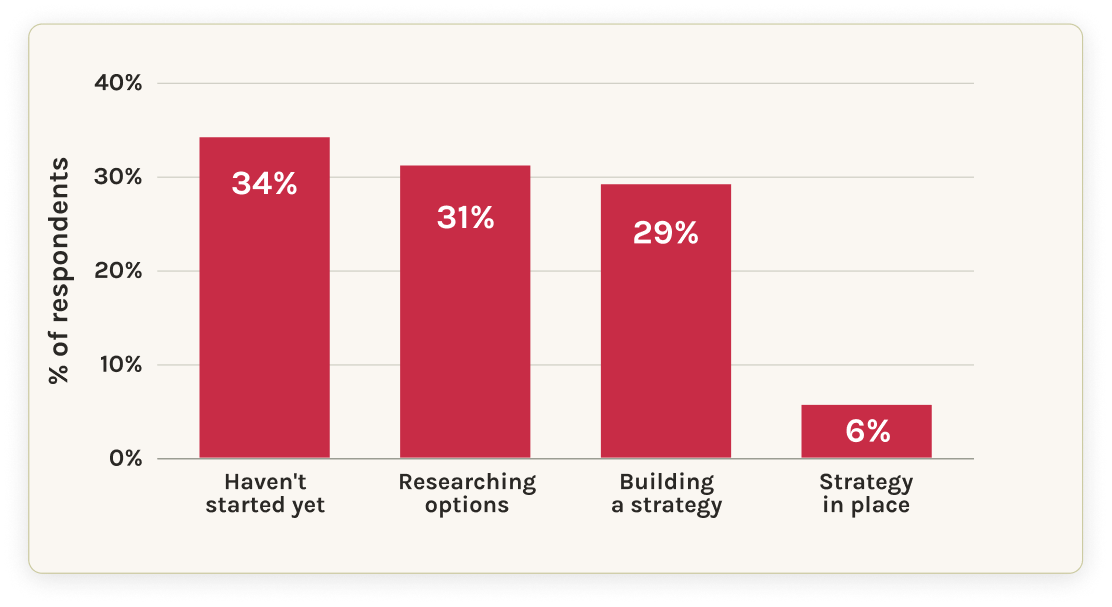
Most teams are still exploring. That means there are no clear best practices yet, and no standard way to measure or report on performance.
But the teams that start now are gradually building their own understanding of how AI recommendations work, what influences visibility, and how it connects to performance. That’s the main advantage right now: learning earlier than others. If you start testing now, you learn what works and build internal knowledge before the space becomes more competitive.
Early channels reward early movers.
How do you measure AI visibility for your app
Why you should not measure your AI visibility via manual prompts
Measuring AI visibility is not as simple as asking ChatGPT a few questions and seeing if your app shows up. Users phrase the same intent in many different ways, and small changes in wording can lead to different answers. What you see in one prompt is just a snapshot, not a consistent view of your visibility.
To measure AI visibility properly, you need a structured approach that looks at a broad set of prompts and tracks how your app appears across them over time.
This is where dedicated AI visibility tools become useful. Instead of checking prompts one by one, they track a large set of prompts on a regular basis (daily or weekly) and give you a consistent view of how often you appear, how you’re positioned, and how that evolves.
How to measure your app’s AI visibility with AppTweak
AppTweak has released a new AI Visibility platform. It is one of the first tools built specifically for apps and games, designed to reflect how users actually search and discover apps.
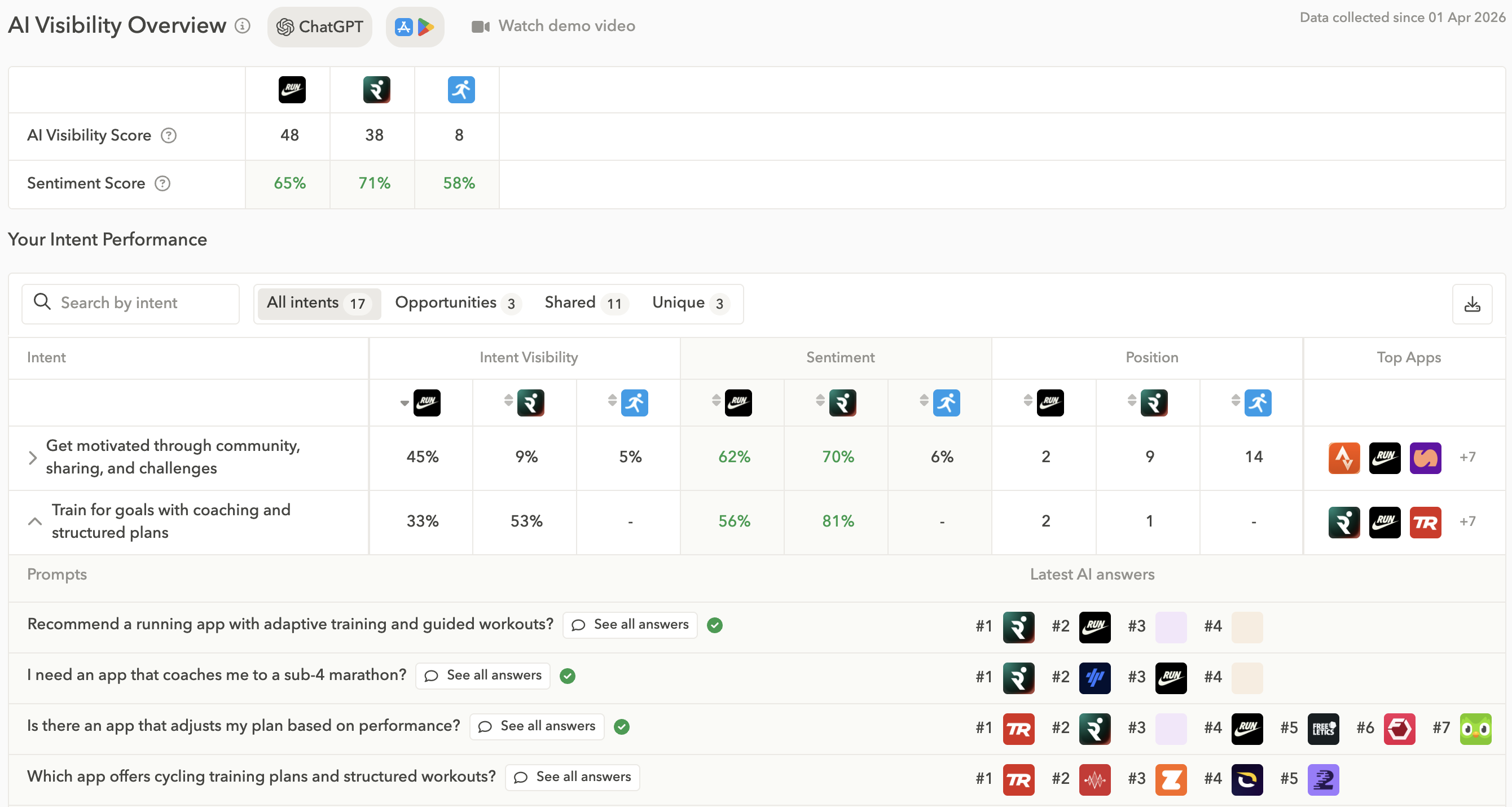
A key part of this is how we define our prompts. Rather than tracking random queries, AppTweak builds prompts based on real user intents. These intents represent the different reasons someone might look for an app like yours.
For example, a fitness app might be associated with intents like:
- tracking workouts
- building muscle
- staying active at home
- improving overall health
Each of these intents is then expanded into multiple prompt variations, reflecting how users naturally phrase their questions when interacting with AI tools.
By structuring prompts this way, you can measure how your app performs across entire use cases. This makes the data much more reliable and easier to act on.
Instead of asking “did we show up for this one prompt?”, you can answer:
- In which intents or use cases are we visible?
- Where are we missing?
- How do we compare to competitors across these intents?
Which metrics to track to measure AI visibility for your app
To measure your AI visibility in AppTweak, you can leverage the following metrics:
- AI Visibility Score: A high-level view of how visible your app is across all tracked intents. It aggregates how often you are mentioned, giving you a clear baseline and making it easy to track progress over time.
- Intent Coverage: This shows where your app appears. It helps you understand which use cases you’re visible in and where you’re missing. In practice, this is often where the biggest opportunities are.
- Position: An aggregated metric to understand in which position your app appears in the AI-generated answers for a certain intent.
- Sentiment: This shows how positively your app is described by AI for the specific intents.
How do you measure the impact of AEO or GEO for your app
Measuring the impact of AEO (AI Engine Optimization) or GEO (Generative Engine Optimization) is fundamentally different from measuring ASO or SEO.
In traditional channels, the model is relatively clear. A user searches, clicks on a result, and installs or converts. You can track that journey, attribute the outcome, and optimize based on it.
AI changes this workflow.
Users don’t just click on a result. They ask a question, get an answer, ask follow-up questions, and gradually form a decision. Then they visit the app stores and search for a specific app or game to download. That makes attribution much more difficult. AI search acts more like an assist channel than a last-click channel.
So instead of relying on a single metric or a clean attribution model, you need to combine different signals to understand its impact.
Direct signals
Direct signals help you understand how traffic and downloads are directly influenced by AI. They won’t give you a complete picture, but they help you validate that AI visibility is translating into real user actions.
- AI Visibility Score: This is your top-level metric to track how visible your app is across AI-generated answers. AppTweak’s AI Visibility Score aggregates how often your app is mentioned across a structured set of prompts and intents. Unlike traffic metrics, this is not an outcome. It is a direct measure of your presence in AI. Tracking how this score evolves over time gives you a clear view of whether your visibility is increasing or decreasing.
- Traffic and downloads from AI-related referrers: You may start seeing referrer traffic coming from sources like ChatGPT, Claude, Gemini etc. in your app store consoles. For many, this traffic is still small, but it’s meaningful to track and monitor over time. Growth in these sources can be an early indicator that your app is being surfaced more often in AI-generated answers.
Indirect signals
In most cases, AI will not appear as a distinct referral in your analytics. Instead, its impact is reflected in how demand for your app evolves, especially through search.
The most useful signals to track are:
- Branded keyword performance. If you use AppTweak, track the volume, max reach and performance of branded keywords such as your app name, common misspellings, and brand variations. This helps you understand whether more users are actively searching for your app after discovering it in ChatGPT or Gemini.
- Traffic & downloads from app store search: Monitor traffic and installs coming from search in App Store Connect and Google Play Console. When users discover your app through AI, they often don’t click directly. Instead, they remember the name and search for it in the App Store or Google Play. That behavior shows up as installs coming from search.
- Conversion rate from app store search: Users coming from AI recommendations are often further along in their decision process, which can lead to higher conversion rates compared to other channels. An increase in conversion rate from app store search might indicate more people are finding your app in AI generated answers.
On their own, these metric doesn’t explain the impact of AI search on your app downloads. But when search-driven installs increase alongside branded keyword demand and your AI visibility score, it becomes a strong signal that more users are discovering your app through AI.
Common mistakes to avoid when measuring AI visibility for your app
Here are the most common pitfalls to avoid when measuring AI Visiblity for your apps and games:
- Tracking AI visibility manually: Checking a few prompts in LLMs might give you a rough idea, but it’s not reliable. Users phrase the same intent in many different ways, and small variations can lead to completely different answers. Manual checks are snapshots, not a measurement system. To measure your app’s AI visibility properly, you need tools like AppTweak that provide a consistent view across a structured set of prompts and intents, so you can track how your visibility evolves.
- Focusing only on traffic to measure the impact of optimizing your AI visibility: AI does not behave like a traditional acquisition channel. A large part of its impact happens before the click. If you only look at traffic or installs, you miss how AI influences awareness, consideration, and positioning.
- Expecting perfect attribution: AI does not provide clean attribution. It often acts as an assist channel, influencing users before they search or install. Trying to attribute installs directly to AI will lead to an incomplete picture. Instead, focus on patterns across AI visibility and brand demand.
Conclusion
AI is changing how users discover apps. If you want to compete in this new environment, you need visibility into how your app shows up in AI-generated answers, not just how it ranks in the app stores.
By tracking your AI visibility across real user intents and connecting it to signals like branded search and search-driven installs, you can start to understand how this new discovery layer influences your growth.
Tools like AppTweak help make AI visibility measurable and trackable over time. Book a demo with our team to learn more!
FAQs
How do you measure AI visibility for an app?
AI visibility is measured by tracking how often an app appears across a structured set of prompts and intents over time. Reliable measurement requires moving beyond manual checks to systematic tracking.
Key components include:
- Tracking multiple prompts per intent to reflect real user behavior
- Monitoring visibility trends over time, not single snapshots
- Evaluating both presence (mentions) and quality (position, sentiment)
AppTweak’s AI Visibility platform structures prompts around real user intents and aggregates results into metrics such as:
- AI Visibility Score
- Intent Coverage
- Position in answers
- Sentiment of descriptions
This approach provides a scalable and consistent view of performance across AI search environments.
Why are manual prompt checks not reliable for AI visibility?
Manual prompt checks are unreliable because AI outputs vary significantly based on phrasing, context, and timing, making single-query observations non-representative of actual visibility. A single prompt only captures one possible answer, while real users express the same intent in many different ways, leading to different AI-generated recommendations.
Without structured tracking:
- Results are inconsistent across prompt variations
- Trends cannot be identified over time
- Competitive benchmarking is not possible
This is why dedicated platforms like AppTweak are necessary to measure AI visibility at scale. AppTweak structures prompts around real user intents, expands them into multiple variations, and tracks how often your app is mentioned across all of them. This provides a consistent, aggregated view of visibility, enabling teams to identify gaps, monitor progress, and compare performance against competitors over time.
How do you prove the business impact of AI visibility?
The business impact of AI visibility is proven by combining visibility metrics with downstream demand signals, since AI influences decisions before measurable actions occur. There is no single attribution model because AI acts earlier in the user journey, shaping awareness and consideration before users reach the app store.
Key signals include:
Direct signals:
- AI Visibility Score trends
- Traffic or installs from AI-related referrers
Indirect signals:
- Growth in branded app store searches
- Increases in search-driven installs
- Changes in demand patterns over time
AppTweak enables this analysis by connecting AI visibility data with app store performance signals in one platform. Its AI Visibility Score provides a consistent baseline of how often your app is recommended across intents, while its broader App Store Marketing & Intelligence capabilities allow teams to track branded keyword growth, search performance, and install trends.
Which tools can help measure and optimize AI visibility for apps?
To measure and optimize app visibility in AI-generated answers you need a dedicated AI visibility platforms. Manual workflows cannot reliably track performance across multiple prompts and intents.
Key capabilities to look for in a tool:
- Structured prompt tracking based on user intents
- Continuous monitoring (daily or weekly)
- Aggregated visibility metrics across prompts
- Competitive benchmarking across the same intents
AppTweak provides one of the first AI visibility platforms specifically built for apps and games, combining structured prompt analysis with metrics like AI Visibility Score and intent coverage to support continuous optimization.


More articles in AI Visibility, Artificial Intelligence (AI)

 Pierre-Antoine Roy