58% of U.S. adults have used an AI assistant to find or choose an app to download. AI app discovery is no longer an emerging trend, but rather the majority behavior.
AppTweak surveyed 1,000 U.S. adults in August 2026 on how they find and choose apps and games, and found that AI search engines now influence multiple points of the user’s discovery journey. Unless otherwise noted, all figures reflect the full sample of 1,000 U.S. adults. Here are the survey results, and what they mean for app growth teams today.
Key takeaways
- 58% of U.S. adults have used an AI search engine at least occasionally to find or choose a new app or game, according to an AppTweak survey of 1,000 U.S. adults. 21% use one half the time or more.
- 34% used an AI assistant at some point before their most recent app download.
- 10% first learned about their most recent download from an AI search engine, level with Google (10.7%), and social media (10.4%).
- When AI recommends an app, 59% still go to the store to check reviews, ratings, or screenshots before deciding.
- 53% named an AI assistant as something they would consider for their next app, second only to the app stores at 63%.
- Among people who use AI to choose apps, ChatGPT and Google Gemini are the two most-used assistants by a wide margin.
58% of U.S. adults use AI to find or choose apps or games
More than half of U.S. adults have used AI to find or choose a new app or game, and 21% do it half the time or more when deciding what to download. Using AI to choose an app is mainstream, not niche. Is your app strategy ready for this new era of discoverability in AI search.
| How often do you use AI to find or choose an app or game? | |
|---|---|
| Never | 41.3% |
| Occasionally | 37.3% |
| About half the time | 9.8% |
| Most of the time | 8.7% |
| Every time | 2.9% |
AI ties Google and social as a first-touch app discovery source
10% of U.S. adults first learned about their most recent app download from an AI assistant, level with Google (10.7%) and social media (10.4%). Store search and personal recommendations still lead, but AI has already drawn even with two of the biggest discovery channels app marketers have optimized for years.
| Where did you first learn about your most recent app or game download? | |
|---|---|
| I searched the App Store or Google Play Store | 20.0% |
| Someone I know recommended it | 17.9% |
| An ad (in an app, on social media, etc.) | 15.6% |
| On a forum or community (Reddit, Discord, etc.) | 13.6% |
| I searched on Google | 10.7% |
| I saw it on social media | 10.4% |
| An AI assistant suggested it (ChatGPT, Gemini, Perplexity, etc.) | 10.0% |
| Somewhere else | 1.8% |
A year ago, AI app discovery was merely an emerging signal on the horizon. Today it’s drawing level with Google and social media as a first point of discovery. Teams pour ad budget into those two channels to be seen. AI visibility deserves the same investment, and the teams who move first stand to gain new users before their competitors.
AI shows up across app discovery, research, and comparison
People don’t rely on AI only for finding new apps. Among people who have used AI while choosing an app, 45.5% were looking for something specific, 27.2% were researching an app they’d already heard of, and 20.7% were comparing apps they were considering.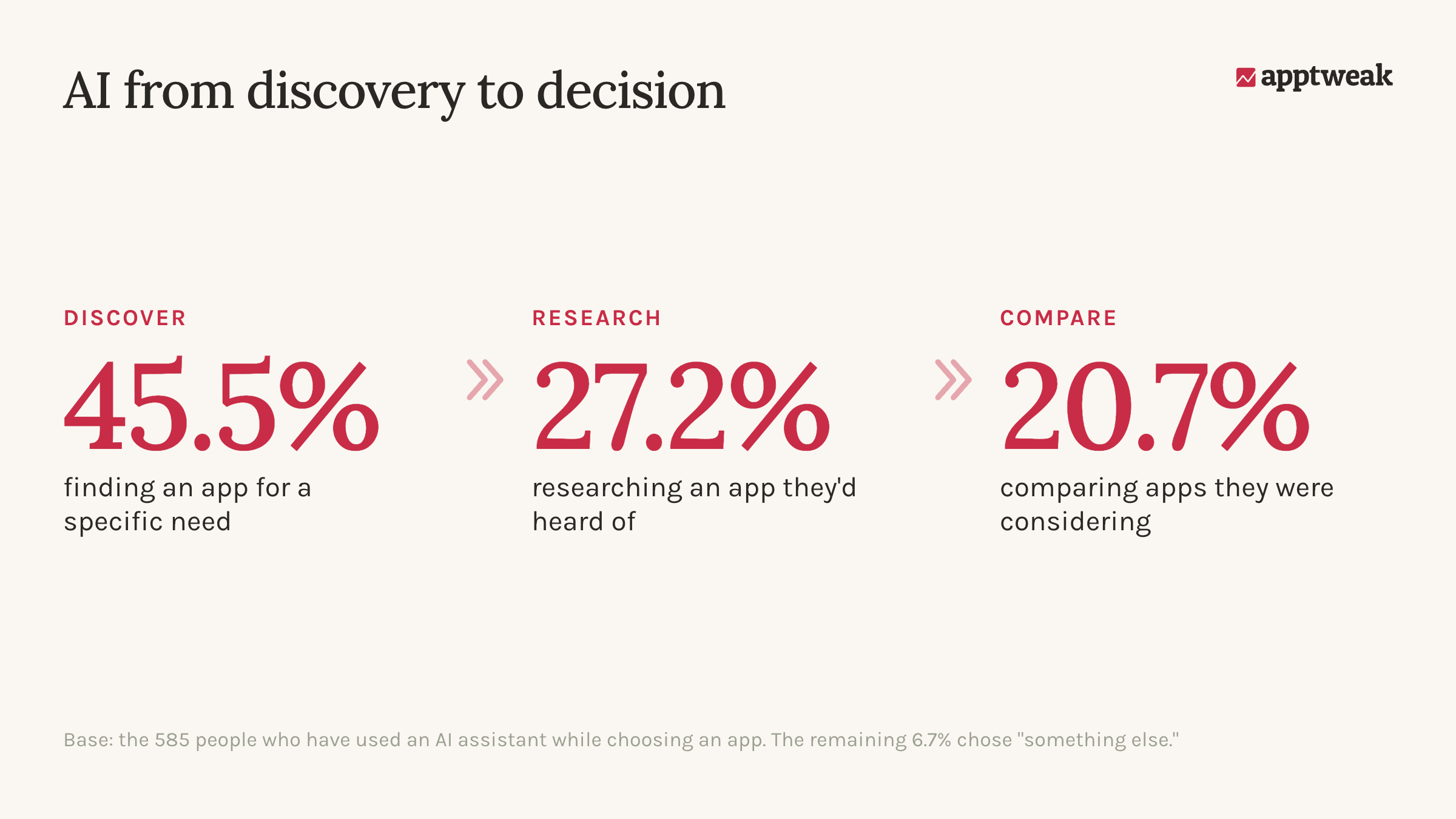
| The last time you used AI while choosing an app or game, what were you trying to do? | |
|---|---|
| Find an app for something specific I needed | 26.6% |
| Learn more about an app I’d already heard of | 15.9% |
| Compare apps I was already considering | 12.1% |
| Something else | 3.9% |
| I’ve never used an AI assistant for this | 41.5% |
Base: the 585 who have used AI while choosing an app; 6.7% chose “something else”.
AI search engines are answering more than users’ questions about a specific need. They are comparing your app to others as well as providing information about your app when queried. As an app marketer, do you know what ChatGPT and Gemini are saying about your app?
People lean toward the AI recommendation over the store’s top result
Asked to choose between an app that an AI assistant recommended and a different app topping store search, more than twice as many people picked the AI recommendation over the store’s top result: 17.3% versus 7.7%.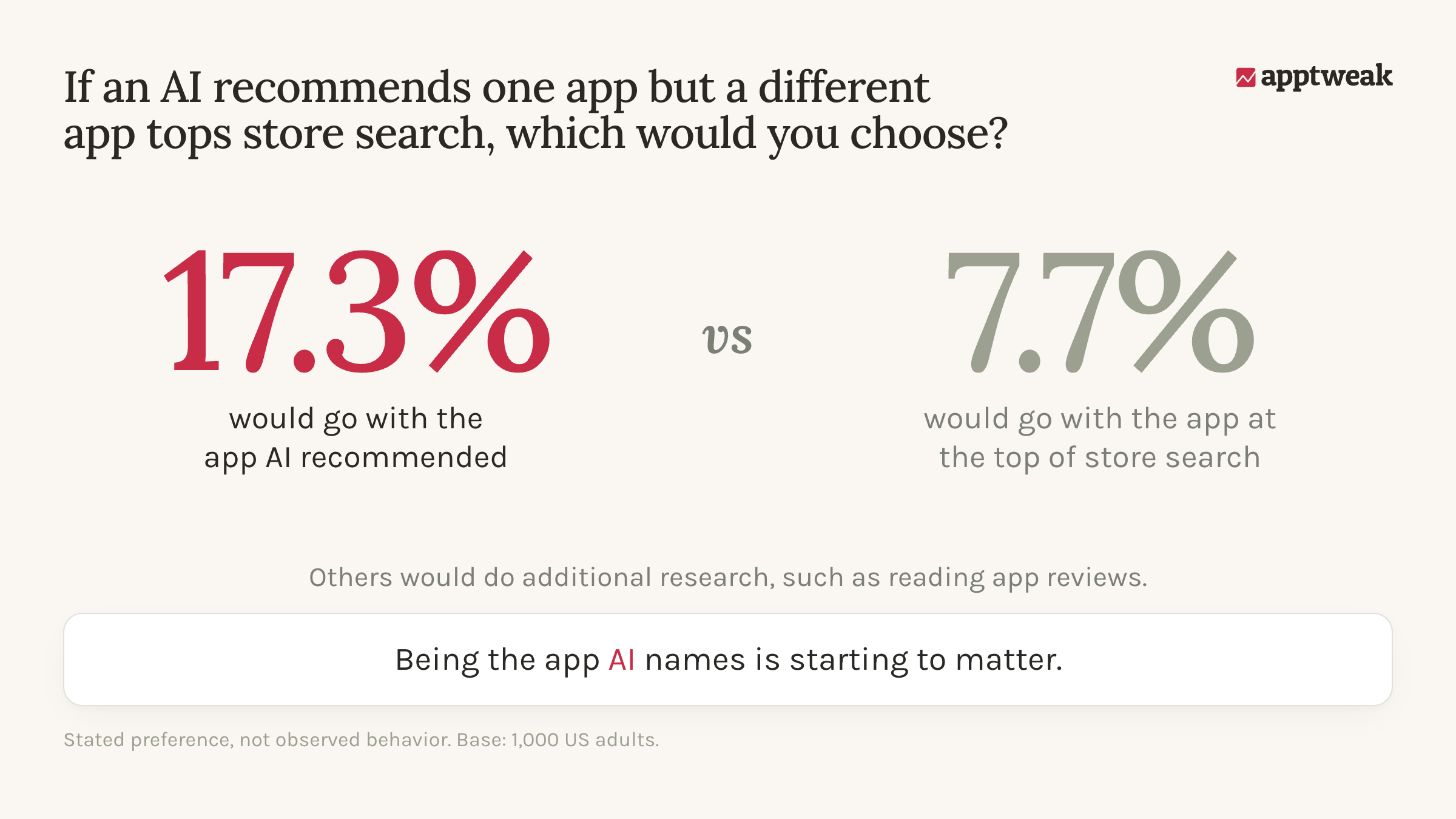
| An AI recommends one app. A different app tops store search results. Which would you pick? | |
|---|---|
| I’d check reviews and ratings before deciding | 69.8% |
| The app the AI assistant recommended | 17.3% |
| The app at the top of the store search results | 7.7% |
| I’m not sure | 5.2% |
These findings dispel the notion that people do not trust AI. For ASO practitioners this means that being the app AI recommends does matter.
59% still check the store before downloading an AI-recommended app
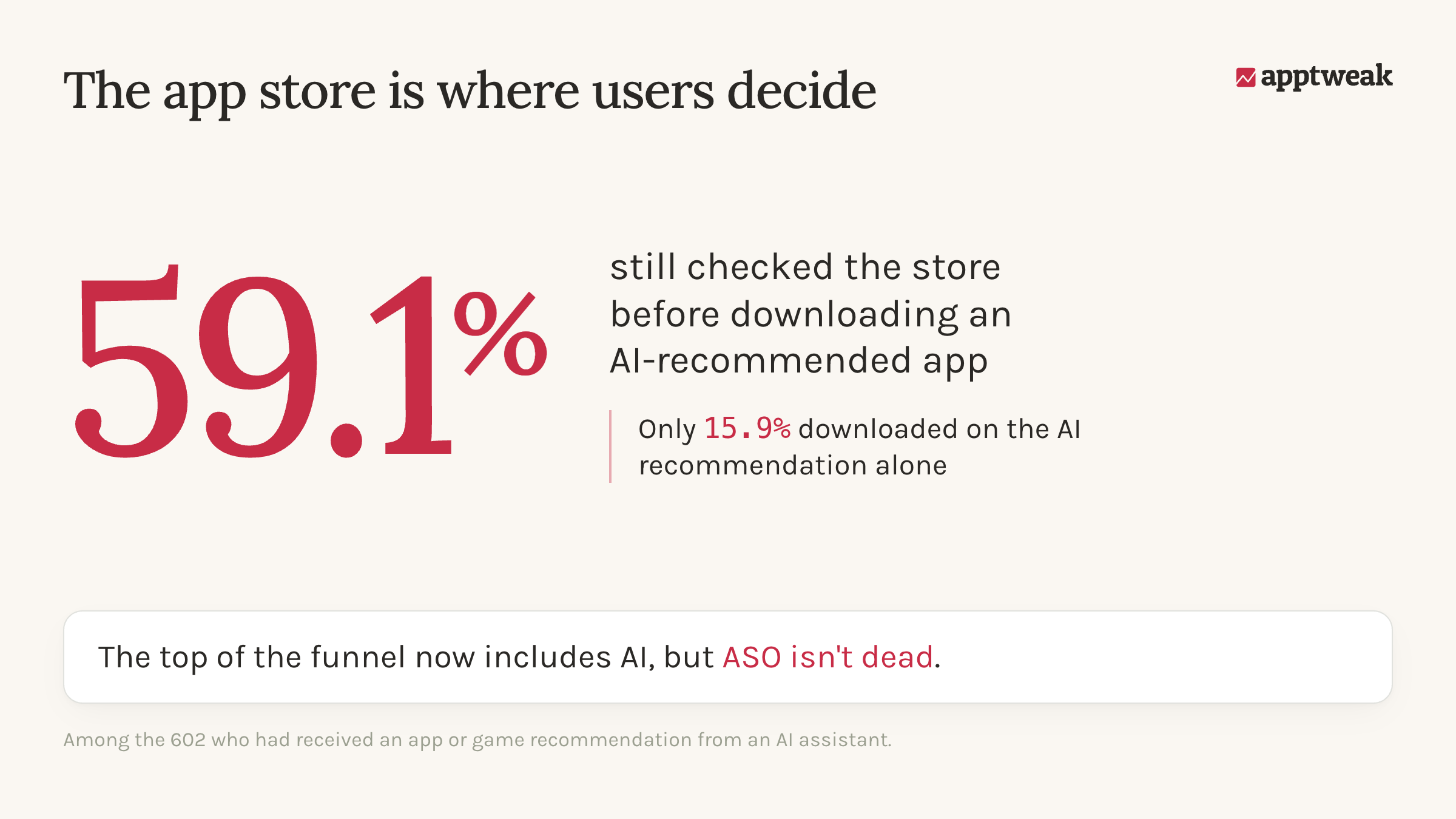
The top of the funnel now includes AI, but ASO isn’t dead. Six in ten people who received an AI recommendation went straight to the store to check reviews, ratings, or screenshots before deciding, and only 16% downloaded on the AI recommendation alone.
| The last time AI recommended an app, what did you do next? | |
|---|---|
| Looked at reviews, ratings, or screenshots on the store before deciding | 35.6% |
| Searched for opinions elsewhere (Google, Reddit, YouTube) before deciding | 10.6% |
| Downloaded it right away, based on the recommendation | 9.6% |
| Didn’t end up downloading it | 4.4% |
| I haven’t had an AI assistant recommend an app or game | 39.8% |
Base: 602 who received an AI app recommendation.
AI can put your app in front of a user, but your store listing still has to close. This is why it’s important to optimize your app store listing for AI and humans.
ChatGPT and Gemini dominate app discovery in AI
ChatGPT is the most commonly used AI assistant for choosing apps and games, at 39.2% of U.S. adults, according to AppTweak’s survey. Google Gemini follows at 30.9%. Claude, Microsoft Copilot, and Perplexity each land in the single digits.
| Which AI assistants have you used when deciding which app or game to download? (Select all that apply) | |
|---|---|
| ChatGPT | 39.2% |
| Google Gemini | 30.9% |
| Claude | 8.3% |
| Microsoft Copilot | 7.6% |
| Perplexity | 2.6% |
| None of these | 44.1% |
If you’re already tracking your app’s AI visibility, that’s a great step ahead of your competitors. However, only tracking one AI search engine means you’re missing part of the picture as we now know that ChatGPT and Gemini carry the overwhelming majority of AI-recommended app choices in the U.S.
For a deeper look at how these assistants actually decide what to recommend, see AppTweak’s AI visibility playbook for apps and games.
The AI visibility playbook for apps
Get strategic frameworks to help you increase your app's AI visibility across three main areas: ASO, SEO/AEO, and communities.
Download nowAI is the #2 place people would look for their next app or game
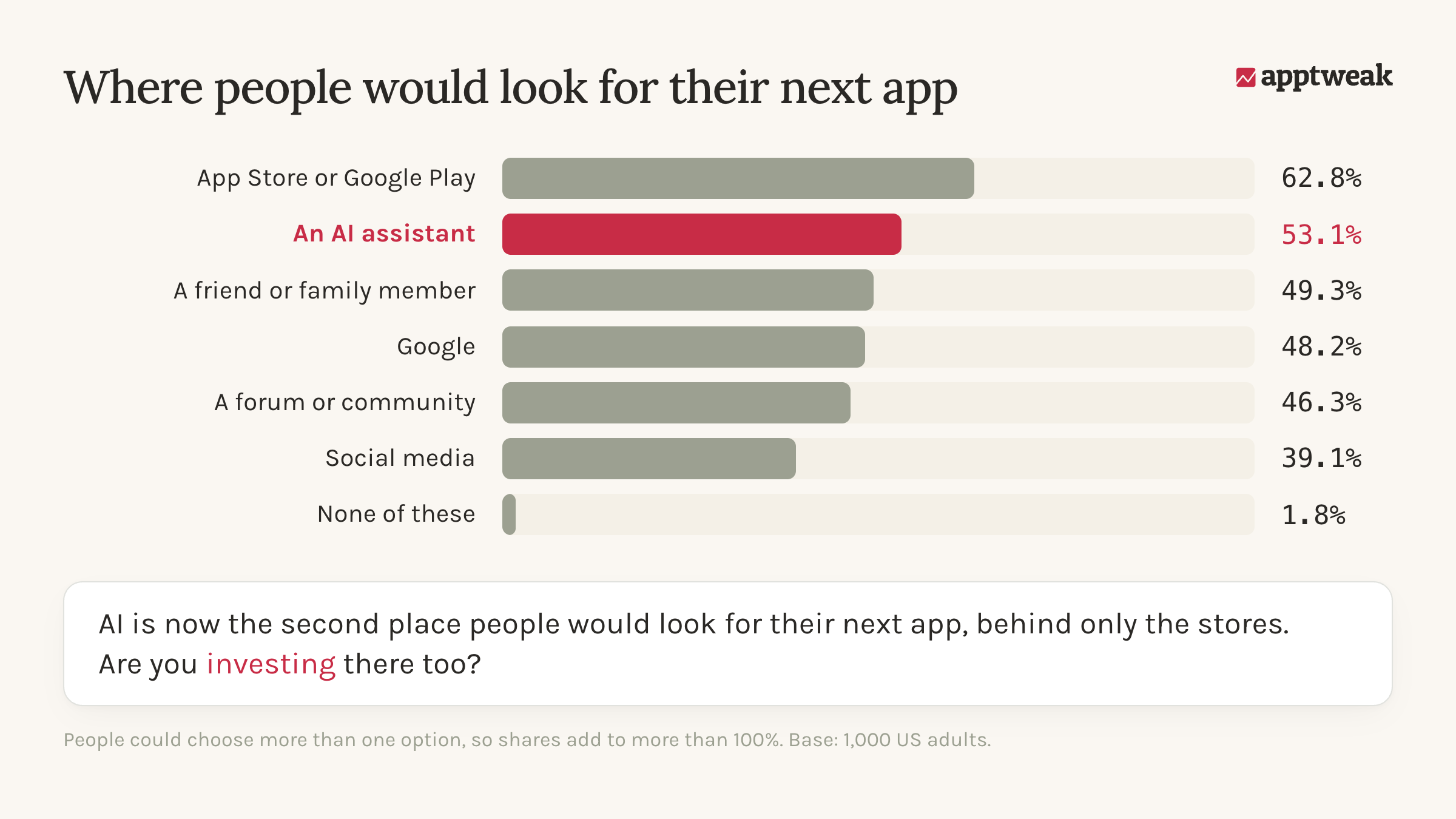
Asked what they would consider using the next time they look for a new app, more people named an AI assistant than Google, friends and family, forums, or social media. Only the app stores ranked higher.
| Which of these would you consider using the next time you look for a new app or game? (Select all that apply) | |
|---|---|
| The App Store or Google Play Store | 62.8% |
| An AI assistant (ChatGPT, Gemini, Claude, etc.) | 53.1% |
| A friend or family member | 49.3% |
| 48.2% | |
| A forum or community (Reddit, Discord, etc.) | 46.3% |
| Social media (TikTok, YouTube, etc.) | 39.1% |
| None of these | 1.80% |
Select-all question so shares sum to more than 100%.
These findings prove ASO is still very much alive and well, but so are AI recommendations. The question for app teams is whether they are investing there too.
To see how AI search engines recommend your app or game, check out AI Visibility for Apps and AI Visibility for Games.
Methodology
AppTweak surveyed 1,000 U.S. adults in August 2026 about how they find and choose new apps and games. Respondents were recruited via Prolific, an opt-in online participant pool, and the sample was matched to U.S. population proportions on age, sex, and ethnicity. Respondents were not told who commissioned the study.
Margin of error is approximately ±3 percentage points on full-sample results, wider on subgroups. Full-sample findings use a base of 1,000. Subgroup findings state their base on the finding: 585 respondents have used AI while choosing an app, 559 have used any AI assistant to choose an app, and 602 received an AI app recommendation. The recommendation-to-verify figures carry a wider margin of error than the full sample.
Caveats:
- All measures are self-reported.
- Findings on individual AI search engines reflect usage as of August 2026 and shift over time.
- Respondents were recruited from an online research participant pool, which skews toward frequent internet users.
- Results are not broken out separately for apps versus games.
FAQs
What percentage of U.S. adults use AI to find or choose apps?
58% of U.S. adults have used an AI search engine at least occasionally to find or choose a new app or game. 21% use one half the time or more, and 41% never do, according to a study performed by AppTweak.
Do people trust AI app recommendations more than app store search results?
Among those who do pick a side, 17.3% would go with the AI recommendation versus 7.7% for the store’s top result, according to an AppTweak survey. And yet most people (70%) say they would check reviews and ratings before choosing between an AI-recommended app and a different app topping store search.This reflects stated preference in a hypothetical scenario, not observed behavior.
Which AI assistants do people use most to find apps?
According to a study performed by AppTweak, ChatGPT and Google Gemini are the two most-used AI search engines for choosing apps, used by 39.2% and 30.9% of U.S. adults, respectively. Claude, Microsoft Copilot, and Perplexity each sit in the single digits.
Does AI replace the app store for downloads?
No. When an AI assistant recommends an app, 59% of people still go to the store to check reviews, ratings, or screenshots before deciding, and only 16% download on the recommendation alone, according to a study performed by AppTweak. The app store remains where the download decision gets made, with AI acting as an upstream discovery and consideration layer.

More articles in AI Visibility, App Market Insights

 Micah Motta


 Pierre-Antoine Roy