App store listings account for nearly half of all sources ChatGPT cites when recommending apps, 47.5% in total. That makes the listing the single highest-leverage surface to optimize if you want your app to show up in AI-generated recommendations.

“App marketers spend significant time and budget on websites, PR, and content marketing. But the surface ChatGPT relies on most is one ASO teams already own and update regularly.”
Alexandra De Clerck, Chief Marketing Officer at AppTweak
Key takeaways
- App store listings make up 47.5% of all sources ChatGPT draws from when recommending an app, more than any website, PR piece, or content page.
- ChatGPT retrieves publicly indexed listing text because it reads as factual and extractable, unlike brand-heavy homepage copy.
- Most listings answer “why download this app”, while AI is asking “what is this app for and when should I recommend it”. Closing that gap is a rewrite, not a rebuild.
- Audience, outcomes, and fit are the three elements most listings leave vague, and where AI has the least to work with.
Why do app store listings carry so much weight in AI recommendations?
When someone asks ChatGPT for an app recommendation, the model retrieves publicly indexed web versions of app store listings, the apps.apple.com and play.google.com pages that are crawlable, structured, and rich with descriptive text.
To an LLM, the app store page functions as a structured, reliable source defining an app’s purpose, audience, and utility. While homepages often prioritize brand-heavy copy, listings offer the factual, extractable data that AI models prioritize when generating recommendations.
The AI visibility playbook for apps
Get strategic frameworks to help you increase your app's AI visibility across three main areas: ASO, SEO/AEO, and communities.
Download nowWhy aren’t most app store pages optimized for AI search?
Most app store pages aren’t optimized for AI search because they were written to convert someone who had already found the app, not to inform an AI model.
So most app store descriptions are written to answer one question: why should I download this app? AI search engines are asking a different one: what is this app, who is it for, and when should I recommend it?
These questions aren’t in conflict. The same clarity that helps a model extract a confident recommendation (a specific audience, defined use cases, concrete outcomes) is what helps a human reader decide quickly whether the app is right for them.
The gap most listings have isn’t a conversion problem or an AI problem. It’s an ambiguity problem. A description that leads with “the ultimate wellness companion” gives an AI search engine almost nothing to work with, and it doesn’t do much for a human reader either. A more useful opening line for humans and AI follows a simple pattern:
[App name] is a [type of app] that helps [target users] [achieve goal] by [core capabilities].
Six ways to optimize your app store listing for AI retrieval?
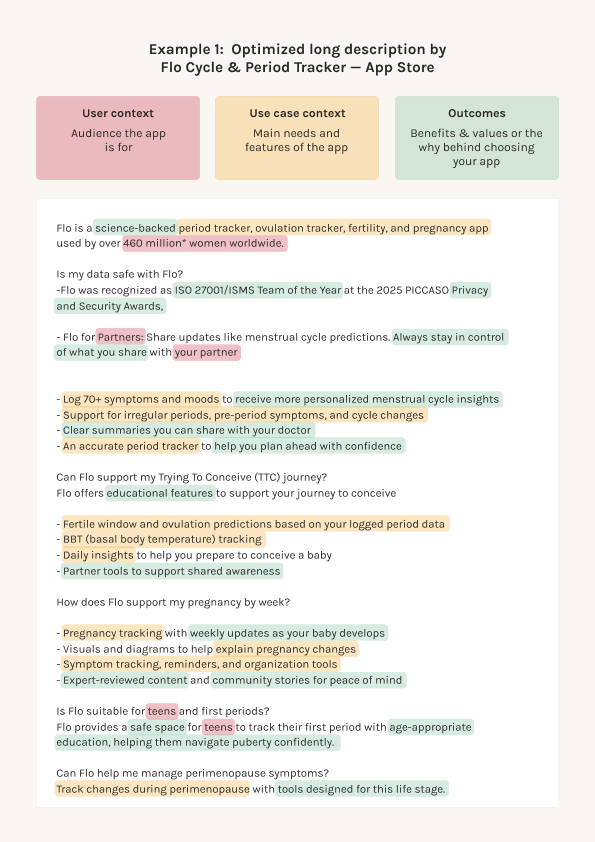
These are six ways to make your listing easier for LLMs like ChatGPT or Gemini to read and extract a clear recommendation from. The examples below are pulled from Flo, the period tracking app.
- Define your audience immediately. The opening line should tell AI and users exactly who the app is for. Flo’s opening line: “Flo is a science-backed period tracker, ovulation tracker, fertility, and pregnancy app used by over 460 million women worldwide.”
- Reinforce a focused set of use cases. Claiming every possible use case creates weak associations in AI systems. Pick the three to five use cases that matter most and reinforce them consistently. This is also just good ASO practice.
- Cut vague positioning language. “All-in-one,” “revolutionary,” and “ultimate platform” describe brand perception, not functionality. “Track ovulation, fertility, pregnancy, and cycle symptoms in one app” is more useful to a model than “your complete health companion.”
- Connect features to outcomes. “Track symptoms and moods” tells AI what the app does. “Track symptoms and moods to better understand cycle patterns and predict periods more accurately” tells AI what the app does and why a user needs it.
- Use question-style formatting where it fits. AI search engines retrieve question-and-answer content well because it mirrors how users prompt them. Flo structures its long description around questions like “Can Flo support my Trying To Conceive journey?” followed by a direct answer. Airalo does the same for eSIM FAQs.
- Add specifics that build trust. Certifications, user numbers, and expert-reviewed content help AI build a more confident picture of your app. “Your privacy matters to us” is easy to ignore. “Flo was recognized as ISO 27001/ISMS Team of the Year at the 2025 PICCASO Privacy and Security Awards” is something a model can retrieve and cite.
How can you audit your app store listing for AI optimization?
Before rewriting anything, check your current description against these five elements. For each one, ask whether your app store page answers the question clearly.
| Element | What to clarify | Example |
| Audience | Who the app is for | “Budgeting app for students and young professionals” |
| Use case | What problem it helps solve | “Track subscriptions and recurring expenses” |
| Features | How the app works | “Shared expense tracking, bill reminders, and spending insights” |
| Outcomes | What users gain | “Stay on top of monthly spending and avoid missed payments” |
| Fit | The situation the app is best suited for | “Ideal for roommates, couples, or anyone managing shared finances” |
Most listings handle features well but leave the audience, outcomes, and fit vague. Those are also the elements AI most needs to make a recommendation, so that’s where the biggest opportunity is.
Conclusion
App store listings are where ChatGPT tends to draw information from. Making yours easier to read and extract from is a reasonable first step, and the content likely already exists. It usually just needs to be restructured.
For ASO practitioners, app store listings were already your most important owned surface. They’re now doing a second job most teams haven’t accounted for yet.
The listing is one of four experiments AppTweak recommends for improving AI visibility. The rest cover your website structure, earning citations from sources LLMs trust, and building community presence.
For the full picture, including how your website and external sources factor into AI recommendations, see AppTweak’s AI visibility playbook for apps and games
FAQs
Do app store descriptions have an impact on AI app recommendations?
Yes. App store listings account for 47.5% of the sources ChatGPT cites when recommending apps, more than any other source type, based on AppTweak’s snapshot analysis of 125,000+ ChatGPT responses across 9,489 app prompts in the US market. A clear, well-structured description directly affects whether and how confidently your app is recommended. AI engines retrieve publicly indexed listing text because it reads as factual and extractable, unlike brand-heavy homepage copy. The App Store contributes 38% of citations and Google Play 9.5%. Structuring your description around audience, use cases, and outcomes gives models more to retrieve and cite.
How do I optimize my app description for AI search?
Write it so a model can extract three things without guessing: who the app is for, what it does, and when to recommend it. This matters because app store pages account for 47.5% of the sources ChatGPT cites when recommending apps, based on AppTweak’s analysis of 125,000+ ChatGPT responses across 9,489 app prompts in the US market (May 2026).
Implement these 6 best practices to optimize your app description for AI search engines::
- Open with a positioning line, not a tagline. Use the pattern: [App name] is a [type of app] that helps [target users] [achieve goal] by [core capabilities].
- Name the audience and the situation the app fits. “For roommates, couples, or anyone managing shared finances” is retrievable. “For everyone” is not.
- Commit to three to five use cases and repeat them. Claiming every possible use case creates weak associations; a focused set creates strong ones.
- Swap positioning adjectives for functions. “Track ovulation, fertility, pregnancy, and cycle symptoms in one app” is extractable. “Your complete health companion” is not.
- Tie every feature to an outcome. A feature tells a model what the app does. A feature plus outcome tells it why a user would need it, which is what a recommendation requires.
- Add verifiable specifics. User counts, certifications, and expert-reviewed claims give a model something concrete to cite. “Your privacy matters to us” gives it nothing.
Most descriptions already handle features well. Audience, outcomes, and fit are where the gaps usually sit, and where AI has the least to work with.
Which matters more for AI visibility: Apple App Store or Google Play?
Based on AppTweak’s US market analysis, the App Store carries more weight, accounting for 38% of ChatGPT citations versus 9.5% for Google Play. Together they make up 47.5% of all cited sources when ChatGPT recommends apps. Both are worth optimizing, but Apple’s listing currently has more influence on ChatGPT recommendations. Because AI engines retrieve publicly indexed listing text, the same principles apply to both stores: define the audience, commit to a focused set of use cases, and connect features to outcomes. Keeping positioning consistent across both listings strengthens how clearly models associate your app with specific user intents.
How often should I update my app store listing for AI optimization?
There’s no fixed cadence. Treat it the same way you’d treat any ASO asset: review it whenever you update positioning, launch new use cases, or notice ambiguity creeping back into the copy.


More articles in Advanced ASO, AI Visibility, Artificial Intelligence (AI)

 Pierre-Antoine Roy