In an AppTweak poll of 200 app marketers, only 6% said they have a defined AI visibility strategy.
Meanwhile, AI search engines now account for 56% of global search activity, and AI-driven traffic grew 527% year over year. The gap between where discovery is heading and where most teams are focused is widening fast.
Today, we’re publishing our first guide dedicated entirely to this shift.
The AI visibility playbook for apps
Get strategic frameworks to help you increase your app's AI visibility across three main areas: ASO, SEO/AEO, and communities.
Download nowIt’s the first resource of its kind built specifically for app and game marketers—not adapted from web SEO frameworks, but grounded in how app discovery in AI search actually works.
What’s inside
The playbook draws on AppTweak’s analysis of 125,000+ ChatGPT recommendation responses across 9,489 app prompts and 9,000+ game prompts to surface emerging patterns, as well as actionable steps teams can take now to increase AI visibility.
Here’s what you’ll have access to:
- How AI search engines decide which apps to recommend. Learn about the two inputs that drive every AI recommendation and the efforts you can take to influence both.
- Early research from AppTweak. App store listings account for nearly half of all sources ChatGPT cites when recommending apps. Apps and games are surfaced differently. And positioning consistency across sources matters more than any single tactic.
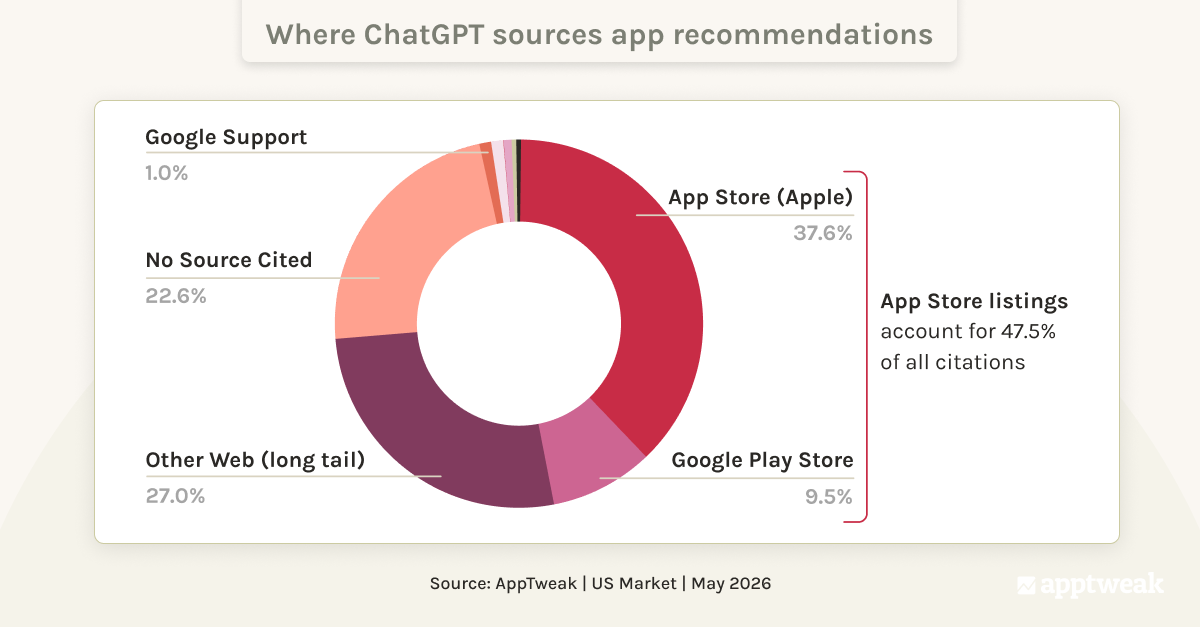
- A three-part framework for AI visibility. See which app store, owned web content, and external authority signals matter for AI visibility and learn the three work together for greater overall AI recognition.
- Four experiments to run now. We provide you with four solid experiments AppTweak experts are recommending to clients to try to increase their AI presence.
- How to measure AI visibility. You’ll walk away from this guide knowing what a baseline looks like, and why manual prompt checks create blind spots rather than fill them.
- Apps and games surface differently in AI search. One of the clearest findings in our research is that apps and games don’t get recommended the same way. App discovery is intent-driven and use-case-focused. Game discovery is experiential; think genre, IP, mood, and similarity to known titles. The playbook covers both, including what that difference means for your strategy.
Download our AI visibility playbook for apps & games to kick start your AI visibility strategy before your competitors do.
FAQs
Is it too early to act on AI visibility ?
The teams measuring and improving AI visibility now will be harder to displace later. AI recommendation patterns reflect signals built over time. Early movers have a structural advantage.
Does this playbook apply to Google Play or just the App Store ?
The playbook covers signals relevant across both the App Store and Google Play, with notes where the approach or effort differs.
Does AI visibility replace ASO ?
No. App store optimization remains foundational, and app store listings are actually among the most-cited sources in AI-generated recommendations. AI visibility extends your ASO strategy; it doesn’t replace it.
How do I increase my mobile app’s visibility in LLMs like ChatGPT, Claude or Gemini?
To increase a mobile app’s visibility in LLMs like ChatGPT, Claude or Gemini, focus on making your app easy for AI search engines to discover, understand, trust, and recommend. In short, LLMs tend to surface apps that have a unique positioning, a crawlable and content-rich website, clear and AEO optimized app metadata on your app store listing, strong third-party validation, and fresh and trustworthy web pages. AppTweak’s AI visibility playbook for apps and games provides a complete framework for AI search visibility and provides four experiments (generative engine optimization tactics for apps) you can try now to enhance your AI search engine presence.

More articles in AI Visibility, App Market Insights, Artificial Intelligence (AI)

 Micah Motta

 Pierre-Antoine Roy