A couple weeks ago, Google held its annual I/O conference, which was marked by a plethora of AI-related announcements across the entire Google product ecosystem. Google Play was no exception this year, as Google officially started mentioning a feature first spotted in Google Play release notes several months ago: Ask Play.
Beyond this headline announcement, Google also showcased a series of improvements for both consumers and app publishers, ranging from new app discovery surfaces to an upcoming developer console analytics revamp. Here’s a comprehensive recap for ASO practitioners if you’ve missed it or need a reminder.
Key takeaways
- Ask Play, Google’s Gemini-powered chat interface embedded in Google Play store listings, draws answers from both your Play Store description and your app’s own website, making consistency between the two a direct factor in how accurately and favorably your app is represented
- For conversational search queries, Guided Search and AI-generated listicles now occupy the first two to three screens of Google Play results, pushing traditional organic results to the fourth screen or beyond, which reduces the traffic value of high keyword rankings for broad queries
- The Gemini standalone app can now recommend and install Android apps without opening Google Play, signaling that AI-driven discovery is expanding beyond the Play Store itself
- AI features on Google Play are currently limited to English-language devices, with EEA markets significantly behind, and results vary day to day due to server-side personalization and A/B testing
- Store listing metadata is now parsed by language models as well as read by users, so front-loading specific, structured information matters more than it did under keyword-ranking logic alone
- Traditional keyword rankings still function as a relevance signal that AI draws on when generating recommendations, but average rankings across semantic clusters are becoming more meaningful than individual keyword positions
Ask Play: Gemini is now reading your store listing to answer user questions
Ask Play was first introduced in December 2025 as the Gemini-powered chat interface embedded in Google Play, appearing on store listing pages. It is meant to give users answers to questions they may have about an app directly on the listing, and can even suggest questions such as how a game mode works, whether there’s a free version, what the core features are.
The first detail that stood out to our team when inspecting this feature is that it works for both installed and non-installed apps. That detail matters: it isn’t only a retention feature, but actually part of how Google wants to allow prospective users to evaluate any app before they ever tap install.
Where Ask Play gets its information
The short answer is: primarily your store listing, but not exclusively.
When a user asks Ask Play about an app, the AI draws first from the description and key features in your Google Play listing. But it doesn’t simply copy and paste. It can reorder information, rephrase your copy, and prioritize content from the top of your description over anything buried further down.
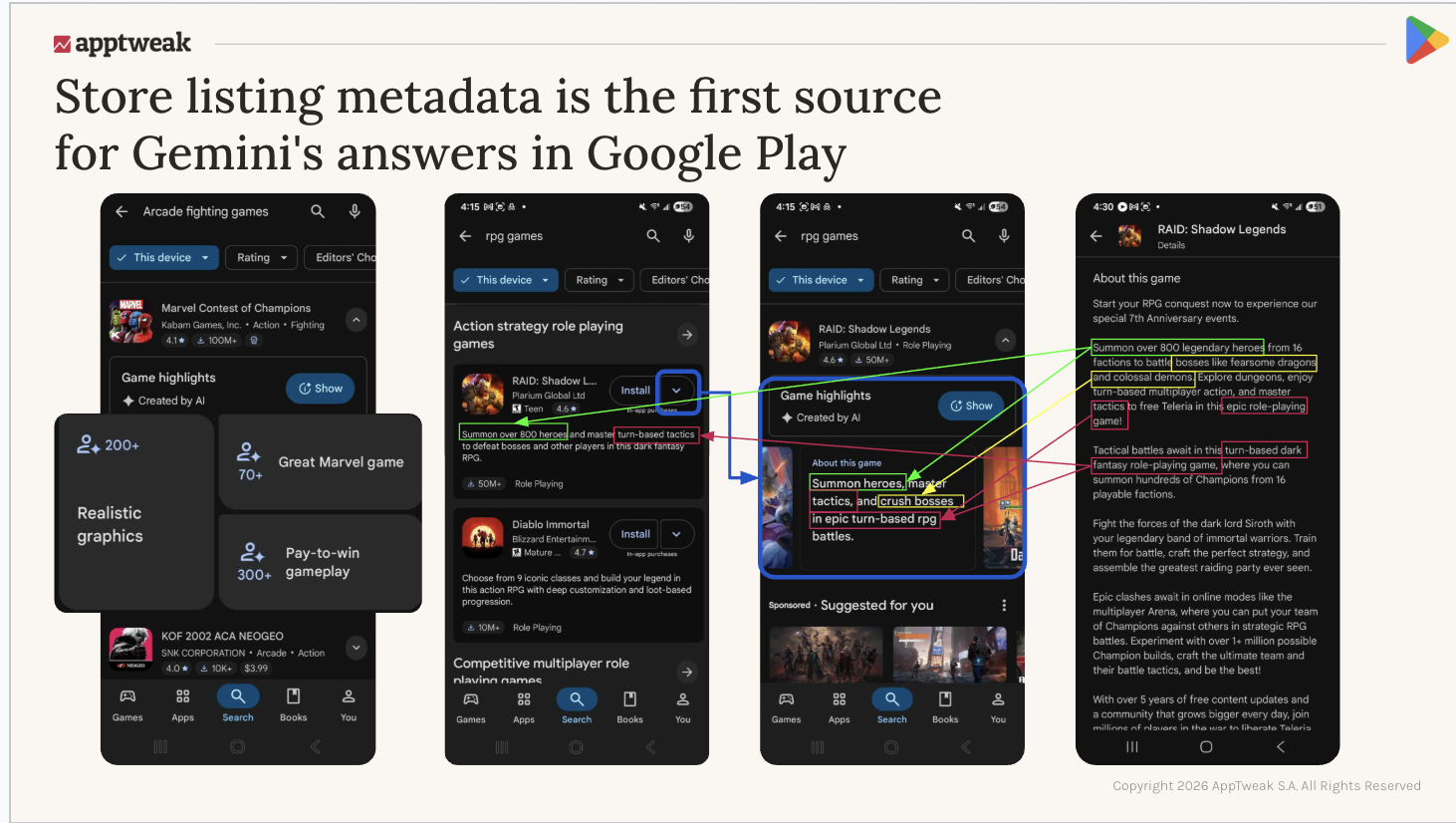
It also reaches beyond the Play Store. We’ve found that Ask Play pulls from an app’s own website, particularly for gameplay mechanics, feature explanations, and factual Q&A-style questions. When we tested Marvel Contest of Champions, questions like “How does Basic Combat work?” were answered using content from the game’s own website pages, not the Play Store listing at all.
The implication is easy to overlook: your store listing and your website now need to tell the same story. If your Play Store description frames your app one way and your website frames it another, you’re handing the AI contradictory signals. Of course, you can use different arguments or go into more details on either surface. But consistency across surfaces you own is quietly becoming a discoverability factor, as AI needs to ground its information. For a deeper dive, check out our blog: How AI is changing relevance in app store search.
Ask Play in search results: the bigger ASO story
While Ask Play’s invocation on store listing pages got a fair amount of attention at I/O 2026, we were surprised to note Google did not insist on the more consequential change happening in search results: Google continues to enrich top results with AI-powered previews and listicles.
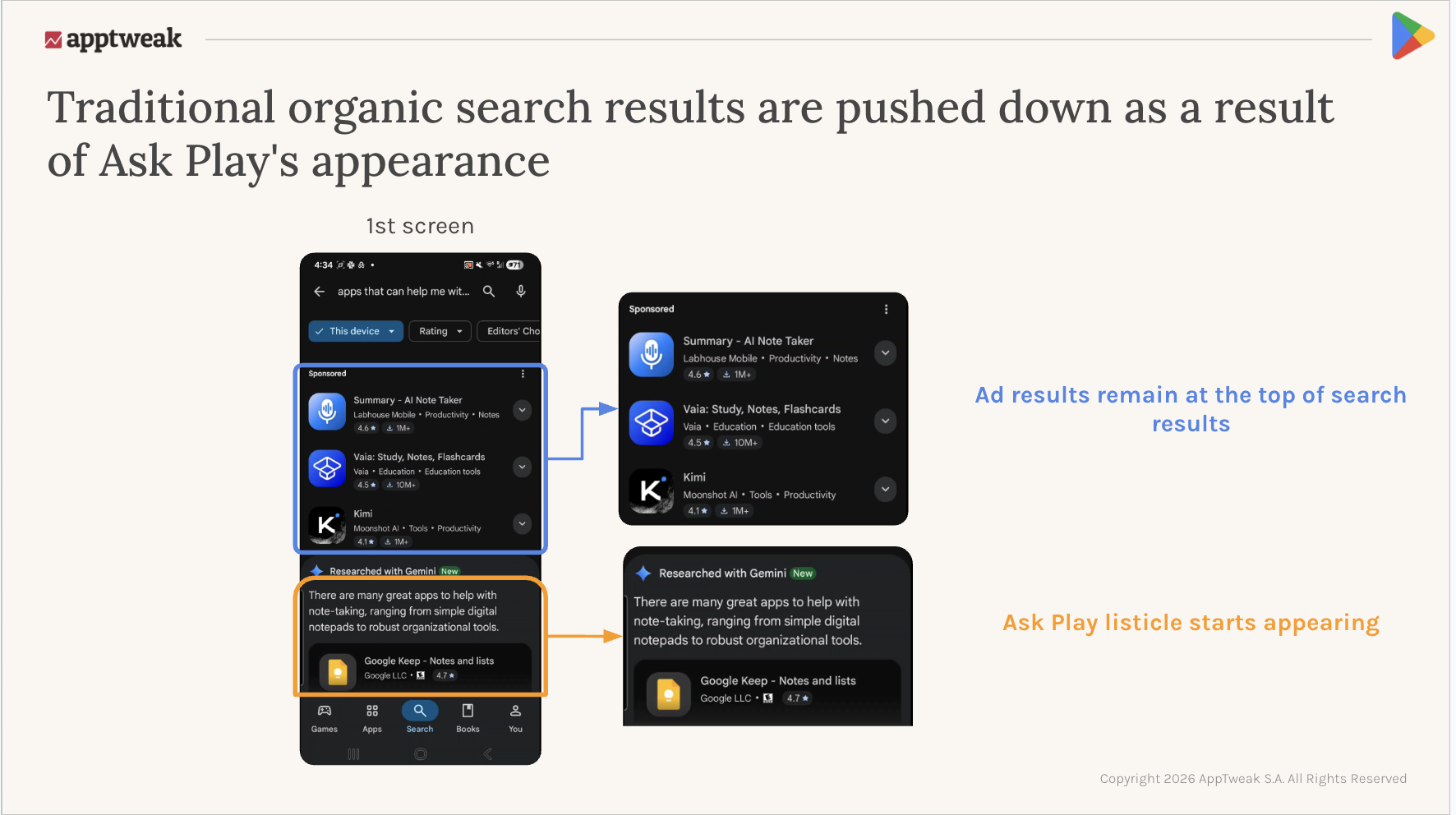
Here’s what that actually looks like on a device, based on our observations:
- First screen: Paid ads hold the top. Below them, a “Researched with Gemini” section starts to appear, which is an AI-generated listicle of recommended apps with short descriptions.
- Second screen: Expand the Gemini answer and the Ask Play listicle takes over the entire second screen. Organic results are nowhere in sight.
- Third screen: “Dive deeper with Ask Play” prompts. These are suggested follow-up questions to keep the Gemini conversation going and fill most of the space.
- Fourth screen onwards: Traditional organic results finally begin.
The full implications of this new behavior are rather complex: short term, it should be noted that this behavior currently applies mainly to longer, conversational queries (the kind that read almost like spoken questions). Short and mid-tail keyword searches, which still make up the bulk of search volume, are far less affected for now and keyword-level ranking data remains a valuable source of information.
However, the longer term trajectory is clear: as users get used to conversional-style search, “traditional” organic search results are going to be pushed down several screens and even top ranking apps will receive limited traffic if they’re not also recommended by AI features sitting above. For ASO, this will mean a mindset shift, where metadata optimization will no longer be about individual keyword ranking positions, but instead focus on semantic coverage to maximize AI-discoverability and mention potential.
Guided Search: AI reshapes how broad queries resolve
Even when it comes to shorter search queries, AI is already disrupting certain search results. Since September 2025, Google Play has been rolling out Guided Search, a feature that suggests more specific sub-queries when users search for something broad like “fighting games”. Instead of dropping users straight into a results list, Guided Search previews some of the top search results for more specific subqueries like “Arcade fighting games”, “Beat ’em up games” or “2D fighting games with online PvP”.
Tap to expand one of these subqueries and you will realise that what looks like an elaborate AI generated listicle is in fact “only” a preview of what you would have found had you searched for that exact subquery. But while Guided Search does not remove the benefits of high organic search rankings entirely, it does already shift the amount of traffic (and therefore the value) associated with broad or specific generic search terms.
Last but not least, Guided Search also allow users to see “Game Highlights” previewing what the recommended games are about. These surface at-a-glance attributes (gameplay style, key features, what makes a title distinctive, all in a visual card) and are generated from your listing content including both your metadata AND user reviews. As a result, it’s also important to remember vague metadata will produce vague highlights, so it will be in your interest to update your metadata and structure it to be AI-friendly so as to not lose on conversion when your app is showcased by Guided Search.
App download outside Google Play becomes a possibility with the Gemini app
On top of Gemini-powered features for Google Play, Google also announced a small but significant revolution during I/O 2026: for the first time, Google is making it possible for Android users to download apps without opening Google Play by allowing the standalone Gemini app to both recommend apps conversationally and creating a download interface within Gemini.
The feature already makes it possible for users to get a few suggestions of apps to download (with Play Store ratings and a direct install button) when specifically asking for app recommendations, and Google even stated the Gemini app would soon also recommend apps to download as part of its answers to content availability queries (such as if you were to ask where you might be able to watch a particular WNBA game). Though Google did not openly state so, we suspect this extra level of recommendation will be unlocked as apps adopt Google’s ContextSDK in their APKs and list AppFunctions (that essentially can turn their apps into MCPs for AI models) in their builds. The takeaway here is that Google is already looking towards search experiences enriched with deep linking organized by AI. And while there is no official timetable clarifying how quickly the change might happen, app publishers who adopt Google’s latest features and frameworks early will likely stand to benefit in terms of discoverability.
The rollout reality: incomplete, hard to track, and personalized
Despite the excitement, we should also note one major caveat when it comes to Google Play changes. None of this is fully deployed, and it would be misleading to imply otherwise. As of May 2026, the picture looks like this:
- Most AI features are currently only applied for English-language devices, even in markets where they’re live.
- EEA markets lag: as Google tends to be cautious of EU regulations, a few major app markets like France and Germany are likely well behind and might not see these features roll out for several more months (the UK is unclear).
- Server-side deployment means Google could still be A/B testing. It is entirely possible for two users with the same device, same Play Store version, living in the same country to see completely different experiences.
The practical consequence is one we’ve watched play out directly: search results are less stable than they used to be. The AI layer introduces personalization and day-to-day variability that keyword-rank tracking alone won’t capture. The same query can return different recommendations on different days.
That’s not cause for panic. If anything, it is a reason to widen how you monitor your app’s visibility. We recently held a webinar at AppTweak discussing how app marketers can measure their app’s AI visibility.
You can watch it here: How to improve your app’s AI visibility: Strategies marketers can act on today.
An ASO adaptation checklist for the Gemini era
For those looking for practical advice to navigate the changes, here’s where I’d focus, in order:
- Monitor your top organic keywords in both Google Play and Google Play Developer Console: Do not abandon keyword optimization processes too fast, but do keep track of keyword-level data in the Google Play Console to spot if any of your top performing terms stop driving traffic and installs to your app. If in doubt, check Google Play directly to catch when Guided Search or Ask Play is triggering for the terms that matter most to you. The manual view is only a snapshot as results shift by query, market, and day. But together they show whether the shift is live in your category.
- Audit your AI visibility, particularly with Gemini. To understand how you’re consistently represented, you need to track it systematically: whether your app is surfaced in Ask Play answers across the queries that matter, which competitors appear alongside you, and which sources the AI is citing. You can’t improve what you haven’t measured.`
- Review your metadata for AI, not just humans. Your long description is now being parsed by a language model, not only skimmed by a user. Take time to learn what content-types and structures are most valued by AI, and adjust your metadata with intent in mind. Front-load your strongest positioning, and be specific about what your app does, for whom, and in what context.Our new AI visibility playbook includes a practical audit table for making your store listing AI-readable.
- Align your website and store listing. Gemini and other LLMs pull from both, so a consistent picture needs to emerge for AI to build confidence about what your app does, even if tone & formats can differ. One practical tip is to ensure major features and content are presented under a consistent name, so AI understand it deals with the same item, not a gaseous concept.
- Keep optimizing store metadata and tracking traditional rankings. Your store metadata is the most relevant information source for multiple LLMs, and your existing keyword rankings usually reflect where you’ve already established relevance. Even if individual ranking positions lose immediate value as they give fewer guarantees to accumulate downloads, average rankings for semantic clusters will work as a soft signal to measure your probability to get recommended by AI. Therefore, treat keyword rankings as an entry ticket, even if they stop being the full prize.
- Watch the language rollouts. If your key markets are non-English or in the EEA, much of the above may not be live for your users yet. It’s coming, and the teams who understand it early will be ready when it arrives.
Other I/O 2026 updates worth a look
Before wrapping-up, a few more announcements from I/O are worth keeping on your radar, even if they don’t reshape discovery the way the Gemini features do.
Play Shorts are confirmed to roll out in the US Play Store for select developers, with more markets to follow. These work as a new discovery surface accessible via the Google Play Apps Tab, and will display as a full-screen, short-form video feed to promote apps (organically for now) in the popular, infinite-scroll format already popular across many apps.
On the retention side, two billing updates landed. Delayed Charging retries failed transactions in the background and keeps users in the app while the charge resolves — Google reports up to an 18% reduction in involuntary churn among top developers using it. And the default account recovery window has doubled from 30 to 60 days. Neither is an ASO story on its own, but involuntary churn feeds directly into the install and retention signals Google uses to judge app quality, which loops back to how you’re evaluated everywhere else.
Several Google Play Developer Console improvements are also on the way, including the option to update local metadata text via Google Sheets or .csv file upload, or most notably a significant revamp of Play Store analytics data. Though some details have not been clarified, Google indicated they will soon introduce new reach metrics to help developers understand visibility in the Play Store outside of Store Listing pageviews and will also aim at redefining their traffic source attribution system to better reflect multi-step acquisition journeys. Unfortunately we did not hear a set timeline for these changes, but do keep in mind these are on the way, particularly if you notice changes in your performance metrics in coming months.
Conclusion
This year’s I/O conference marked the official beginning of the AI-powered Google Play era, but it doesn’t mean AI search is the end of App Store Optimization.
Ask Play now sits between a user’s intent and your store listing. Guided Search is reshaping how broad queries resolve. The Gemini app is becoming a discovery surface in its own right, outside the Play Store. And for a growing set of queries, what we’ve been used to calling “organic results” will now start somewhere between the second and fourth search results screens.
Nevertheless, none of these changes make the fundamentals irrelevant. Strong rankings still generate the associations AI draws on to generate its results, and a well-built store listing is still the primary source for AI answers. Reviews still shape the summaries users read before they decide.
Instead, the job to make your app discoverable is expanding. Apps can no longer afford to simply “be seen”, and must strive to “be found” or even “recommended” instead. To that effect, make sure you present your apps clearly, efficiently explaining who your users are and what problems they are able to solve with your app.
And remember to do so across the multiple sources an AI engine can reach.
FAQs
Does a high keyword ranking still matter for app discoverability on Google Play?
Yes, but rankings now function as a relevance signal for AI rather than a direct traffic driver. Because AI-generated results occupy multiple screens above traditional organic results for a growing share of queries, a high ranking no longer guarantees proportional install traffic. ASO teams should treat keyword rankings as an entry condition for AI consideration, and track average rankings across semantic clusters rather than optimizing for individual keyword positions.
Which markets and languages are Google Play's AI features available in?
As of May 2026, most AI features on Google Play are limited to English-language users in non-EEA markets. EEA markets including France and Germany are significantly behind, with no confirmed rollout timeline. Because deployment is server-side, two users with identical devices in the same country can encounter entirely different experiences. Publishers with primary audiences in non-English or EEA markets should monitor rollout progress rather than treat these changes as immediately live.
What is Guided Search on Google Play?
Guided Search is a Google Play feature that suggests more specific sub-queries when a user searches for a broad term, such as “fighting games.” Instead of returning a flat results list, it previews top results for narrower sub-categories like “arcade fighting games” or “2D fighting games with online PvP.” It has been rolling out since September 2025. While it does not eliminate the value of high organic rankings entirely, it shifts traffic away from broad generic search terms toward more specific ones.
How should app publishers optimize their Google Play store listing metadata for AI?
App store listing metadata is now parsed by language models as well as read by users, so how it is structured affects how AI represents your app. Simon’s I/O 2026 recap recommends front-loading your strongest positioning at the top of your description, being specific about what your app does and for whom, and avoiding vague language that produces vague AI-generated highlights. Metadata that is clear and specific gives AI systems more to work with when generating recommendations or answering user questions about your app.


More articles in App Marketing, Google Play

 Nisrine Khafif

 Micah Motta