App store listings are the source AI search engines tend to cite most when they recommend apps, ahead of the open web. The exact mix varies by app category and shifts as models change.
In AppTweak’s May 2026 analysis of more than 125,000 ChatGPT recommendation responses in the US market, app store listings (App Store and Google Play combined) accounted for 47.5% of cited sources, and the open web for 27%. In 22.6% of cases, ChatGPT cited no source and recommended from knowledge already inside the model. AppTweak AI Visibility currently tracks ChatGPT, so every figure in this article is scoped to ChatGPT.
App discovery is moving into AI assistants, part of the broader shift toward AI search and app discovery. Knowing which sources ChatGPT pulls from shows you where your effort can change a recommendation.
This article breaks down the full source-type split, how citation behavior shifts by ranking position, category and app-versus-game, what makes a source citable, and where to invest first.
Key takeaways
- In May 2026, app store listings are the source ChatGPT cites most when recommending apps, at 47.5% of citations, ahead of the open web at 27%
- ChatGPT cites no source in 22.6% of app recommendations, and cited sources fall from 80-85% in the top positions to under 25% by position eight
- Games lean harder on store listings and community sources than apps, with roughly five times more Reddit and Wikipedia citations
- Cited sources vary widely by category: app store listings account for 65.8% of Weather app recommendations but only 29.3% for Food & Drinks, while Education has the highest no-source share at 29.1%
- The two biggest citation surfaces, app store listings and owned web, are ones marketers already control, making the store long description the highest-leverage first move
Which sources does ChatGPT cite most for apps?
According to AppTweak’s analysis in May 2026, ChatGPT cites app store listings more than any other source when it recommends an app. The store listing is the single highest-leverage surface for AI visibility, because it is both the most-cited source and one you already control. The open web is the second-largest surface, and for many teams it is a more direct lever than they realize, since it includes the pages on your own domain.
Here is the full breakdown of what ChatGPT cites across app recommendations. AI citation behavior can shift, so treat these numbers as directional.
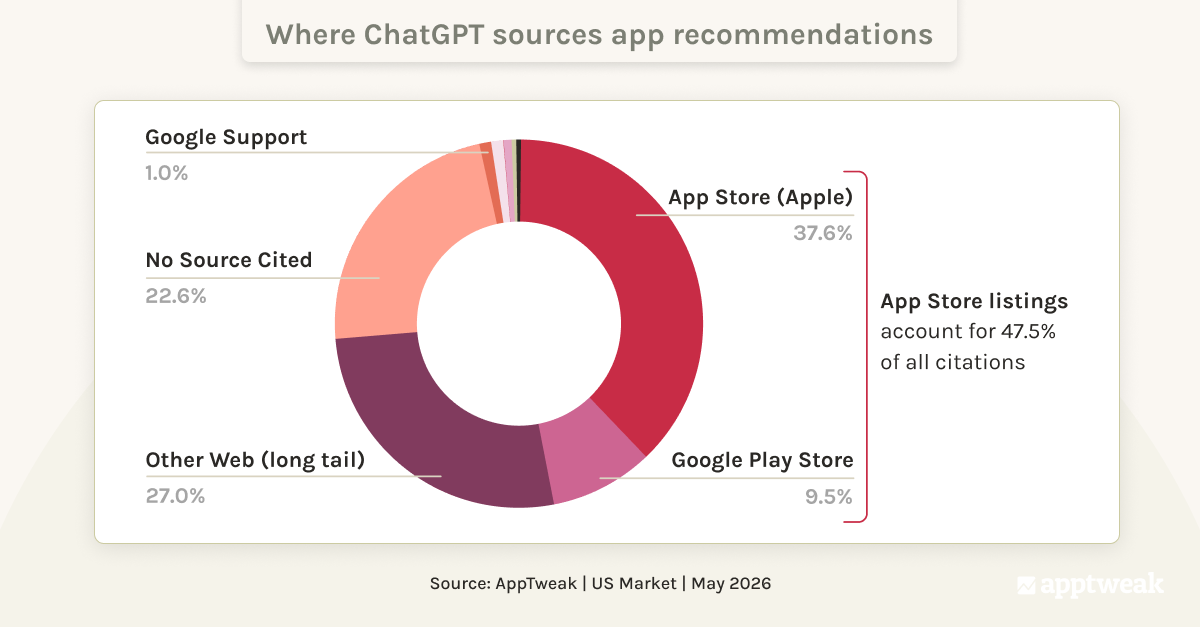
| Source type | Share of ChatGPT citations (apps) | What it is |
| App store listings (total) | 47.5% | App Store and Google Play listing pages combined |
| App Store (Apple) | 37.6% | The single most-cited source |
| Google Play | 9.6% | Android listing pages |
| Open web | 27% | Brand-owned support and product pages, plus app aggregator sites |
| No source cited | 22.6% | Drawn from the model’s training knowledge, not live retrieval |
The App Store alone accounts for 37.6% of citations, making it the most-cited individual source by a wide margin. And the open web’s 27% is largely addressable: a clear product page and support content on your own domain feed directly into that share. The open web here is not just your site; it also covers app aggregator and review sites, so part of that 27% is content you influence rather than own outright. Together, store listings and owned web make up almost three-quarters of what ChatGPT cites, and both are surfaces marketers already manage.
The 22.6% where ChatGPT cites no source is not random: those recommendations are shaped upstream, by the consistency of your positioning over time rather than by any single page retrieved today. The next section covers why that share grows as an app ranks lower.
If you want the reasoning behind these numbers rather than the breakdown itself, the explainer on how AI search engines decide which app to recommend works from the same dataset.
Does source citation change with recommendation position?
Yes. The higher an app ranks in a ChatGPT recommendation, the more likely the model is to back it with a cited source, according to research by AppTweak ChatGPT cites a source 80% to 85% of the time for apps in positions one through four, around 68% at position five, under 50% by position seven, and under 25% by position eight. Lower-ranked recommendations lean far more on the model’s training knowledge than on a retrieved source.
This is why ChatGPT sometimes recommends an app without citing anything. A “no source cited” recommendation is a training-memory recommendation: the model surfaces the app from what it learned during training rather than from a page it retrieved in the moment. That is slower to influence, but the fix is the same one that helps everywhere else, which is clear and consistent positioning across credible surfaces so the model learns the association.
There is an opening here for challenger apps. A weakly-sourced app in position seven is easier to displace than a strongly-sourced app in position three, because the higher-ranked recommendation is anchored to citations that reinforce it. If a competitor holds a lower slot with no source behind it, the position is contestable.
How do cited sources differ between apps and games?
Games lean even harder on store listings and on community and editorial sources than apps do. The store share climbs and the mix of secondary sources shifts toward places where players gather.
| Source | Apps | Games |
| App Store (Apple) | 37.6% | 42.6% |
| Google Play | 9.6% | 16.0% |
The pattern is clear: both stores are cited more for games. The App Store rises from 37.6% for apps to 42.6% for games, and Google Play climbs from 9.6% for apps to 16.0% for games, well above its app share.
Beyond the stores, games see roughly five times more Reddit citations and five times more Wikipedia citations than apps. The reason is structural. Games tend to have thinner owned web content than apps do, so when ChatGPT looks for a source it falls back on store listings, gaming press, and fan communities. For a game, that makes community and editorial presence a real citation lever, not a nice-to-have.
If you work on games, the AI visibility for games breakdown goes deeper on this.
The AI visibility playbook for apps
Get strategic frameworks to help you increase your app's AI visibility across three main areas: ASO, SEO/AEO, and communities.
Download nowDo the sources AI cites change by app category?
Yes, significantly. The share of citations coming from app store listings almost halves across categories, from 65.8% for Weather apps down to 29.3% for Food & Drinks apps. The surface that matters most for AI visibility depends on what your app does, so a single playbook applied across categories will leave most apps optimizing the wrong thing.
Here is how ChatGPT’s citation mix shifts across app categories.
| App category | App store listings | Other web sources | No source cited |
| Weather | 65.8% | 18.2% | 9.8% |
| Commerce & Shopping | 50.5% | 28.6% | 17.5% |
| Medical | 45.5% | 30.4% | 18.6% |
| Education | 43.2% | 22.6% | 29.1% |
| Productivity & Tools | 39.7% | 23.7% | 24.7% |
| House, home & real estate | 34.9% | 31.3% | 25.5% |
| Finance | 31.9% | 44.3% | 18.4% |
| Food & Drinks | 29.3% | 45.7% | 22.3% |
Store listings and other web sources make up most of each category’s citations; the remainder splits between smaller official, editorial, reference, and community sources, and answers where ChatGPT cites nothing at all. The figures are ChatGPT-only, drawn from the same AppTweak’s May 2026 analysis of the US market.
Because AI citation behavior shifts over time, treat this as a snapshot rather than a fixed rule.
Three patterns are worth acting on. Weather and Commerce & Shopping apps are the most store-driven, with more than half of their recommendations citing the store listing, which makes store metadata the top lever in those categories. Food & Drinks and Finance apps lean the other way, earning close to half their citations from other web sources (45.7% and 44.3%), so owned web content and third-party pages do more of the work there than the listing alone. And the share of recommendations with no cited source varies widely, from just 9.8% for Weather up to 29.1% for Education, the highest of any category.
When a large share of a category’s recommendations cite no source, ChatGPT is recommending from training knowledge rather than live retrieval, so the priority shifts toward building consistent presence on surfaces likely to sit inside a model’s training data rather than pages that only work through live retrieval.
AppTweak’s AI Visibility for Apps shows how ChatGPT sources and recommends apps at the intent level in your category, so you can see which surfaces drive your citations rather than guessing from an industry average.
What makes a source citable by AI search engines?
A source is citable when it is structured, extractable, and reinforced across high-trust surfaces. AI search engines favor content they can lift cleanly and match to a query, published somewhere the model already trusts, and repeated consistently enough that the association holds.
Three properties do most of the work:
- Extractable structure. AI engines retrieve sections, not whole pages: use clear headings, structured content (bullet points, numbered lists, tables), FAQ-style sections, and atomic paragraphs.
- Domain and surface authority. A claim on a high-trust surface, whether that is the store listing, your own domain, or an established community, carries more citation weight than the same claim in a low-signal place.
- Consistency across sources. The same positioning across your store listing, owned web, reviews and community mentions compounds. Reinforcement across source types is what moves a recommendation from training-memory guesswork to a sourced, defensible citation.
Consistency is the property teams most often miss, because it spans surfaces different people own. The store listing is managed by one team, the product page by another, community mentions by no one in particular. When a model sees the same clear positioning in all three, the association strengthens; when the three disagree, no single source is authoritative enough to cite with confidence. Aligning your positioning across surfaces is your best chance in citation win. The apps that try to be everything to everyone give AI Engines nothing solid to hold, so it recommends them for nothing in particular.
Where should app marketers invest on to improve AI visibility?
The winning strategy is to diversify the sources that back your app rather than rely on a single one. App store listings account for 47.5% of the citations ChatGPT uses when recommending apps, and the open web accounts for 27%. That mix varies by category and can shift over time, so a source that carries your recommendations today may carry less of them tomorrow. Looking at the source mix for your app, your competitors and your category helps you decide where to act first.
Start with your app store listing
Whatever your category, the store listing is the first move. It is the largest single citation share, you already control it, and you can change it today. Optimize your long description for AI readability so a model can extract what your app does, who it is for and why it stands out. To go further, optimize your app store listing for AI search covers the listing work in detail. App store optimization remains the foundation.
Run three checks to find your gap
- Check the top sources when your app is mentioned. These are the pages ChatGPT already trusts to recommend you. Keep them accurate and current, because they are what you stand to lose.
- Check the top sources when your competitors are mentioned but your app is not. This is your gap, and usually the most useful list you will find. A source that keeps backing a competitor’s recommendation and never yours is the clearest place to act first.
- Check the source mix of your app category. It shows what normal looks like for your type of app, so you can tell whether your own mix is an outlier or just reflects how ChatGPT handles your category.
Taken together, the three checks show what is working, what you are missing and what comes with your category.
What to do based on your checks
- If the store listing dominates your gap or your category mix, treat it as your main lever rather than a one-off fix. Keep refining the listing text and change one element at a time so you can see what moves your citations.
- If brand-owned or aggregator pages dominate, build owned web content: a clear “what, who, why” product page plus an FAQ. That way you win the open-web share directly instead of depending on aggregators for it.
- If you work on a game, make community and editorial presence your next investment after the listing. Games earn 5x more Reddit and Wikipedia citations than apps, so those sources are more likely to show up in your gap.
- If your category leans on the open web, as Food & Drinks and Finance do, strengthen your owned content and third-party presence alongside your listing.
Set your AI visibility baseline to prove it works
Diversifying only pays off if you can show it is working. In AppTweak’s AI Visibility, the prompt-level view shows the exact ChatGPT or Gemini answer, the competitors recommended alongside you and the sources cited, and the intent filter narrows the source breakdown to a single use case. Run the three checks there before you change anything to set your baseline, then run them again after each change to see whether new sources start citing your app. The four experiments to improve your app’s AI visibility give you a structured way to test those changes. For the full method behind this prioritization, see the GEO framework for apps.
How did AppTweak measure which sources AI cites?
To trust the breakdown, it helps to know how it was measured. Every figure in this article is based on AppTweak’s analysis of more than 125,000 ChatGPT recommendation responses, across 9,489 app prompts and more than 9,000 game prompts, in the US market, May 2026. Source attribution, sentiment and position data were extracted from AppTweak’s AI Visibility for Apps platform.
The prompts are non-branded and intent-level, built from how real users search for and discover apps rather than from brand names. Citations are counted from the publicly indexed store versions on apps.apple.com and play.google.com. The dataset is ChatGPT-only, so every number here describes ChatGPT’s behavior specifically, scoped to that assistant and that time window.
Two caveats keep the numbers honest. These figures are a May 2026 snapshot, and AI retrieval behavior shifts over time, so treat the mechanism as more durable than any single percentage.
Conclusion
AI recommendations rest on two things: the intents a model associates with your app, and the sources it trusts enough to cite. When ChatGPT recommends an app, it reaches most often for app store listings (47.5%) and the open web (27%), it cites more confidently at the top of a recommendation than at the bottom, and it weights sources differently for games and across categories. The through-line is that the surfaces doing the most work are the ones you already own.
The averages stop there. How your own app gets cited, and where competitors get recommended instead, is something you can measure directly.
AppTweak’s AI Visibility for apps and games is the first tool built specifically to track how mobile apps and games are discovered and recommended by AI assistants like ChatGPT. Powered by AppDNA, it maps 1,200+ user intents across 200+ app subcategories and runs 10,000+ non-branded prompts weekly to measure your app’s AI Visibility Score, sentiment, and competitive positioning at the intent level. Unlike web-based AI visibility tools that start from your domain, AppTweak’s approach is built on how real users search for and discover mobile apps, surfacing the intents you’re winning, the ones you’re missing, and where competitors are being recommended instead. Built into ASO Intelligence, now app marketers can leverage AppTweak’s ASO and AI Visibility insights to win in the app stores and AI search.
FAQs
What share of ChatGPT’s app citations come from the App Store?
The App Store accounts for 37.6% of the sources ChatGPT cites when recommending apps, and app store listings together (the App Store plus Google Play) account for 47.5%. Google Play makes up the remaining 9.6% of that combined figure, and the open web follows at 27%. These shares come from AppTweak’s analysis of more than 125,000 ChatGPT recommendation responses in the US market, May 2026. For app marketers, the App Store listing is the single highest-leverage surface to optimize for AI visibility, because it is both the most-cited source and one you fully control. Because AI citation behavior are constantly changing, please treat these as a snapshot rather than fixed shares.
Why does ChatGPT recommend some apps without citing a source?
ChatGPT cites no source in 22.6% of app recommendations, which likely means it’s drawing only on what it already learned about the app during training, not a page it can point to. That’s a weaker position: outdated or thin, and not backed by anything you can point to as evidence. Therefore, you should work to provide AI search engines reputable, current sources to draw from, your app store listing, your own site, credible third-party coverage, so it has real material to cite instead of relying on a static impression from training. That improves your odds of being recommended with a source behind it, not just recommended from memory.
Is it easier to displace a lower-ranked app in ChatGPT recommendations?
Yes. A weakly-sourced app in a lower position is easier to displace than a strongly-sourced app near the top, because higher-ranked recommendations are usually anchored to cited sources that reinforce them. ChatGPT cites a source for 80% to 85% of apps in positions one through four, but under 50% by position seven. An app in a lower slot with no source behind it holds a contestable position: consistent, extractable content across your store listing and owned web can build the citations needed to overtake it. That makes lower, unsourced positions the most realistic first targets for challenger apps.
How can I see which sources ChatGPT cites for my own app?
AppTweak’s AI Visibility for Apps tracks how ChatGPT and Gemini sources and recommends your app, so you can see which surfaces drive your citations instead of estimating from an industry average. It is built on AppDNA, which maps 1,200+ user intents across 200+ app subcategories and runs 10,000+ non-branded prompts weekly to measure your AI Visibility Score, sentiment, and competitive positioning at the intent level. Because citation behavior varies by category and between apps and games, measuring your own app is the only way to know which sources to prioritize.
Is AppTweak AI Visibility suitable for both apps and games?
Yes, through two products built for how each is discovered: AppTweak AI Visibility for Apps and AppTweak AI Visibility for Games. The split matters because the citation mix is different. Apps earn most of their AI citations from store listings and owned web content, so the apps product concentrates there. Games pull far more from community and editorial sources such as Reddit, Wikipedia, and gaming press alongside the stores, so the games product weights those signals. Both measure your AI Visibility Score, sentiment, and competitive positioning at the intent level, so you can see where you are recommended and where competitors appear instead.

More articles in AI Visibility

 Pierre-Antoine Roy

 Micah Motta