AI is becoming a real upstream channel for app discovery. According to Adobe, 72% of users who already use AI search engines rely on them as their primary tool for researching products and brands, and 47% use them specifically to get product recommendations. ChatGPT referral traffic is now appearing in App Store Connect analytics, and while early e-commerce data shows conversion rates from AI-referred sessions run 31% higher than non-branded organic search, the pattern reflects a broader truth: users arriving from AI recommendations tend to be further along in their decision-making.
The pattern is consistent: a user describes a need in natural language, an AI search engine recommends a specific app by name, and the user acts on it, often without running a single keyword search in the app store. That changes where visibility needs to be measured.
Two types of tools exist to track this. App-specific tools are built around how users actually discover apps in AI search, mapping visibility back to real app IDs and user intents. Web-based tools like Semrush, Profound, Peec AI, and Otterly.ai track brand and domain mentions in AI responses, which is useful for companies with a strong web presence but structurally limited for app-level discovery.
In this guide, we will cover both tool types, and we will help you figure out which one fits your specific use case.
Key Takeaways
- AI is becoming a measurable app discovery channel: 47% of users have already used an AI assistant to get product recommendations, and per one e-commerce study, conversion rates from AI-referred sessions run 31% higher than from non-branded organic search.
- AI-driven app discovery works differently from traditional search. A user describes a need in natural language, an AI engine recommends a specific app by name, and the user converts, often without running a keyword search in the app store.
- Most AI visibility tools were built for websites and brands. They track domain citations and brand mentions in AI responses, but cannot map recommendations back to real app IDs or app-specific user intents.
- AppTweak AI Visibility is the first AI search visibility tool built specifically for mobile apps and games. It derives its methodology from 1,200+ user intents across 200+ app subcategories, running 10,000+ prompts to ChatGPT weekly and matching responses back to real app IDs.
- For most app marketing teams, the right approach is not one tool or the other. Web-based tools cover brand visibility on the web; app-specific tools cover how users actually discover apps in AI search.
Why is AI Search visibility important today?
AI search visibility matters because AI platforms are already influencing discovery at scale, while outbound referral traffic is not yet the whole story. According to Similarweb’s 2026 generative AI data, AI platform visits increased by 28.6% between January 2025 and January 2026, but referral traffic from AI platforms to external sites remained flat over the same period.
A growing number of users are no longer discovering apps through traditional app store searches alone. As AI becomes embedded in the tools people use every day, asking for an app recommendation has become as natural as asking for directions: A user describes a need in natural language, an AI engine recommends a specific app by name, and the user converts via a branded search or a direct download. No keyword search. No app store browse. The decision happens upstream, before the user opens the App Store or Google Play.
That’s where AI visibility differs from ASO.
Traditionally, ASO has focused on optimizing visibility and conversion within the stores themselves: rankings, metadata, creative conversion. AI visibility addresses the moment before that, when a user’s intent gets matched to an app recommendation by a model that has never seen your keyword strategy. The two aren’t in competition: they operate at different points, in the same discovery funnel.
For ASO managers, the implication is this: optimizing for store visibility alone no longer covers the full discovery journey.
You can read more about this on our recent blog about AI app discovery in LLM search.
What are the best tools to track mobile app visibility in AI search engines?
The best tools to track mobile app visibility in AI search include AppTweak’s AI Visibility for Apps and games to get app-specific context, and Semrush, Profound, Peec AI, and Otterly.ai for web domain tracking.
Most AI visibility tools on the market were built for websites and brands. They track domain citations and web mentions, which are useful signals, but not designed around how users actually discover apps. Most tools require a starting point to set up tracking. That starting point is a website or domain. For app-specific tools, it’s the mobile market.
The best AI Visibility tools for mobile apps
| Tool | Based on | AI engines covered | What it tracks |
| AppTweak AI Visibility for Apps & Games | Mobile apps and games | ChatGPT (Launched April 2026, more platforms coming soon) | App recommendations by intent, share of voice, rank position, sentiment, competitor benchmarking |
| Semrush AI SEO | Web domains | ChatGPT, Gemini, Perplexity, Google AI Overviews, Google AI Mode | Brand mention rate, share of voice, sentiment, competitor visibility, prompt-level tracking |
| Profound | Web domains | ChatGPT, Gemini, Claude, Perplexity, Grok, Microsoft Copilot, Meta AI, DeepSeek, Google AI Overviews | Brand mentions in AI answers, prompt volumes, agent analytics (AI bot crawl behavior), sentiment and brand perception |
| Peec AI | Web domains | ChatGPT, Perplexity, Gemini, Google AI Mode | Brand visibility (mention rate), position within AI responses, sentiment, source citations, competitor benchmarking |
| Otterly.ai | Web domains | ChatGPT, Perplexity, Gemini, Google AI Overviews, Google AI Mode, Microsoft Copilot | Brand mentions and position, source citations, share of voice, sentiment, content crawlability and AI-readiness |
AppTweak AI Visibility for Apps and Games
AppTweak AI Visibility is the first AI search visibility tool built specifically for mobile apps and games. Rather than starting from a brand’s web presence, it derives its methodology from app store intelligence.
- What it tracks: app recommendations by name across AI engines, share of voice against competitors, rank position per intent, sentiment, and visibility trends over time.
- How it works: mapping of 1,200+ user intents across 200+ app subcategories via AppDNA and GameDNA, expansion into prompt variations reflecting real user phrasing, and 10,000+ weekly prompts to ChatGPT matched back to real app IDs.
- Key strength: intent-level visibility derived from actual app market data, not self-defined prompts, including blind spots where competitors are recommended and your app is absent.
- Current limitation: ChatGPT and Gemini coverage, with more AI tools on the roadmap.
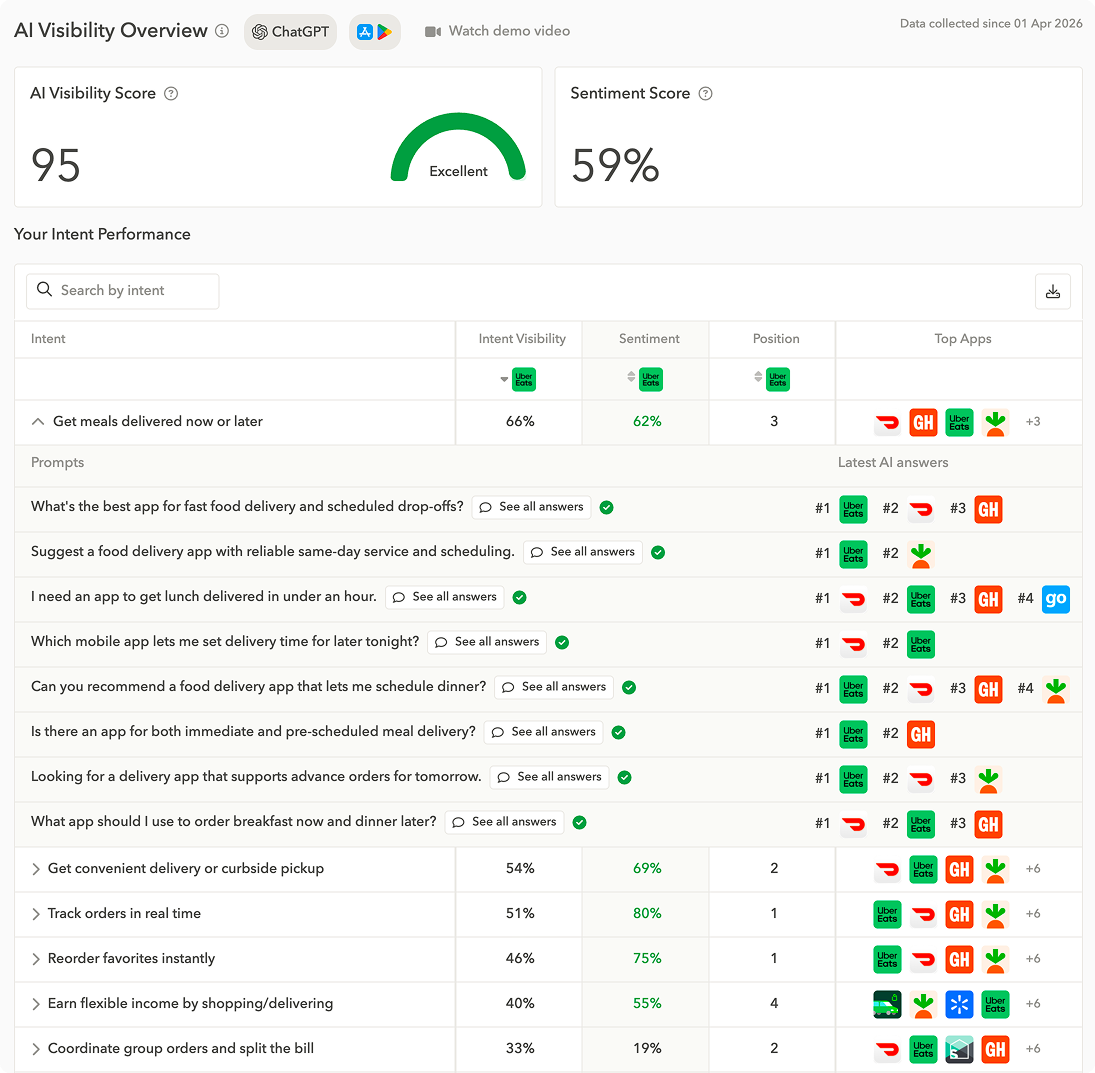
Explore AppTweak’s AI Visibility for Apps & Games
AI Visibility for Apps
AppTweak’s AI Visibility for Apps is the first tool built specifically for app and game discovery in AI search. Unlike web-based tools, it starts from your app market, built from 10+ years of real app store data across 200+ subcategories. No domain, no setup required.
- AI Visibility Score: A normalized 0–100 score showing how visible your app is across 10,000+ tracked prompts, so you have a stable baseline to build from.
- Sentiment Score: How positively your app is described in AI responses, and how that compares to competitors on the intents that matter most.
- Intent visibility: See exactly which user needs your app wins and which it’s losing, all of which are mapped to how people actually search for apps, not generic web searches.
- Actual AI responses: See the real answers ChatGPT gives when users ask for an app like yours, including the sources it pulls from to make that recommendation.
- Competitor intelligence: Which apps are recommended alongside or instead of yours, matched to real app IDs you can track.
AI Visibility for Games
AppTweak’s AI Visibility for Games is the first tool built specifically for game discovery in AI search. Unlike web-based tools, it starts from the game, not the domain, and is built on 10+ years of real store data across 100+ GameDNA subcategories. No domain, no setup required.
- See how you perform across the 6 ways players search: Track how your game is recommended across the ways players actually search: IP, genre, theme, features, context, and alternatives. We call these the 6 discovery dimensions.
- Position by topic: See where your game ranks within each dimension, and which topics you lead, and where competitors outrank you.
- Actual AI responses: See the real answers ChatGPT gives when players ask for games like yours, including which sources it draws from to make that recommendation.
- Real game IDs across iOS and Android: Every AI mention is matched back to a real game in AppTweak’s database, something domain-based tools can’t do.
- Competitor intelligence: Uncover which games are recommended alongside or instead of yours. Often this is a different competitive set than your ASO competitors.
Semrush
Semrush AI Visibility Toolkit is part of Semrush One, a platform that combines traditional SEO and AI visibility tracking in a single suite. Built for SEO teams, digital marketers, and agencies managing web presence across multiple markets.
- AI engines covered: ChatGPT, Gemini, Perplexity, Google AI Overviews, Google AI Mode
- What it tracks: brand mention rate, share of voice, sentiment, competitor visibility, prompt-level tracking, and technical site audit for AI crawler accessibility
- Key strength: deep integration with Semrush’s existing SEO suite, combining traditional search rankings and AI visibility in one workflow. Prompt Research functions like keyword research for AI search, grouping related prompts by topic and intent.
- Limitation for app teams: domain-based setup only, with no support for app store data or app IDs. Apps published under a parent company domain, or with no dedicated website, will return limited or irrelevant data.
Profound
Profound is a full-stack AEO (Answer Engine Optimization) platform built for marketing teams, AEO specialists, and agencies. It combines AI visibility monitoring with autonomous marketing agents designed to help brands improve their presence in AI-generated answers.
- AI engines covered: ChatGPT, Gemini, Claude, Perplexity, Grok, Microsoft Copilot, Meta AI, DeepSeek, Google AI Overviews
- What it tracks: brand mentions and representation in AI answers, prompt volumes (what real users ask AI engines), agent analytics (how AI bots crawl and interpret your site), sentiment and brand perception
- Key strength: broadest AI engine coverage of any tool in this list, with autonomous marketing agents for content creation and optimization. Prompt Volumes surfaces real user demand across AI engines, useful for aligning content strategy with what people actually ask.
- Limitation for app teams: domain-based setup with no native support for app store data, app IDs, or app-specific user intents. Teams tracking a mobile app will need to manually define prompts relevant to their app category.
Peec AI
Peec AI is an AI search analytics platform built for marketing teams and agencies. Focused on simplicity: set up your prompts, track your visibility, act on what the data surfaces.
- AI engines covered: ChatGPT, Perplexity, Gemini, Google AI Mode
- What it tracks: brand visibility (share of prompts where your brand is mentioned), position within AI responses, sentiment, source citations (which URLs AI engines pull from to generate answers), competitor benchmarking
- Key strength: clean, focused interface that avoids feature overload, with clear distinction between brand mentions and source citations. Native integration with Looker Studio and CSV export for reporting workflows.
- Limitation for app teams: prompt-based setup requiring manual definition of all tracked queries, with no native app store data or app-specific intent mapping. Teams tracking a mobile app will need to manually build and maintain a prompt library relevant to their category.
Otterly.ai
Otterly.ai is an AI search monitoring and optimization platform built for marketing teams and agencies. It covers the full cycle from prompt research to citation tracking to content optimization recommendations.
- AI engines covered: ChatGPT, Perplexity, Gemini, Google AI Overviews, Google AI Mode, Microsoft Copilot
- What it tracks: brand mentions and position in AI responses, source citations (which URLs AI engines pull from), share of voice against competitors, sentiment, content crawlability and AI-readiness of web pages
- Key strength: broadest feature set among the domain-based tools in this list, going beyond monitoring to include a Content Audit (why AI skips your pages), GEO optimization recommendations, and a Prompt Research module.
- Limitation for app teams: domain-based setup with manual prompt configuration and no native support for app store data, app IDs, or app category intents. Limited relevance for app teams unless the app has a strong dedicated web presence.
How to choose the right AI visibility tool for mobile apps?
The right AI search visibility tool depends on whether you need app-specific intelligence, web-based brand tracking, or both. Most of the time, it’s not one or the other.
| If you… | Choose… |
| Want to know whether your app or game is being recommended by ChatGPT, for which user needs, and your true competitors. | AppTweak AI Visibility |
| Run brand or domain tracking for a company with a strong web presence | Semrush AI SEO, Profound, Peec AI, or Otterly.ai |
| Want to understand both app-level discovery and web-based brand visibility | AppTweak AI Visibility + a web-based tool |
| Work at an agency managing both app and web clients | AppTweak AI Visibility for app clients + a web-based tool for brand clients |
The tools in this space are not competing for the same use case. Web-based platforms start from your domain and measure where it surfaces in AI responses. AppTweak starts from the full universe of user intents in your app category and measures whether your app gets recommended. Those are different questions, and for most app marketing teams, both are worth answering.
What are the limitations of AI search visibility tools?
Every AI search visibility tool comes with structural constraints. Understanding them is essential before drawing conclusions from the data.
No tool can tell you how many users are asking a given prompt
AI search engines do not let you access prompt search volume data. There is no equivalent of keyword search volume for AI queries. Some tools provide volume estimates, but these remain approximations. Visibility metrics like share of voice and mention rate reflect relative performance across tracked prompts, not absolute demand.
AI responses are (very) variable
The same question phrased differently, asked in a different location, or sent on a different day can produce different results. A single manual check in ChatGPT tells you very little. Reliable tools normalize results by running the same intent across multiple prompt variations and aggregating the output. Tracking visibility at the intent level, rather than the individual prompt level, is what makes the data actionable.
Attribution from AI visibility to app downloads is difficult to measure
AI search is largely a zero-click environment. Most users who receive an app recommendation from an AI engine convert later via a branded search or a direct download, without a traceable referral link. That makes it hard to draw a straight line from AI visibility to installs. The signal is real, but the attribution chain is indirect.
Tools that rely on your own prompts only confirm what you already know
Some AI visibility tools require you to define the prompts you want to track. That means you are only measuring intents you have already thought of. If a competitor is being recommended for a use case you have never considered, you will not see it. Tools that derive intents from market data rather than user-defined inputs surface blind spots that self-defined prompt sets cannot reach.
Why tracking your web domain isn’t enough for app marketing teams
Web-based AI visibility tools measure whether your brand or domain gets cited in AI responses. That’s a useful signal, but it’s not the same question app marketing teams need to answer.
- AI recommendations are intent-driven, not domain-driven. When a user asks ChatGPT “what’s the best app to track my spending,” the response is a list of apps, not links to websites. AI search engines match a user intent to a product, and what determines whether your app appears is how clearly and consistently it’s associated with that need across the sources AI can retrieve, not just your domain’s search authority.
- Your real competitors are apps, not domains. When a web tool reports that a competitor is visible in AI, it means their website was cited somewhere. But the competitor that matters is the app being recommended in the same slot as yours. App-specific tools map AI mentions back to real app store listings, so you’re benchmarking against your true competitors.
- Domain tracking confirms what you already know. App-specific tracking shows what you’re missing. Web tools start from your brand and measure where it appears. App-specific tools start from the full landscape of user intents in your category and check whether your app shows up at all, including intents where competitors are being recommended and you’re completely absent.
Conclusion
AI-driven app discovery is not a trend to monitor from a distance. It is already showing up in App Store Connect analytics, already influencing which apps users download, and already creating a gap between teams that measure it and teams that don’t.
The tools available to track it differ fundamentally in where they start. Web-based platforms start from your brand’s domain and measure where it surfaces in AI responses. App-specific tools start from how real users actually search for apps, mapping visibility back to intents, categories, and competitors users can download.
For most app marketing teams, the question is not which type of tool to use. It’s whether the tool you choose is built for how apps actually get discovered.
FAQs
What are AI search visibility tools?
AI search visibility tools help marketers understand whether their brand or product appears when users ask AI engines for recommendations. They track metrics like mention rate, share of voice, and sentiment across platforms like ChatGPT, Gemini, or Perplexity.
For app teams, the question goes further: not just whether your brand is mentioned, but whether your app is recommended for the intents that lead to installs. Most tools start from a domain, whereas app-specific tools start from user intents and app categories.
What are AI search visibility tools used for?
AI search visibility tools help marketers answer three practical questions: where does my brand or app appear in AI-generated recommendations, how does it compare to competitors, and is visibility improving or declining over time.
In practice, teams use them to benchmark competitors, identify which intents they are winning or missing, track sentiment, and prioritize metadata or content changes based on what AI engines actually recommend.
For app marketing teams, the use case is more specific. Rather than tracking domain citations, an app-specific tool maps visibility back to the user intents and app categories that drive downloads. That turns a broad question (“is my app visible in AI?”) into something actionable (“which intents am I missing, and who is winning them instead?”).
Is there an AI visibility tool built specifically for mobile apps?
Yes. AppTweak AI Visibility is the first AI search visibility tool built specifically for mobile apps and games.
Most AI visibility platforms rely on prompts you define yourself, or generate automatically from your website. AppTweak takes a different approach. Using 10+ years of app store intelligence through AppDNA and GameDNA, its proprietary market classifications, it maps the recurring needs users have when searching for apps. Those needs become intents: specific goals like “fall asleep faster” or “track workouts without a subscription.”
Each intent is then expanded into multiple prompt variations that reflect how real users phrase the same need differently. “What’s the best app combining sportsbook and casino in one” and “which app lets me bet sports and play casino games together” are two prompts expressing the same intent.
The result is intent-level visibility that reflects how users actually discover apps in AI search. AppTweak runs 10,000+ prompts to ChatGPT and Gemini every week and matches responses back to real app IDs, so you see which apps are being recommended by name, not just whether a domain was cited somewhere on the web.
Can web-based AI visibility tools like Semrush or Ahrefs be used to track app AI visibility?
Yes, with limitations. Tools like Semrush and Ahrefs track brand and domain mentions in AI responses, which is useful for app companies with a strong web presence. But they are structurally limited for app-specific use cases: they start from a domain rather than user intents, cannot map AI mentions to real app IDs, and often return irrelevant results for apps published under a parent domain or with no dedicated website.
Use web-based tools to understand brand and domain visibility. Use an app-specific AI visibility tool to understand whether your app is being recommended for the intents that lead to installs.
I check ChatGPT manually so why would I need an AI Visibility tool for my app?
Manual checks give you a snapshot of one prompt, on one day, in one phrasing. AI responses vary by how the question is worded, where it’s asked, and which model version answers it. What you see in a single check may not reflect what most users actually get.
An app-specific AI visibility tool tracks this systematically, monitoring share of voice, rank position, and sentiment across hundreds of prompt variations. AppTweak currently does this at scale for ChatGPT and Gemini, with other AI assistants planned. That turns ad-hoc spot-checks into consistent, comparable data you can act on over time.
What can ASO managers do to increase their app’s AI search visibility?
ASO managers need to think beyond app store rankings. AI engines evaluate apps across multiple surfaces simultaneously, and the goal is to be consistently associated with the right user intents across all of them.
- Start by measuring where you stand
Before changing anything, audit how your app currently surfaces in AI search. Which prompts bring it up? Which competitors appear instead? Which intents are you missing entirely? AppTweak AI Visibility tracks 10,000+ prompts weekly, giving a structured, intent-level view of where your app appears and where it doesn’t.
- Optimize your app store metadata around user goals
Titles, descriptions, and update notes are now grounding data for AI, not just conversion tools. Describe real user outcomes rather than features. An update note that says “improved sleep tracking accuracy for users who wake up at irregular hours” is a usable AI signal. “Bug fixes” is not.
- Build a clear, intent-aligned web presence
Your website should clearly describe what your app does, who it’s for, and what problems it solves. FAQs that answer “how do I…” and “can this app…” questions are high-value formats because they map directly to how users phrase queries in AI search. Comparisons, problem-solution pages, and best-of content are formats AI engines retrieve and synthesize more reliably than generic marketing copy.
- Build external authority
Review sites, press mentions, Reddit threads, and “best apps for X” articles are among the top content formats AI engines pull from when generating app recommendations. Descriptive reviews carry more weight than generic ones. A review that says “this app helped me fall asleep in 10 minutes” does more work for AI visibility than “love this app.” Depth and specificity matter as much as volume.
- Maintain consistency across every surface
AI engines look for consistent associations between your app and specific user intents across every surface they can access. If your app store listing, website, and external content all describe your app differently, the model has weaker signals to recommend you. Consistent positioning around the same core user problem, repeated across every surface, increases your likelihood of being recommended.


More articles in AI Visibility, Artificial Intelligence (AI)

 Pierre-Antoine Roy