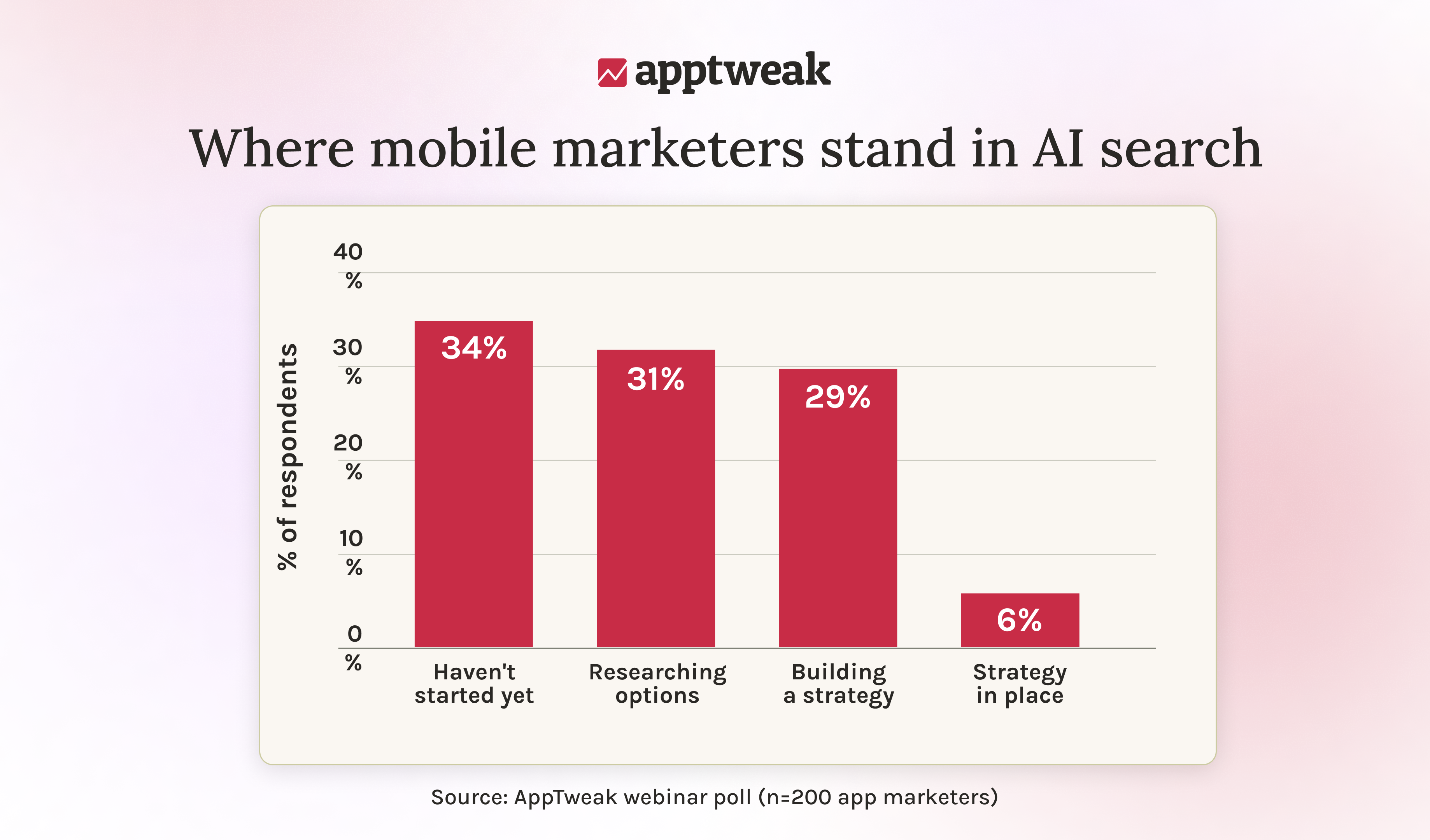
According to a survey we ran with 200 app marketers during one of our webinars, most are still at the starting line of AI visibility: 34% haven’t begun, 31% are researching options, 29% are building a strategy, and only 6% have one in place. That gap is the opportunity. Acting now, while your category is still undecided, is a distinct competitive advantage.
Four experiments can change how often AI search engines recommend your app: rewriting your long description for AI readability, structuring your website for LLM retrieval, earning citations in sources LLMs trust, and building an authentic community presence. Each targets a different stage of how an AI search engine finds, evaluates and synthesizes information about apps.
Most app teams already accept that how AI search is changing app discovery matters. The harder question is what to change on Monday morning. AppTweak’s AI Visibility Playbook identified these four experiments and ranked them by how quickly a team can act.
Here are four experiments you can try today to improve your app’s AI visibility.
Key takeaways
- App store listings are the largest cited source in AI-generated app recommendations at 47.5% of all citations in the US market, which makes the long description the highest-value surface to rewrite.
- Structuring a website for LLM retrieval, through crawlable pages, a real-question FAQ section and a public changelog, increases the number of extractable sections an AI search engine can surface.
- Earning citations in third-party sources that LLMs treat as authoritative provides external validation of what an app does, which carries more weight than self-description alone.
- Reddit is the single most-cited source aggregated across all AI models in the US, making community participation one of the few areas where smaller apps compete with category leaders.
- AI recommendations vary by model, prompt and day, so measurement requires a baseline plus repeated readings across multiple prompt variations per intent.
How do I measure my app’s AI visibility?
Take a baseline before changing anything. AI visibility is an emerging discipline, no tactic guarantees a result, and recommendation behavior varies across models, prompts and categories.
Two rules follow. Sequence the experiments instead of stacking them, so a change can be attributed to a specific action. And judge results across many prompt variations per intent, repeated over time. The same prompt asked twice on different days can return different recommendations. You are not looking for what ChatGPT said once. You are looking for what it tends to say.
Experiment 1: Rewrite your app store long description for AI readability
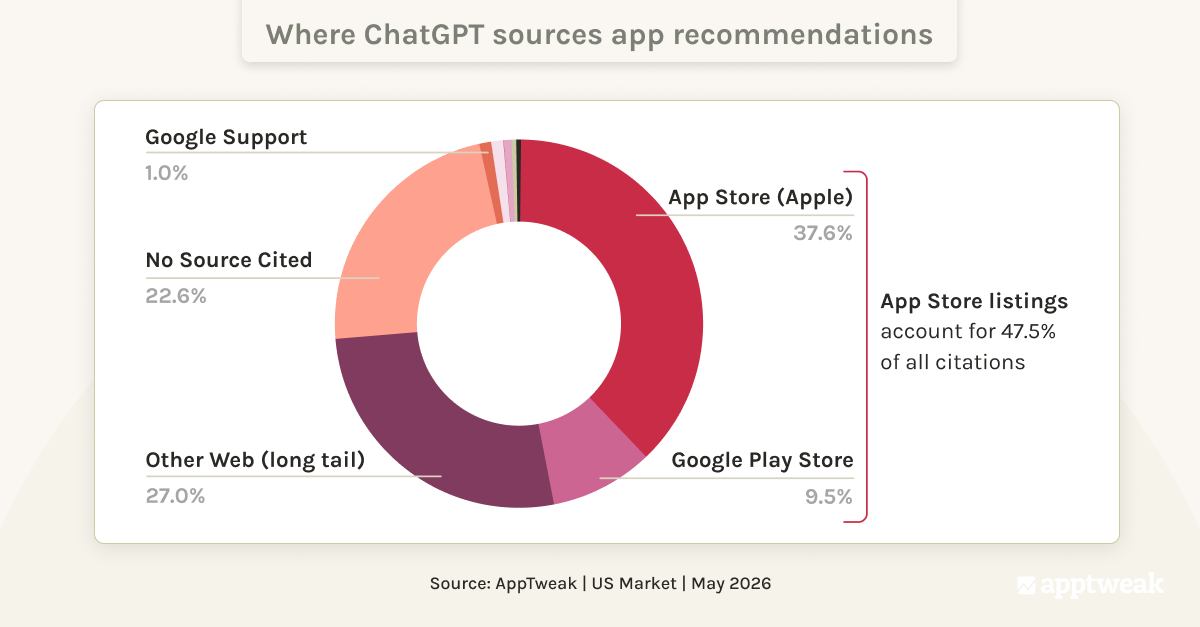
App store listings are collectively the largest cited source in AI-generated app recommendations. Based on AppTweak’s analysis of 125,000+ ChatGPT recommendation responses across 9,489 app prompts in the US market (May 2026), the Apple App Store accounts for 38% of citations and Google Play adds 9.5%, together nearly half of everything ChatGPT draws from.
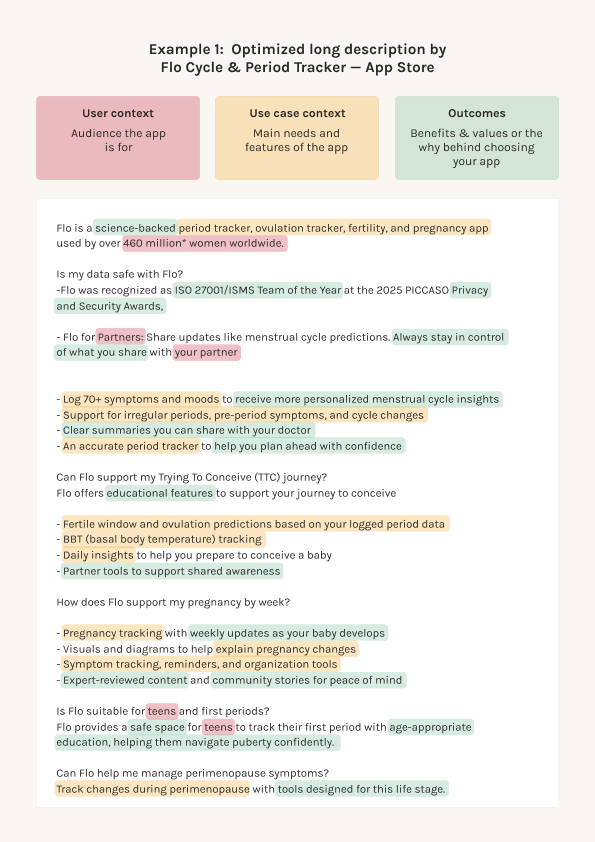
Rewrite your long description so an AI search engine can extract a clear, confident recommendation from it. Six tactics:
- Define the audience immediately
- Reinforce a small number of core use cases
- Reduce vague positioning language
- Use question-style formatting where relevant
- Connect features to outcomes
- Reinforce trust and specificity
Prioritize the App Store listing, since it is cited significantly more often, but update Google Play at the same time.
Effort: Low. Google Play changes push from the Play Console with no new submission. App Store metadata updates go through App Review, typically 24 to 48 hours.
Read the full guide: how to optimize your app store listing for AI
Experiment 2: Structure your website so AI search engines can retrieve your app’s information
Your website is the most crawlable and citable input available to AI search engines, and unlike your store listing it has no character limit. For the classic search side of your app’s website, see our guide on SEO for apps.
AI search engines retrieve individual sections rather than whole pages, so structure decides whether anything gets surfaced.
- Confirm crawlability and indexability. Google Search Console is the quickest audit. Check robots.txt for blocked AI user agents such as GPTBot, ClaudeBot and PerplexityBot.
- Maintain a clean site structure. Descriptive URLs, proper internal linking, no duplicate or broken pages.
- Start with your core app landing page. State plainly what your app does, who it is for, and the main problems it helps users solve.
- Add or strengthen an FAQ section. AI search engines are particularly effective at retrieving question-answer content, the same format people use when prompting an LLM. Build entries around real user questions: “Can [app] do X?”, “Is [app] suitable for Y?”
- Maintain a public changelog. Visible product evolution signals freshness, a meaningful factor in AI retrieval.
- Apply the same formatting principles across pages. One idea per section, a direct answer early, clear descriptive headings, bullets over long prose, and no abstract marketing language.
Content should still read naturally for people and avoid sounding artificially optimized for machines.
Effort: Medium. Requires content and SEO involvement, but no paid budget.
Experiment 3: Earn citations from sources that LLMs trust
AI search engines do not rely only on what you say about your own app. They look for external validation: third-party sources that independently describe your app and tie it to specific use cases. When those sources carry authority, LLMs weigh their content more heavily. For games, that external signal counts for even more.
- Identify which sources hold authority in your category. These vary: general tech media for broad utilities, niche review sites for games, health publications for wellness apps. To find them, note which domains keep coming up when you search “best [category] apps”, and which sources AI tools cite when they answer prompts in your category. AppTweak AI Visibility surfaces this directly: it shows which sources each model cites when recommending apps in your space, so you can see where the authority actually sits instead of guessing.
- Pitch for inclusion in “best apps for X” listicles and comparison articles. These formats are beneficial for AI retrieval because they are structured and explicitly framed around recommendations. The most natural route is existing relationships: partners, adjacent brands, or platforms you already work with. A content exchange or co-authored piece is lower friction than cold outreach.
- Time outreach around meaningful product moments. Feature releases and category milestones give publishers a concrete reason to cover you, and a press release keeps your app described accurately wherever that description gets repeated.
- Publish that release somewhere indexed. A newswire or distribution site adds another crawlable page describing your app in context.
The conclusion here: Tie your case to a specific use case rather than a generic feature announcement. A mention earned alongside a real product story carries more descriptive context than a bare name drop.
Effort: Medium to high. Identifying sources is quick. Earning placements depends on relationships, news cycles and outreach volume.
Experiment 4: Build an authentic community presence to improve your app’s AI visibility
AI search engines scan community platforms, forums and review sites to understand how real users describe, compare and recommend apps. Reddit deserves particular attention: in the US it is the single most-cited source aggregated across all AI models. It is also one of the few channels where a smaller app with genuine presence in the right community can be surfaced alongside a much larger competitor.
Start by listening: search your app, your competitors and your core use cases to see what language users already use. Then contribute where your app is a legitimate answer, responding to threads that mention you and correcting outdated information. According to Reddit, older established threads carry more retrieval weight than new or thin content, so consistent early participation compounds.
Once you have credibility, an AMA with your product or leadership team generates substantive, long-form indexed content. Coinbase did exactly this: CEO Brian Armstrong ran a three-day AMA on Reddit with his executive team, opening up questions about the business and the broader crypto economy.
As Ryan Angerami, Global Head of App Development at Reddit, put it: “The authentic conversations where you are genuinely contributing are what become cite-worthy in AI-powered search.”.
Effort: Low to start, medium ongoing.
→ Read the full Reddit strategy: how to leverage Reddit for app visibility
Conclusion
These four experiments target different stages of how AI search engines process information, from how clearly your app matches an intent to whether independent sources confirm it is worth recommending. None require significant budget or engineering work. A marketing team can start the first one this week.
Download the full AI visibility playbook for apps and games for the complete framework, or see how AppTweak AI Visibility tracks your app across AI-generated recommendations.
FAQs
How long does it take for AI visibility experiments to show results for my app?
Timing varies by experiment and no result is guaranteed. Google Play description changes push from the Play Console without a new submission, while App Store metadata updates go through App Review, typically 24 to 48 hours. Citations and community presence take longer, since both depend on third parties publishing content. Because AI responses vary day to day, judge results on repeated readings rather than a single check. AppTweak AI Visibility tracks how consistently your app appears across AI recommendations over time, which is what turns those repeated readings into a trend you can read.
Do I need to run all four experiments at once?
No. Each experiment targets a different part of how AI search engines retrieve and evaluate app information, and each works independently. Start with Experiment 1, since rewriting a long description takes the least effort and targets the most-cited source. Running them in sequence also makes it easier to attribute a change to a specific action.
What is query fan-out and why does it matter for app marketers?
Query fan-out is the process by which an AI search engine expands one user prompt into multiple intent paths before retrieving information, in order to understand the user’s goal, relevant use cases, possible app categories, and comparison or feature considerations. It matters because your app does not need to match the exact prompt. It needs to match the expanded set of intent paths. This is exactly the layer AppTweak AI Visibility measures: rather than tracking one query, it maps each app market into user intents and runs multiple prompt variations per intent every week, so you can see which intents your app is recommended for and which ones competitors are winning instead.
Can these experiments work for mobile games too?
Yes, with adaptation. External signals play a significantly larger role for games, and gaming recommendations lean more heavily on community discussion, which makes Experiments 3 and 4 especially relevant.
How do I measure whether my app's AI visibility improved?
Measuring AI visibility reliably takes a dedicated tool, because you are tracking a moving target rather than a fixed ranking. A single prompt can return different answers on different days, so a one-off check tells you little. Establish a baseline before changing anything, then track how consistently your app appears across prompts tied to the same underlying intent, with enough prompt variations and enough repetition to separate signal from noise. Doing this by hand at any useful scale is not realistic. AppTweak AI Visibility handles it directly: it runs multiple prompt variations per intent, refreshed weekly, and normalizes the result into a visibility score you can compare before and after a change. See how to measure AI visibility and prove impact.
Does improving my app store description for AI visibility hurt my ASO?
No, the changes are complementary. ASO remains foundational, and descriptions written for AI readability tend to be clearer, more specific and better matched to real user language, which serves store search as well. The difference is emphasis: keyword optimization still matters for store algorithms, while AI visibility rewards intent clarity and factual specificity.
What sources do LLMs cite most when recommending apps?
In AppTweak’s analysis of ChatGPT recommendation responses in the US market, app store listings were the largest cited source at 47.5% of all citations, split between the Apple App Store at 38% and Google Play at 9.5%. A further 27% came from the open web, and 22.6% of recommendations cited no source at all.
Read more inside AppTweak’s AI Visibility Playbook for Apps and Games.


More articles in Advanced ASO, AI Visibility, Artificial Intelligence (AI)

 Pierre-Antoine Roy