One month ago, we launched AI Visibility for Apps – the first AI search platform built for mobile. The response from our clients, partners, and team has been unlike anything we’ve seen in 12 years of AppTweak.
Today, we’re bringing that AI search intelligence to mobile gaming.
Meet AI Visibility for Games, the only platform built to measure if and how mobile games are being recommended in AI assistants such as ChatGPT or Gemini.
Key takeaways
- Game discovery in AI search is experience-driven rather than functional. Players search for specific genres, themes, moods, or alternative titles, which requires a different measurement framework than non-gaming apps.
- AI Visibility for Games is the first platform built to measure whether and how mobile games appear in AI assistants recommendations, by tracking performance across 1,000+ gaming topics and 10,000+ prompts with weekly aggregated results.
- Only 6% of mobile marketers currently have an AI search strategy in place. Competitive leadership in AI-driven game discovery is still open, giving early-moving studios a clear advantage.
- Games rely on app store listings even more than apps in AI search. In AppTweak’s analysis of 125,000+ ChatGPT recommendations, Apple App Store listings were cited in 42.6% of game recommendations vs. 37.6% for apps, and games drew 5× more Reddit and Wikipedia citations, a direct consequence of their thinner owned web presence.
AI is changing how players discover mobile games
From direct recommendations inside ChatGPT to Gemini-powered experiences across Google Play, AI systems are increasingly shaping how players discover mobile apps and games.
This adds a new layer to mobile discovery, where visibility depends on how well AI systems understand, categorize, and recommend your app for the right user intents.
For mobile games specifically, the opportunity is significant.
AI systems make their recommendations using signals from the web – including indexed app stores and broader web pages. Unlike many app businesses with mature SEO, web presence for games is often fragmented across titles, communities, and third-party content.
This means competitive leadership in AI game discovery is still far from established.
This gap shows up directly in the data. Because games tend to have thinner owned web content – fewer dedicated sites, less editorial coverage – AI systems lean harder on the sources that do exist. In AppTweak’s analysis, Apple App Store listings accounted for 42.6% of citations in game recommendations (vs. 37.6% for apps), and Google Play for 16.0% (vs. 9.5% for apps). For games teams, that makes building a clear owned web presence the single highest-leverage opportunity available.
At the same time, player behavior is already shifting. Studies suggest that almost half of consumers prefer AI search to traditional search methods. The marketers that move early have a rare opportunity to learn, experiment, and shape their visibility – before the channel gets too crowded.
How AppTweak measures AI Visibility for games
Today, many game studios are testing their AI visibility manually – by typing a few prompts into ChatGPT or Gemini and checking which titles appear.
While useful as a starting point, individual prompts only provide anecdotal insights.
Since AI responses naturally vary (with phrasing, intent, timing, etc.), a few successful prompts do not necessarily mean your game is broadly visible in AI recommendations.
Properly measuring AI visibility for games requires:
- Enough prompts to reflect how players actually search
- Consistent tracking over time
- Aggregated performance metrics across prompts
- Competitive benchmarking across topics
These principles are what AppTweak’s AI Visibility is built on, providing a consistent view of which games ChatGPT and Gemini recommend, for which topics, and why.
How players search for games vs. apps
When someone asks an AI assistant for an app, their search is functional. “Budget tracker that syncs to my bank.” “Meditation app for beginners.” Users have a specific problem, and are looking for the right app to solve it.
On the other hand, when someone searches for a game, they’re looking for an experience. “Games like Among Us.” “Offline sudoku games.” “Romance games.” The trigger is a mood, a context, or a familiar world.
Our AI Visibility platform is built to reflect and measure this discovery behavior, not just brand mentions or isolated prompts.
This difference isn’t only about how players phrase their searches – it changes which sources AI trusts to answer them. App discovery draws on a relatively wide pool of blogs, listicles, and review sites. Game discovery leans on a narrower ecosystem, which reshapes where your visibility actually comes from.
Prompt intelligence built for mobile game discovery
To measure AI Visibility for Games, we first needed to understand why players search for mobile games.
We mapped six key dimensions to cover this:
- Alternatives: Games similar to a specific title
- IP: Popular franchises or intellectual property
- Genre: A specific gameplay category
- Theme: A specific world, setting, or aesthetic
- Features: Functional gameplay attributes
- Context: When or how the game is played
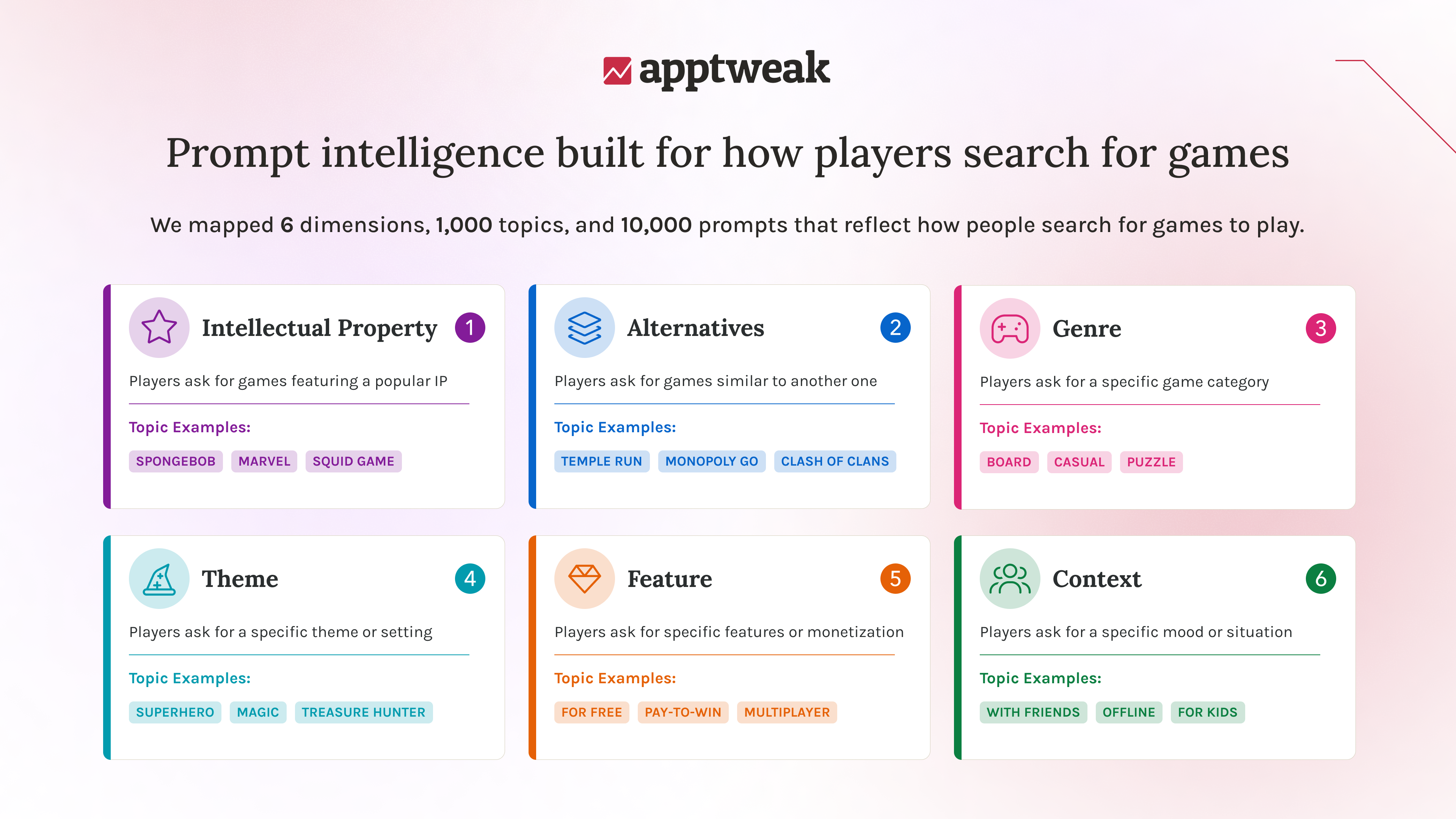
For each dimension, we then identified hundreds of topics – a curated list of the most common reasons players search, drawn from our GameDNA intelligence:
- Popular game subgenres
- Leading titles, franchises, and IPs
- Top searched keywords
Next, we built thousands of prompts – the specific questions sent to ChatGPT and Gemini. These prompts are designed to reflect how players search for games in conversational language, and combine topics to reliably measure how each game performs across discovery intents.
Finally, each game mentioned by the AI assistant is mapped to real game IDs within AppTweak’s database, uncovering true competitive landscapes across prompts and topics.
In total, AI Visibility for Games analyzes over 1,000 gaming topics and 10,000 prompts, with weekly ChatGPT and Gemini responses aggregated over time. Our framework is grounded in:
- 12+ years of app store data across iOS and Android
- Deep mapping of 100+ GameDNA subcategories
- Hands-on experience helping mobile games grow
By aggregating results across prompts, topics, and time, AI Visibility helps reduce the noise and variability that naturally exist in individual AI responses.
Meet AI Visibility for Games, only available in AppTweak
AI Visibility in AppTweak now shows where and how mobile games appear in AI recommendations, across relevant gaming topics and player intents.
AI Visibility Overview
First, the AI Visibility Overview provides a data-driven summary of the main dimensions and topics your game appears for in AI answers.
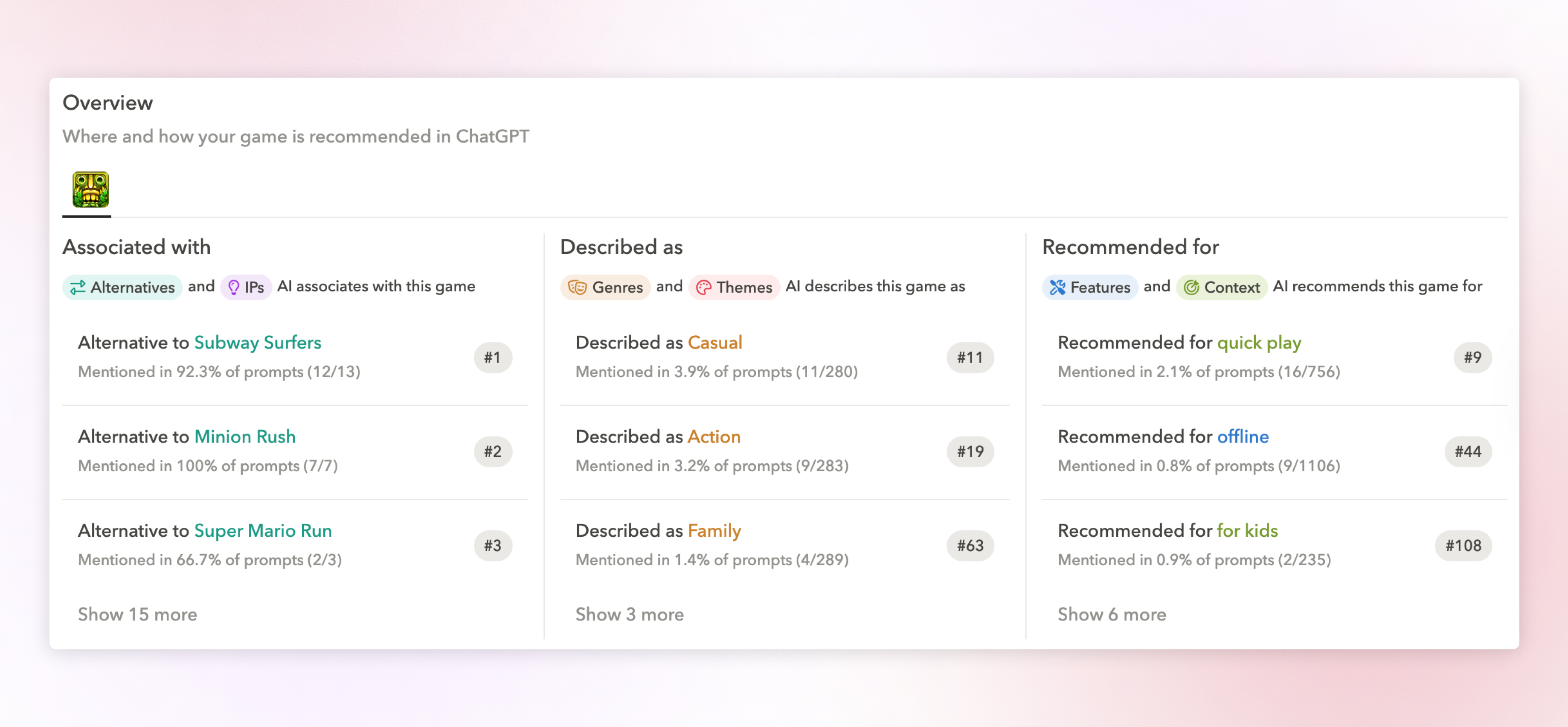
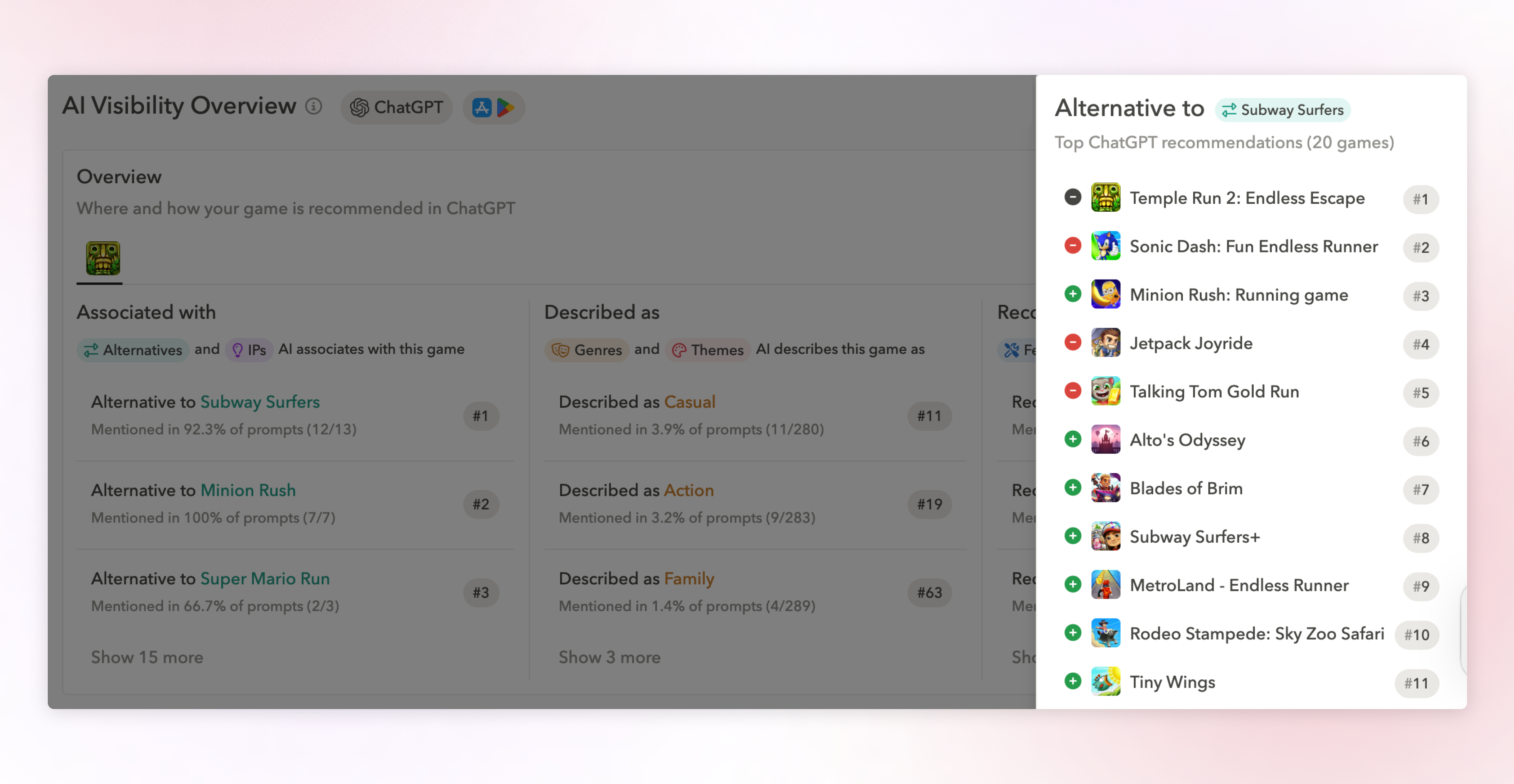
For example, Temple Run 2 is currently positioned by ChatGPT as:
- #1 alternative to Subway Surfers
- #11 recommended casual game
- #9 recommended game for quick play
You get a clear view of how AI systems perceive your game, which player intents you dominate, and which other competitors are leading your key topics.
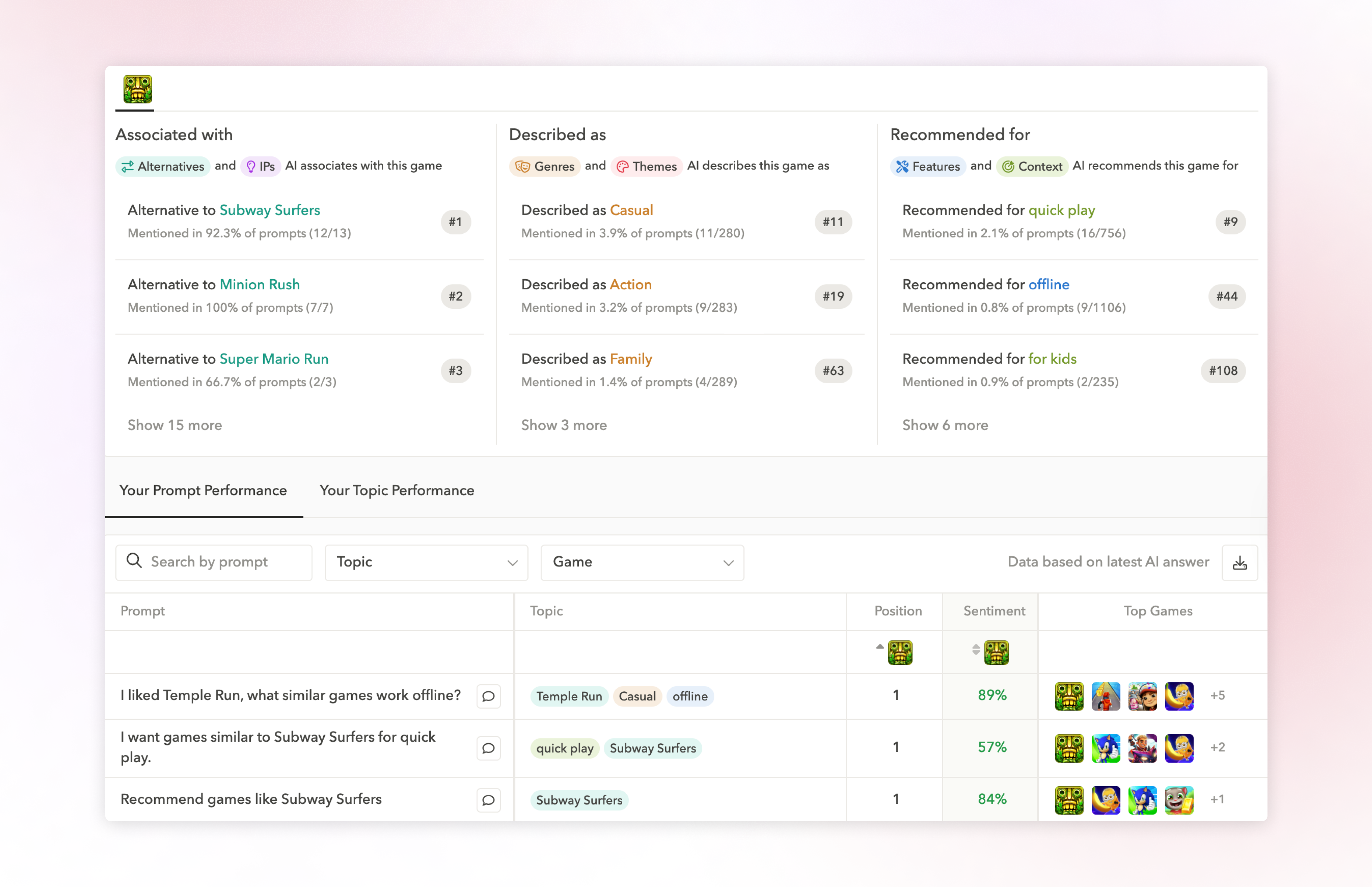
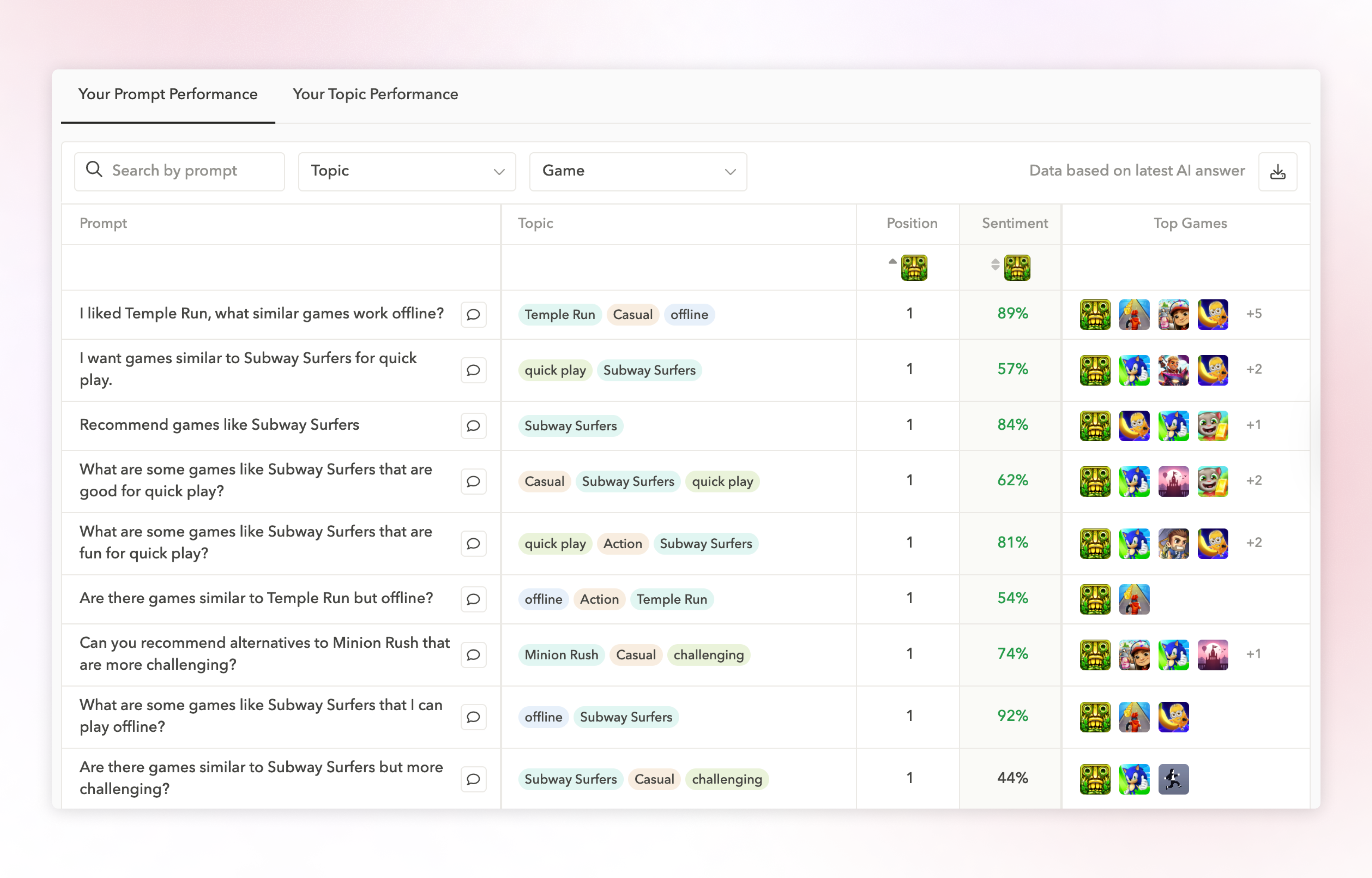
Game performance across AI prompts and topics
For every topic and prompt your game appears in, AppTweak tracks:
- Position: Your weighted ranking, factoring in how often and how highly your game is recommended by AI
- Sentiment: How positively AI describes your game
- Top Games: The strongest-performing competitors for each topic, based on Position
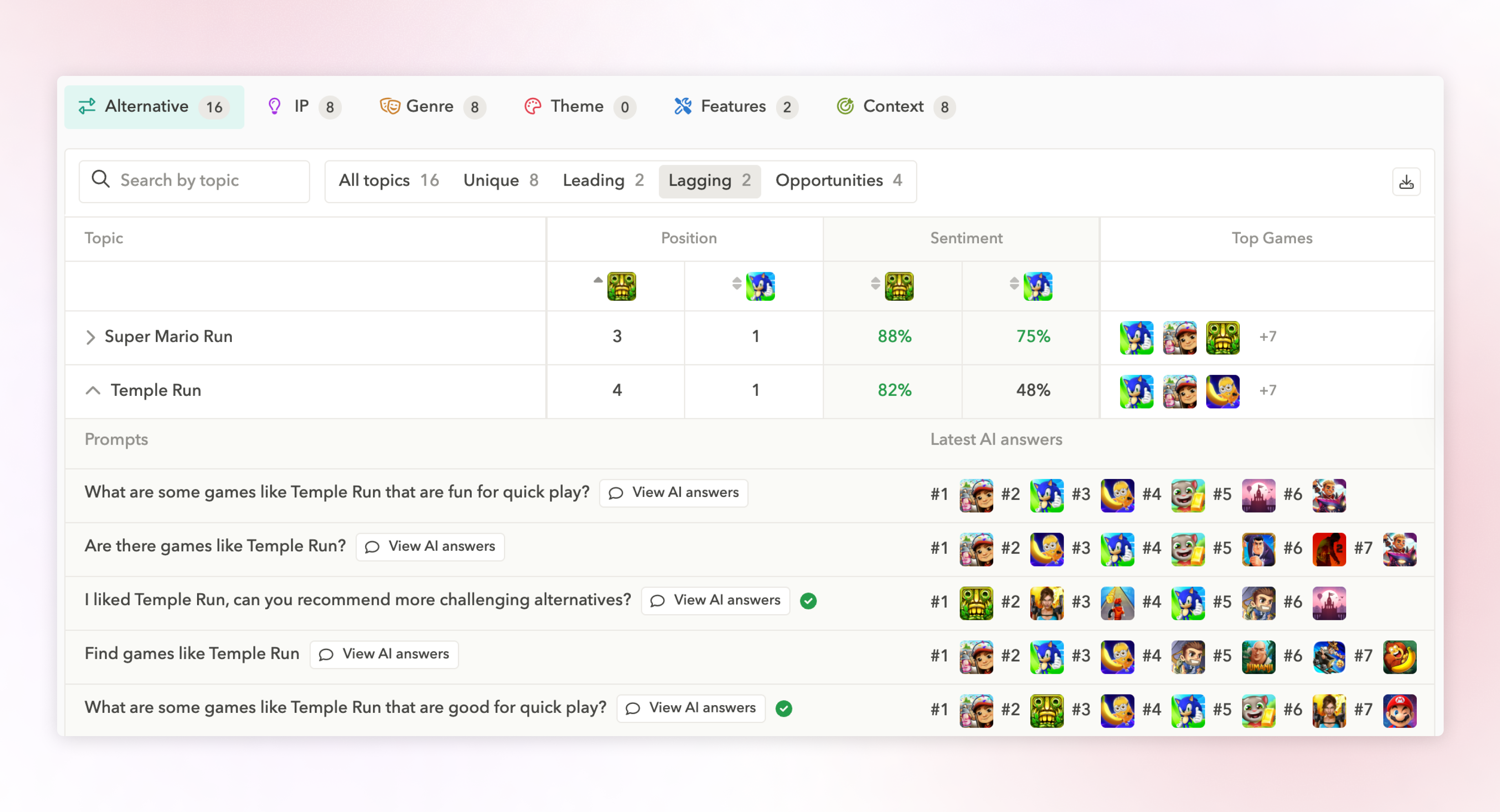
Competitive benchmarking across topics
By adding competitors, you can also compare your games’ AI search performance to uncover the topics you lead, where competitors outperform, and new competitors or themes you may not be tracking yet.
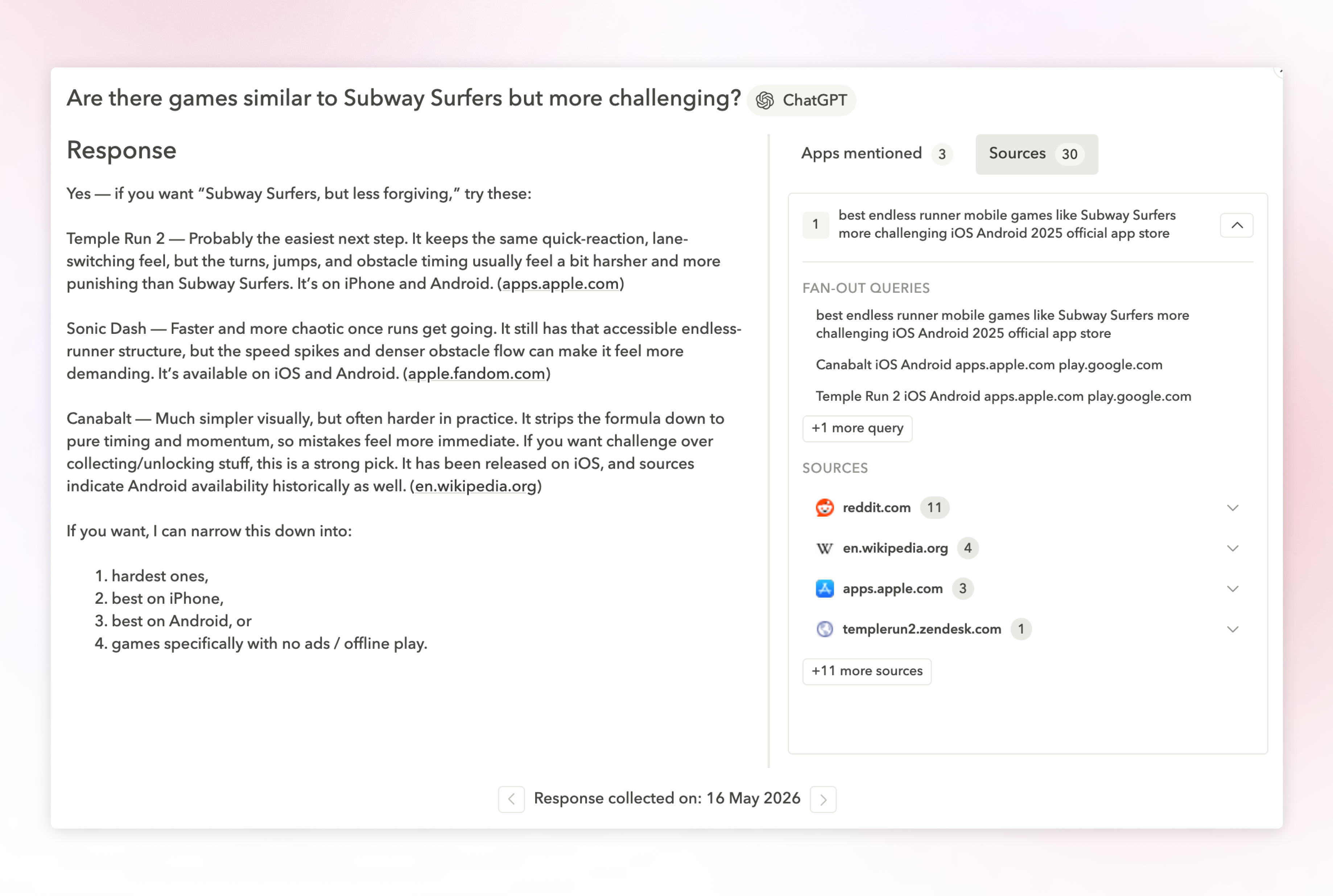
Sources and fanout queries: Understand how ChatGPT makes each recommendation
Understanding your games’ visibility is step one. To improve your position, you also need to prioritize efforts based on the sources and signals AI actually uses.
In AppTweak, you can get more qualitative context by viewing raw ChatGPT responses, the fanout queries AI sent to research the question, and the web sources it referenced.
If a competitor ranks above your game for a specific topic, you can trace exactly where that visibility may be coming from – whether from app store listings, editorial coverage, or community forums.
Tips to improve AI visibility for mobile games
Improving AI visibility starts with understanding how AI systems interpret and surface your game.
Then comes experimentation.
Early patterns point to a clear order of priority for games. Because AI leans so heavily on app store listings for games, optimizing your store listing is the highest-impact first step. Longer term, building owned web content is the biggest gap most studios have, even a simple page explaining what your game is, who it’s for, and what makes it worth playing can be one of the highest-leverage moves available.
- On your app store listing: App store pages are indexed on the web and used by AI systems to understand apps and games. Make sure your metadata clearly reflects the features, themes, and audiences you want your game associated with. Your long description is also a great opportunity to reinforce important discovery topics that may not appear elsewhere in your metadata.
- On your website: Create dedicated pages for each title explaining what the game is, who it’s for, and how it compares to alternatives. Experiment with FAQs and internal linking to help AI better understand relationships between your titles and topics – this is the biggest gap for most games teams.
- In community spaces: Find the forums and community platforms where players already gather – Reddit, fan wikis, community pages. These are among the most cited sources in ChatGPT recommendations.
How to measure AI visibility and prove impact
Measuring impact in AI search is fundamentally different from traditional search, as AI recommendations influence consideration before a player ever reaches the app stores.
While a small portion of users may click directly on cited links, many simply remember a recommendation and search for the game later, making AI discovery a largely zero-click environment.
As a result, measuring AI visibility requires a different set of leading and lagging indicators, including:
- AI recommendation positions
- Sentiment
- Brand keyword growth
- Organic traffic trends
The challenge is timing.
By the time AI-driven impact can be clearly measured in installs, competitive leaders may have already pulled ahead. That’s why the studios experimenting and learning today are likely to be in the strongest position as the channel matures.
More tips to measure the impact of GEO efforts for mobile apps and games
AI Visibility: A new intelligence layer for mobile game discovery
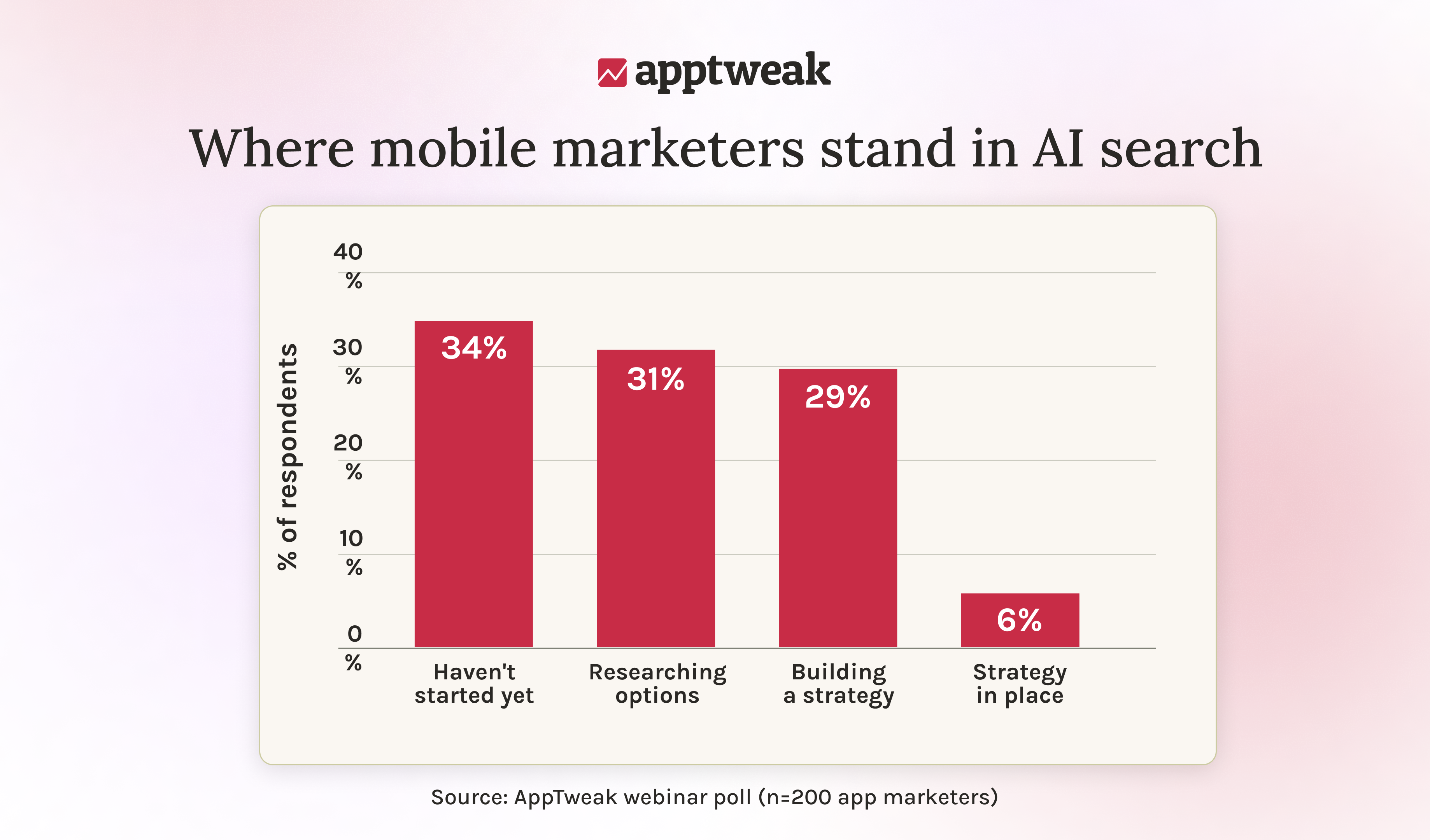
AppTweak recently asked 200 app marketers where they stand on AI search.
Only 6% said they already have a strategy in place. 34% said they have not started at all.
But AI-driven discovery is already happening. Mobile games are already being surfaced, compared, and recommended by AI tools like ChatGPT and Gemini.
AI Visibility for Games is the first intelligence built to show whether your games appear, where competitors are outperforming you, and which player intents influence your visibility in AI search.
If your game isn’t part of the answer, who is?
To see where your games stand in AI chatbots, AI Visibility is now available as an add-on to AppTweak Enterprise plans.
FAQs
What is AI Visibility for Games?
AI Visibility for Games is the first measurement platform that shows mobile game studios if and how their games appear in ChatGPT and Gemini recommendations. AppTweak mapped over 1,000 gaming topics and 10,000+ prompts built around how players actually search for mobile games. Results are aggregated weekly to reduce the natural variability of individual AI responses.
How is AI game discovery different from AI app discovery?
AI game discovery is experience-driven, while AI app discovery is task-driven. Players ask a chatbot for games based on mood, setting, or familiar titles (e.g., “games like Among Us,” “cozy farming games,” “offline puzzle games”). Non-gaming app searches are typically anchored to a specific job to be done, such as “budget tracker that syncs to my bank.” This difference in intent is why AppTweak built a separate measurement framework for games rather than extending its apps approach directly.
Why isn't manually testing prompts in an AI assistant enough to measure AI visibility?
Manually testing a few prompts in AI assistants only provides anecdotal evidence – not a reliable picture of how your game performs across AI recommendations broadly. AI responses vary based on prompt phrasing, timing, and player intent, meaning a handful of successful results can create a misleading sense of visibility. Properly measuring AI visibility for games requires enough prompts to reflect why players actually search, consistent tracking over time, aggregated performance metrics, and competitive benchmarking across topics, none of which manual testing can deliver at scale.
What sources does ChatGPT use when recommending mobile games?
ChatGPT draws on live web retrieval when generating game recommendations. Based on early patterns visible in AppTweak’s AI Visibility source data, the most commonly referenced sources include app store listing pages, game studio websites, and community platforms such as Reddit, Wikipedia, and gaming forums. App store pages are indexed on the web and used by AI systems to understand what a game is, who it is for, and how it relates to similar titles. Studios can view the exact sources and fanout queries AI used for each recommendation directly inside AppTweak.
How do I improve my mobile game's visibility in AI assistants?
Improving AI visibility starts with making sure the signals AI assistants retrieves about your game are clear and consistent. Three areas worth prioritizing based on early patterns:
- App store listing: Make sure metadata reflects the genres, themes, and audiences you want the game associated with – including the long description, which AI systems can read when crawling the web-indexed app store page.
- Game website: Create dedicated pages per title explaining what the game is and how it compares to similar games; FAQs and internal linking help AI systems understand relationships between titles.
- Community spaces: Reddit threads, fan wikis, and gaming forums are among the most cited sources in ChatGPT recommendations.
How do I measure the impact of AI visibility on game downloads if it's a zero-click channel?
Because AI game discovery is largely zero-click (players receive a recommendation and then search directly in the store rather than clicking a link) traditional conversion tracking cannot capture early-stage impact. The main indicators to monitor include AI recommendation positions, sentiment trends, and brand keyword growth in the app stores. The challenge is that by the time AI-driven impact becomes clearly visible in install data, competitive positions may already be set – which is why studios that start experimenting and learning now will be in the strongest positions as the channel matures.


More articles in AI Visibility, Artificial Intelligence (AI), Product Updates

 Georgia Shepherd

 Antoine Bentin

 Pierre-Antoine Roy