The World Cup is one of the clearest examples of how seasonality changes user behavior in the App Store.
For the audiences most connected to the tournament, the shift is real. Search behavior becomes more intentional. Decision-making speeds up. Competition intensifies around the queries, messages, and moments that feel most relevant to the event.
This is what makes the World Cup such a critical moment for app marketers. It is not just a spike in attention, but a period where relevance is tested in real time. The apps that perform best are usually not the ones making the loudest last-minute push. They are the ones that understand how demand builds, where it concentrates, and how to align their App Store presence to what users care about before and during the tournament.
For sports, streaming, and sports betting apps, that opportunity is direct. For other categories, it is less obvious but still significant. The challenge is not simply to be present during the World Cup. It is to make sure your app feels contextually relevant when user intent is at its highest.
Key takeaways
- The World Cup creates multiple high-intent demand spikes tied to specific matches, teams, and moments rather than a single, steady traffic increase
- Search behavior becomes more specific during the tournament, shifting from broad queries to intent-driven searches such as live viewing, scores, or match-related actions
- App Store visibility during the World Cup is typically won before the event through early keyword alignment, metadata optimization, and creative preparation
- Effective ASO strategies rely on structuring keywords into intent clusters rather than targeting a small list of generic World Cup terms
- Performance depends on aligning metadata, creatives, custom product pages, and Apple Ads with real-time user intent during key match moments
- Long-term growth comes from measuring incrementality and identifying which gains persist after the tournament, not just tracking install spikes
Plan your World Cup strategy before the tournament peaks
Download The 2026 World Cup App Store playbook
Get a practical framework to plan, execute, and optimize your App Store strategy across every phase of the World Cup, including market insights and CPI benchmarks to guide your ASO & Apple Ads efforts.
The 2026 World Cup App Store playbook
This playbook gives you a practical framework to plan, execute, and optimize your App Store strategy with market insights and CPI benchmarks to guide your ASO and Apple Ads efforts.
Download nowWhat changes in the App Store when World Cup demand rises
The World Cup does not create one single burst of demand. It creates a sequence of high-intent windows. Search behavior rises around the opening phase, important national-team matches, knockout rounds, and other culturally charged moments. In some markets, a locally relevant fixture can matter more than a globally significant one.
AppTweak’s analysis of the previous World Cup reveals that demand rises quickly once the tournament begins, but not evenly. Opening-week growth can be strong across regions, while the sharpest peaks often cluster around locally relevant matches, which makes the World Cup both a global opportunity and a market-specific one.
Search gets more specific, and more competitive
As interest in the tournament rises, users move from broad browsing to more deliberate search. They look for tournament-related terms, team-related queries, live experiences, and category-specific needs tied to the moment.
For sports betting apps, that might mean odds, live betting, or match-specific searches. For streaming apps, it could mean team coverage, live viewing, or tournament access. For other categories, the shift may show up differently, but the pattern is the same: user intent becomes more specific.
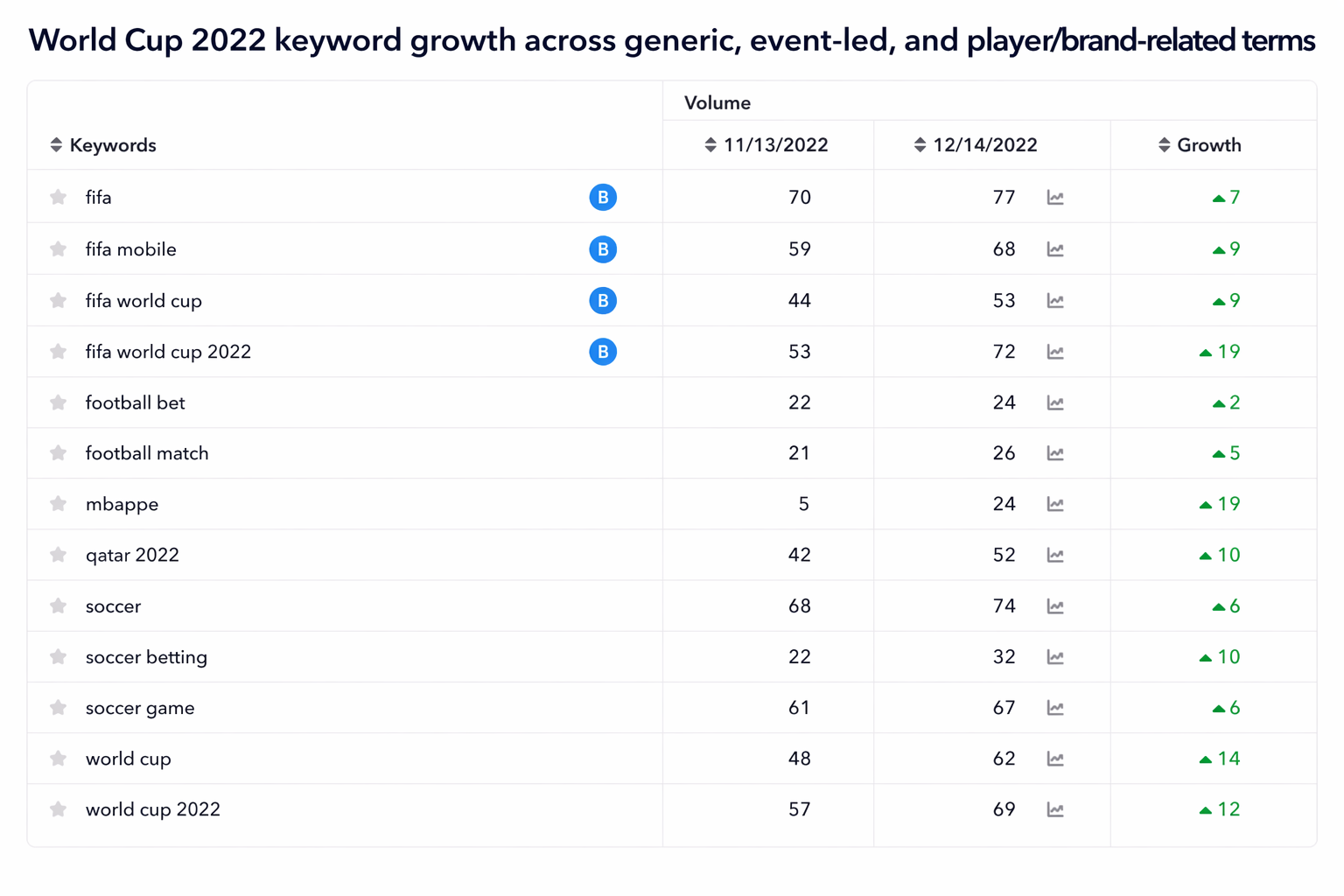
This is why search becomes incredibly important during the World Cup. Tournament periods do not just expand demand. They also compress competition around the most valuable terms. That is especially visible when keyword volumes increase across generic, event-led, and branded searches at the same time.
Demand concentrates around moments, not averages
The World Cup does not unfold like a steady seasonal curve. Demand clusters around specific moments. The highest US peak in the previous World Cup occurred the day before the England vs USA match, which is a good reminder that local team relevance can create sharper spikes than broader tournament interest alone.
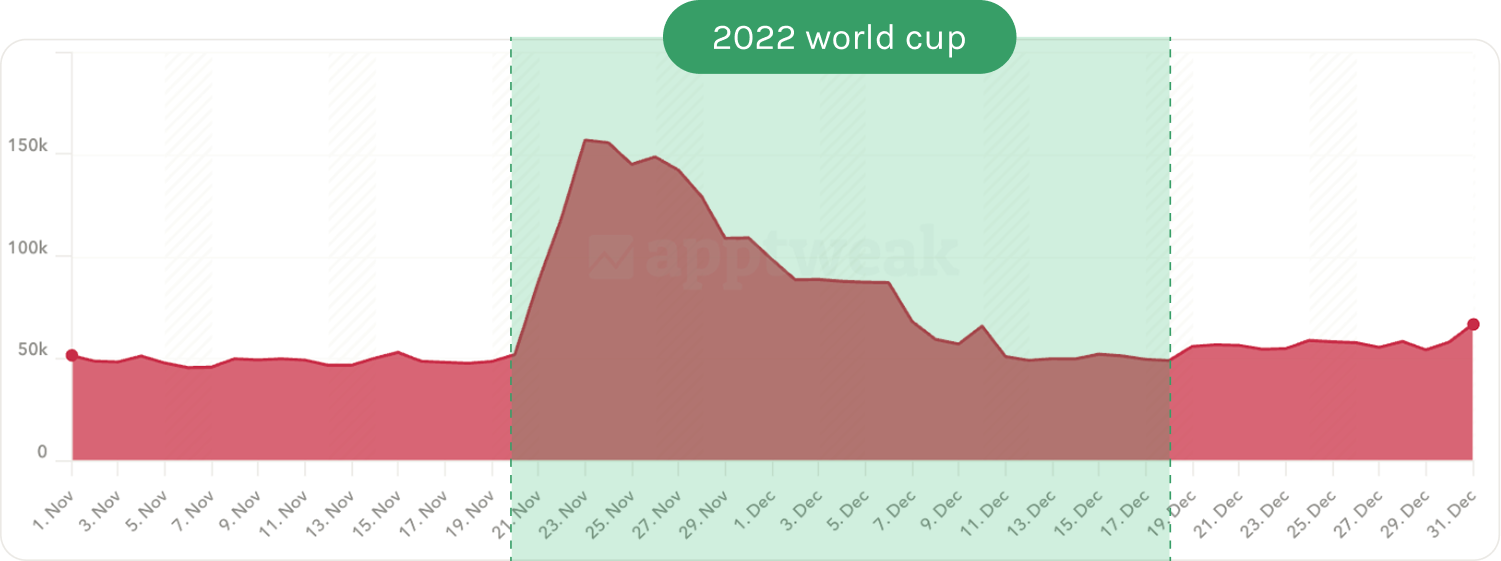
That means the strategic question is not “Will demand rise?” It is “Which moments will matter most in our priority markets, and are we prepared when they arrive?”
Why visibility is won before the opening match
If the World Cup makes one thing obvious, it is this: visibility is usually earned before the event.
By the time tournament demand peaks, the most effective apps have already done the hard work. They have thought through keyword coverage, seasonal messaging, creative alignment, and where paid and organic need to reinforce each other.
Early relevance is cheaper than late urgency
When teams wait until the tournament is already underway, they are often trying to build relevance at the same moment competition intensifies. That is one reason seasonal execution can feel expensive and reactive.
A more effective approach is to prepare for demand before it fully materializes. HBO Max (now HBO), for example, began ranking for “March Madness” keywords immediately after an early version update—likely by adding these terms to its metadata. This early alignment helped build relevance ahead of peak demand, strengthening visibility and likely contributed to improving Apple Ads performance during the event.
![- [ ] HBO Max ranking for "March Madness" keywords after version update in March 2024.](/img/2026/05/Screenshot-2026-05-01-at-7.25.11-AM.png?auto=format%2Ccompress&w=738&h=798&fit=crop)
Seasonal demand needs a keyword structure, not a keyword list
Another mistake teams make is treating World Cup ASO as a short list of headline keywords. That approach is too narrow for how search works today.
A better way to plan is to organize demand into intent clusters. Separate event-core searches, branded terms, host-market and national-team queries, and live score and results by intent. Your keyword list not just be grouped by topic, but by the user motivation behind them. It is to understand whether the user is looking to watch, track, compare, bet, follow a team, or solve some adjacent need.
A broad term like “world cup” does not signal the same need as “usa soccer,” “live score,” or a branded search for a known app. If those queries are treated as one undifferentiated keyword target, the resulting metadata, creatives, and Apple Ads coverage often become too generic to perform well. For a deeper dive on intents, read How AI is changing relevance in app store search.
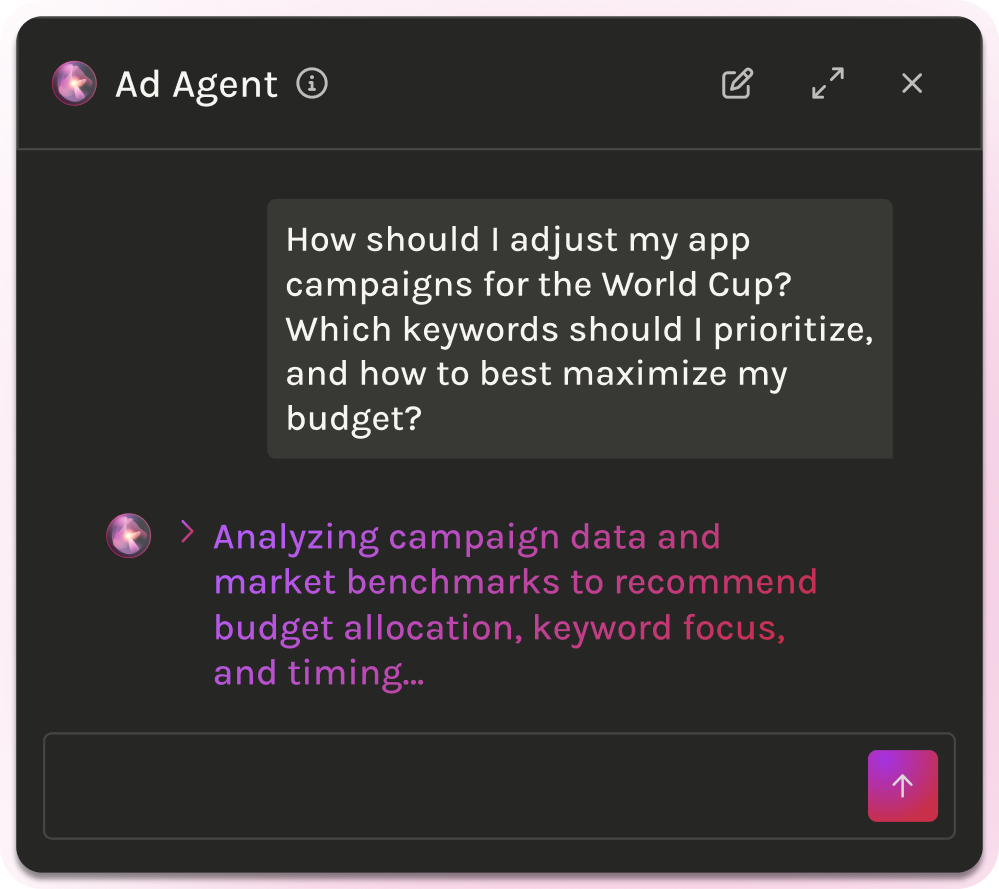
In AppTweak, this kind of work starts by building semantic keyword lists around the main World Cup themes, then refining them into intent-informed clusters. Teams can use Keyword Research, Semantic suggestions, and keyword clusters to expand from a seed term like “world cup” or “soccer” into related search patterns, then group those terms according to what users are actually trying to do.
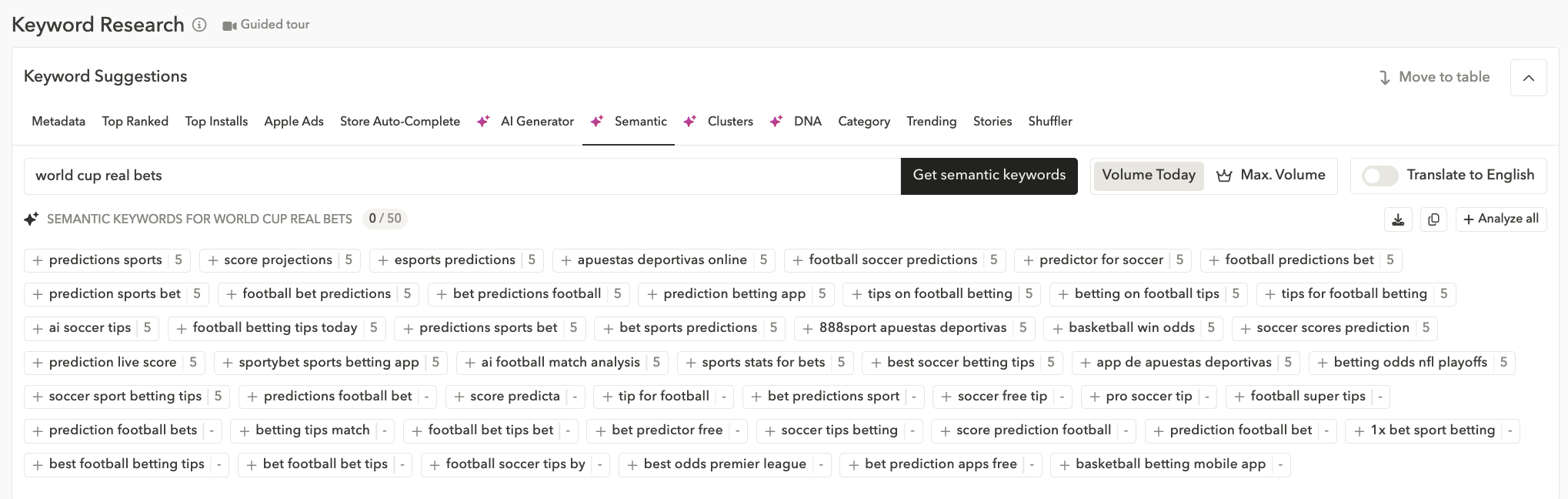
From there, those clusters become decision tools. They can guide which terms belong in metadata, which themes deserve dedicated creative treatment, and where custom product pages or Apple Ads campaigns should map to a more specific tournament use case. This reflects how search relevance actually works today.
Preparing early also means preparing assets
Preparing early is not only about deciding which keywords matter. It is also about deciding how those intents will show up on the page once users land there.
It’s essential to think “Which of my world-cup-related intents are important enough to deserve their own message?” A streaming app may need one creative direction built around live match access and another around tournament coverage. A sports app may want to distinguish between live score intent and team-following intent. A non-sports app may only need a lighter seasonal variant, but even that should connect to a real event-driven use case rather than a cosmetic refresh.
Creative research, competitor monitoring, and keyword clustering can help teams see which themes are rising, what rivals are highlighting, and whether certain intents deserve their own custom product page or screenshot direction.
In practice, metadata research informs custom product pages, seasonal patterns guide timing, and creatives should reflect the intents users care about most.
Why the best World Cup strategies are adaptive, not static
Preparation matters, but the World Cup does not reward static planning. It rewards teams that can respond as the tournament changes shape.
Team progression, local excitement, upset results, and match timing all affect how demand behaves.
Plan your response before the moment happens
During the World Cup, performance shifts faster than teams can react manually.
Bids fluctuate, competitors refresh creatives, and conversion rates can change within hours depending on match context. Reacting in real time often means reacting too late.
High-performing teams plan their response in advance. They define how campaigns should behave when conditions change—scaling bids when conversion rises, protecting efficiency when it drops, and adjusting coverage when competition intensifies.
This is where automation becomes a strategic advantage.
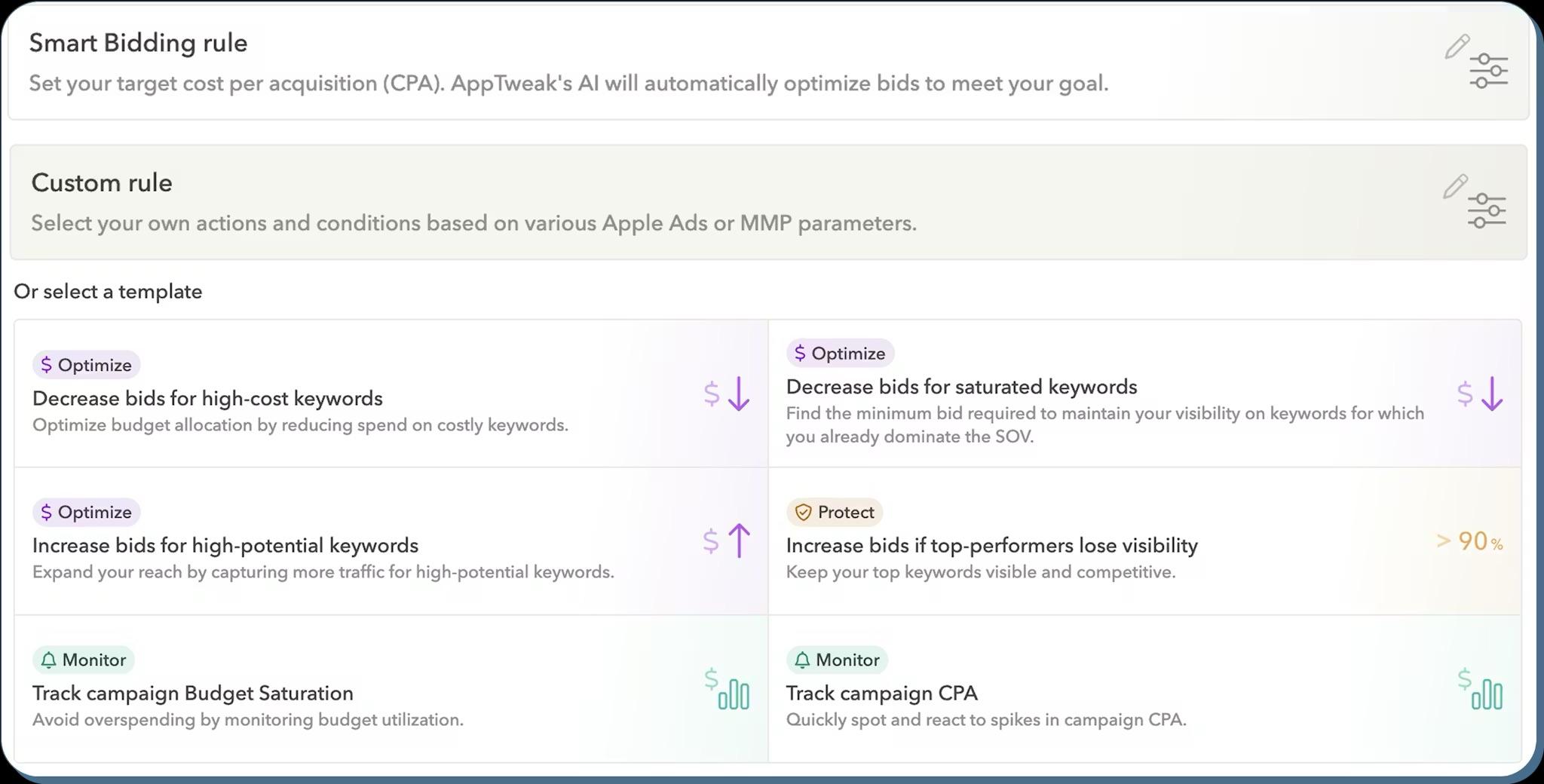
With AppTweak’s Campaign Manager, teams can set automated rules and alerts across their Apple Ads campaigns. This allows them to maximize their budgets and scale visibility when intent is highest during the World Cup.
The result is not just faster execution. It is more controlled execution during the moments that matter most.
Adapt to market-specific momentum
Tournament momentum is not evenly distributed. When a national team captures attention, local demand can rise quickly. Saudi Arabia’s win over Argentina in 2022 is a clear example. The result triggered nationwide celebrations and even a national holiday, concentrating attention around the tournament and increasing engagement with football-related content. Moments like this tend to amplify search, comparison, and app usage in the markets most emotionally invested in the outcome.
Therefore, it’s crucial app marketers adapt to the momentum in how people search, shop, and engage in a given market affected by the World Cup. That means teams should be ready to adjust market prioritization during the tournament, not just before it. A static international plan can miss where momentum is actually building.
Adapt to match-day intent, not daily averages
One of the biggest misconceptions about the World Cup is that demand rises evenly across the tournament.
It doesn’t.
Interest concentrates around specific moments. Kickoff windows, high-stakes matches, national team fixtures, and knockout rounds all create short bursts of high-intent behavior. During these windows, users are not casually browsing. They are searching with a clear purpose and making faster decisions.
That has direct implications for how apps should approach visibility.
Winning teams do not optimize for an “average World Cup day.” They align their App Store presence to the moments when user intent is at its highest.
This changes how different categories execute:
- A streaming app may shift its messaging to emphasize live viewing just before kickoff
- A media app may highlight real-time updates, scores, or breaking coverage during matches
- A sports betting app may align its store message, Apple Ads coverage, and in-app event to a specific fixture or betting moment
The key is alignment. What users search for, what they see in the App Store, and what the app promises should all reflect the same moment.
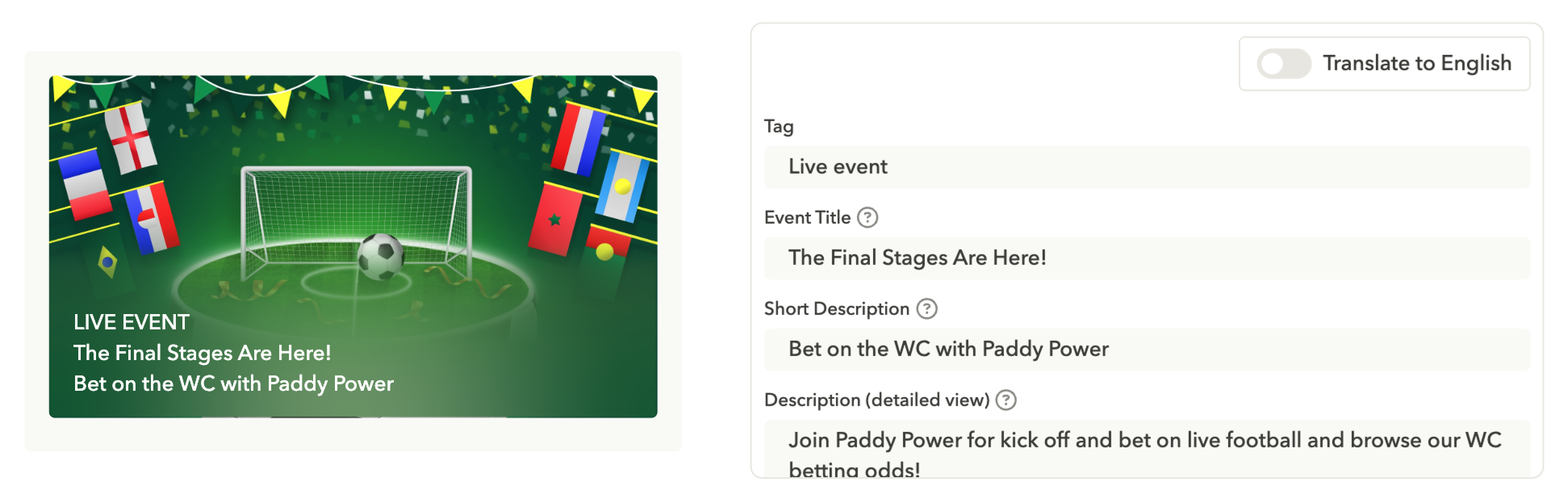
In this example, the in-app event by Paddy Power Sports Betting is tied directly to the final stages of the World Cup, with messaging focused on immediate action: betting on live matches and engaging with tournament odds. The timing and framing are intentional. This is not a generic World Cup message. It is aligned to a specific phase of the tournament when user urgency is highest.
Each phase of the tournament, each match window, and each shift in user behavior may require a different message. Managing those transitions manually across multiple custom product pages quickly becomes difficult, especially when timing matters.
Scheduling becomes critical.
With AppTweak’s CPP Scheduling, teams can plan and automate when specific custom product pages go live. This makes it possible to align creatives with kickoff windows, knockout rounds, and other high-intent moments without relying on manual updates.
The logic is simple. Users searching at this stage are not responding to general tournament awareness. They are reacting to a specific moment. When the App Store presence reflects that immediacy, it becomes easier to convert intent into installs.
Adapt creative and messaging as the story evolves
The World Cup does not unfold in a straight line. User intent shifts as the tournament progresses, and messaging needs to shift with it.
Early in the tournament, users are exploring. They follow multiple teams, compare apps, and look for broad coverage. As the competition narrows, intent becomes more focused. Users care about specific matches, outcomes, and real-time updates. By the final stages, urgency peaks and expectations shift toward immediate action.
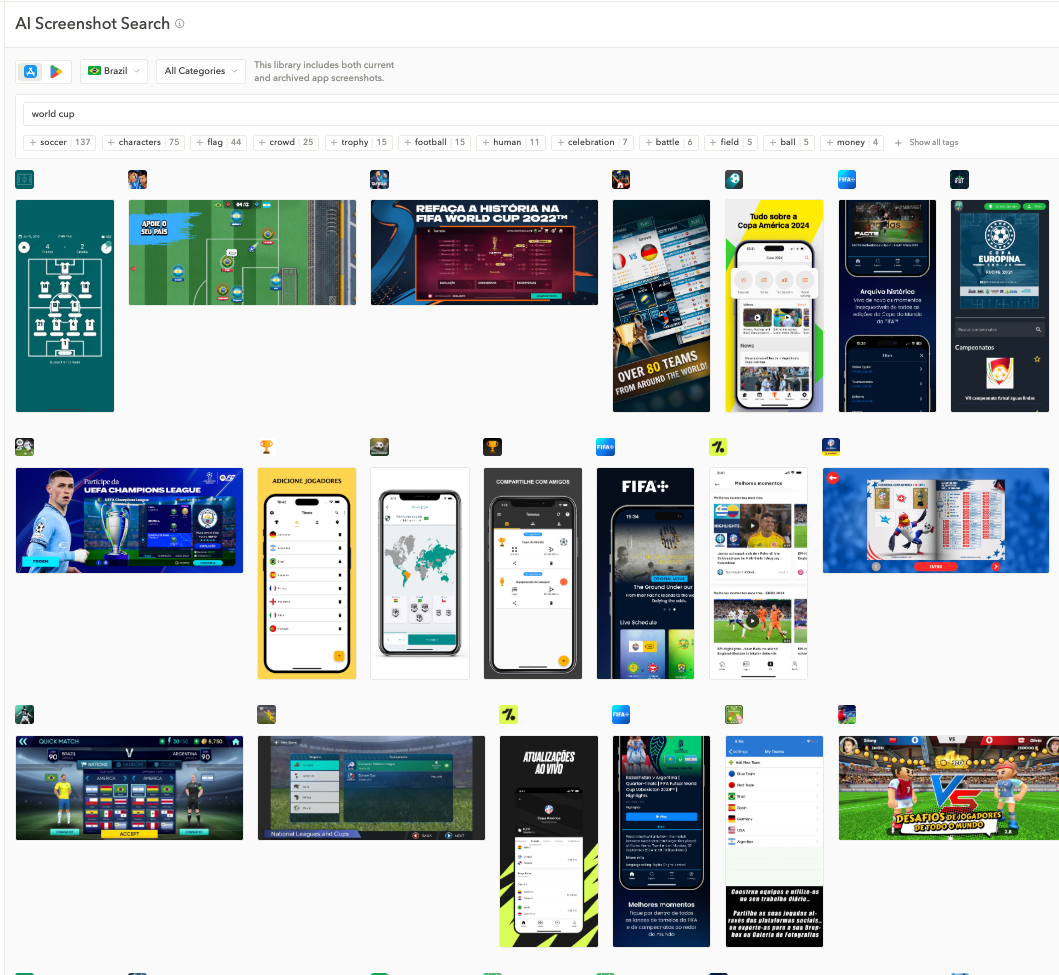
For example, a streaming app might start with broad “watch the tournament” messaging, then shift toward “watch live matches” during knockout rounds, and finally emphasize immediacy during the final. The same pattern applies across categories, even if the use case differs.
The key is aligning messaging with how user intent evolves over time.
How apps outside sports can capitalize on the World Cup
The World Cup is the most consequential for sports, streaming, score, and sports betting apps. But it also creates openings for categories that are adjacent to fan behavior rather than the sport itself. That is the more interesting non-sports story, and it belongs here, once the mechanics of demand and adaptation have already been established.
E-commerce apps can align with match-day behavior
During major matches, user behavior often shifts toward match-day preparation. That can include upgrading viewing setups, buying merchandise, or organizing watch parties.
For e-commerce apps, the opportunity is to reflect these use cases directly in the App Store. Instead of generic promotions, creatives can highlight products in context, such as home viewing setups, limited-time bundles, or team-related merchandise.
The goal is not to position the app as part of the sport itself. It is to show how it fits into the way users experience the tournament.
Gaming apps can translate tournament structure into engagement
The World Cup naturally mirrors many of the mechanics that drive engagement in games. Competition between countries, knockout progression, and match predictions are all systems users already understand.
Gaming apps that perform well during these moments tend to build on that structure. Instead of relying on generic football visuals, they introduce features or events that reflect how the tournament works, such as prediction challenges, country-based competitions, or time-limited events tied to match outcomes.
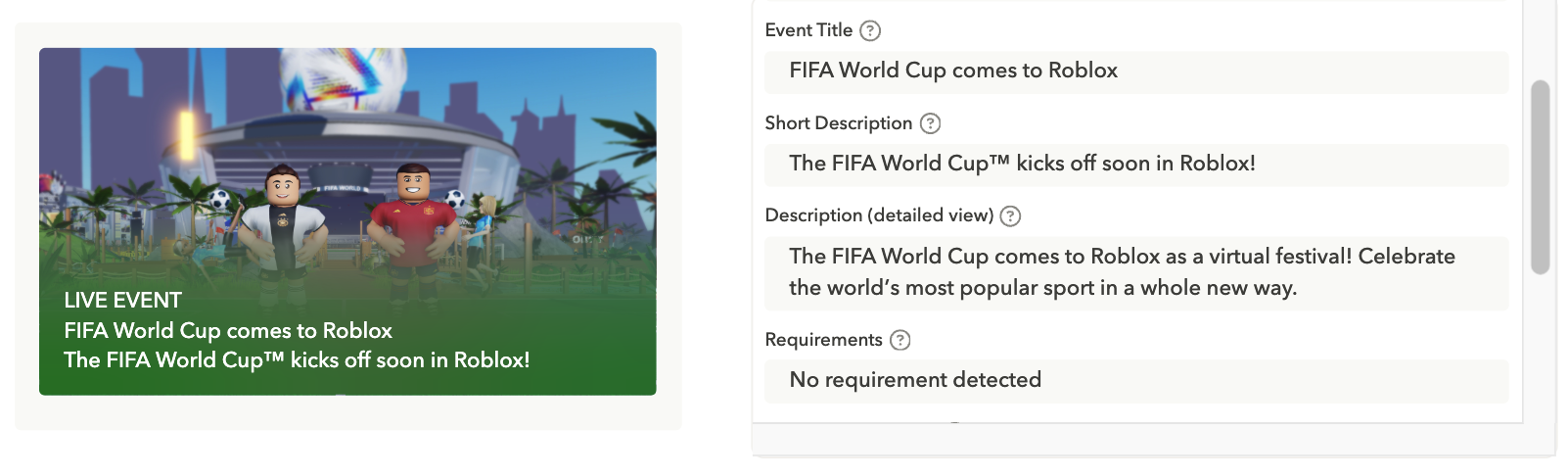
In the App Store, this can be reinforced through creatives and in-app events that clearly connect the gameplay to the tournament experience.
Fitness and lifestyle apps can use the moment more subtly
Not every category needs a full World Cup activation.
For fitness and lifestyle apps, a lighter approach is often more effective. The tournament can serve as a contextual layer rather than the core message.
That might mean leaning into themes like performance, training, or competition in a way that feels timely without forcing a direct link to football. Even a subtle creative refresh can make the product page feel more current and aligned with what users are paying attention to.
In many cases, this kind of understated approach is more credible than a heavy seasonal message that does not clearly connect to the app’s core value.
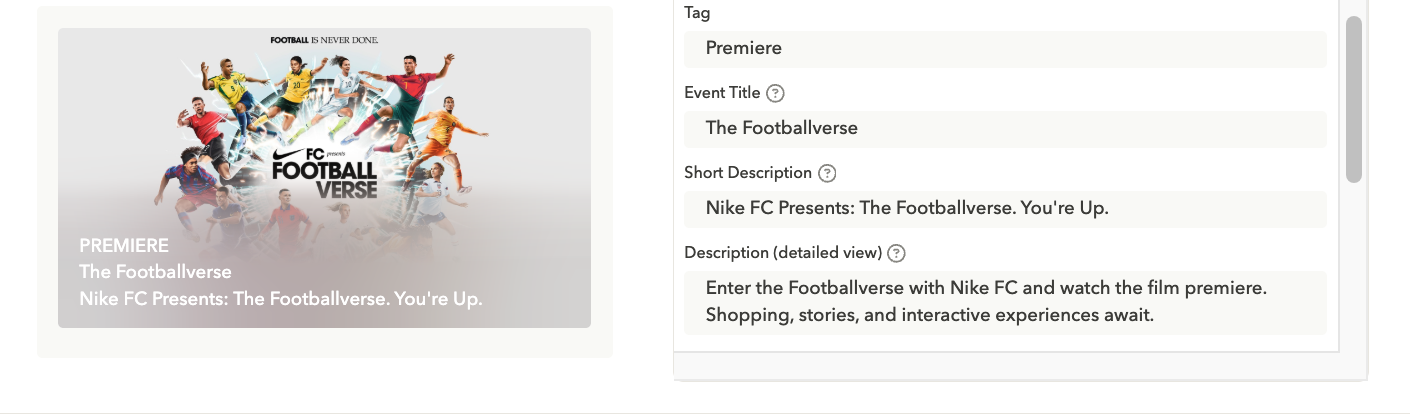
Nike’s ecosystem is a good example of building a campaign around the World Cup as a brand. During the 2022 World Cup, the brand extended its Footballverse campaign into its apps through in-app events and editorial content, framing the moment around performance, athlete mindset, and global competition rather than the tournament itself. The focus wasn’t on football as a feature, but on capturing the energy of the event in a way that still aligned with Nike’s core fitness and training proposition.
The rule for non-sports apps is relevance, not decoration
Apps outside sports can benefit from the World Cup, but only when the connection feels logical from the user’s point of view. A themed screenshot alone is rarely enough. The best non-sports activations are the ones where the seasonal moment clarifies the app’s value instead of distracting from it. When that link is clear, the World Cup becomes a powerful growth driver, even for categories that sit outside sport.
How ASO and Apple Ads reinforce each other
The World Cup is also one of the clearest moments to show why ASO and Apple Ads work best together.
When demand rises quickly, more apps begin targeting the same queries and audiences within a short window. In that environment, paid and organic should not operate independently; instead, they can reinforce each other.
Teams that treat them as a combined system tend to capture demand more efficiently.
Build relevance before demand peaks
When seasonal demand spikes, acquisition costs often increase. That makes early organic relevance a meaningful advantage.
Apps that have already aligned their metadata and keyword coverage to World Cup-related intent are more likely to rank, convert, and perform efficiently once Apple Ads activity increases. Instead of relying entirely on paid visibility during peak demand periods, they enter the moment with a stronger foundation.
A common pattern during major events is that early keyword alignment improves organic positioning first, which then supports Apple Ads performance as demand grows. The result is not just more visibility, but more efficient visibility when it matters most.
Importantly, this does not necessarily mean increasing spend, but improving how paid and organic strategies work together.
Match the landing experience to the intent behind the search
During the World Cup, not all users are searching for the same thing.
Some are looking to watch matches. Others want live scores, team updates, or ways to engage with the event in real time. These represent different types of intent, even within the same tournament.
This is where custom product pages become critical.
Instead of relying on a single default page, teams can align different landing experiences to different search behaviors. A user searching for live viewing should land on a page that emphasizes immediacy. A user searching for team-related content should see messaging that reflects that context.
What often gets overlooked is how quickly intent can shift during live events. A user searching before a match may be exploring options, while the same user during a live game is looking for instant access or real-time updates.
Teams that adapt their product page messaging to these moments tend to create a more consistent experience from search to install.
When the message matches the intent behind the tap, conversion rates improve. When it does not, even strong visibility may underperform.
Use real-time signals to improve both channels
The World Cup creates a fast-moving environment where performance signals become more visible.
Keyword rankings shift. Creatives evolve. Conversion rates change in response to match outcomes and user interest. These changes happen quickly, and they influence both organic and paid performance.
Teams that monitor these signals closely are better positioned to adapt. They can refine keyword focus, update creatives, and adjust budget allocation based on observed performance trends.
This is where tools like AppTweak play a role, helping teams track keyword movement, app visibility, and performance trends so they can respond with greater clarity.
The advantage is not just stronger performance during the event, but the ability to make informed decisions while the market is still evolving.
What separates short-term spikes from lasting gains
The World Cup will drive a surge in installs for many apps. That part is expected. What matters more is understanding how much of that growth is actually incremental.
Not every spike reflects real performance. Some of it comes from seasonal demand that would have happened anyway. Some of it is driven by paid campaigns capturing users who might have converted organically. And some of it disappears as soon as the tournament ends.
This is where teams need to look beyond total installs and focus on impact.
- Did a metadata update drive new visibility, or just redistribute traffic across keywords?
- Did Apple Ads campaigns bring in new users, or capture existing demand?
- Did a creative change improve conversion, or simply benefit from peak interest around the event?
These are the questions that separate temporary uplift from meaningful growth.
Tip: Tools like AppTweak’s Incrementality Analysis help teams answer these questions by isolating the true impact of ASO updates, Apple Ads campaigns, and seasonal activations from underlying market trends.
Look at what holds after the event
One of the clearest ways to identify real impact is to observe what continues to perform once demand normalizes.
If certain keyword clusters keep ranking, if specific creatives continue to convert, or if a custom product page maintains stronger performance, those are signs of improvement that go beyond the event itself.
If performance drops immediately after the tournament, it is more likely that the uplift was driven by external demand rather than by changes in strategy.
Use the World Cup to improve future performance
The value of the World Cup is not limited to the event itself.
It creates a clear window to test how different keywords, creatives, and acquisition strategies perform under high demand. Teams that analyze those results can identify what actually influenced growth and apply those insights to future campaigns.
Conclusion
The World Cup is not a single spike in the App Store. It is a series of high-intent moments.
The teams that win are not just more visible. They are more relevant at the right time, with messaging that reflects how user behavior shifts throughout the tournament.
For some apps, that means competing directly for event-driven demand. For others, it means connecting their value to how users experience the moment.
AppTweak helps teams understand, capture, and scale that opportunity through ASO, Apple Ads, and performance insights.
Want to build a smarter World Cup strategy?


 Sukanya Sur
More articles in App Market Insights

 Micah Motta

 Pierre-Antoine Roy

 Nathalie