Major sports moments like the Super Bowl, the World Cup, or playoff finals compress demand, competition, and decision-making into extremely short windows. During these periods, the App Store stops behaving like a discovery channel and starts functioning as a high-intent marketplace. Users aren’t browsing—they’re searching with purpose, comparing options quickly, and installing the app they trust to deliver immediately.
For sports betting apps, that pressure is amplified because demand doesn’t rise evenly across “the event”—it concentrates into micro-peaks (pre-game, kickoff, live moments, half-time, finals).
Some teams treat these moments as simple traffic spikes and increase Apple Ads spend at the last minute. App marketing teams should treat them as engineered growth moments: they build relevance weeks in advance, align store messaging and creatives to the moment, and use ASO and Apple Ads together to capture peak intent efficiently.
Key takeaways
The following takeaways summarize how sports betting apps can plan and execute App Store Optimization and Apple Ads strategies to capture high-intent demand during major sports events
- Major sports events compress App Store demand into short micro-peaks where users search, compare, and install with high intent
- App store relevance must be built weeks before demand peaks, since keyword indexing takes time, and competition intensifies as the event approaches
- Different sports moments attract different bettor profiles, requiring event-specific messaging, creatives, custom product pages, and Apple Ads structures
- Aligning ASO, Apple Ads, custom product pages, and in-app events around the same game-day intent increases conversion efficiency during peak windows
- Effective event strategies focus on timing and intent, using historical seasonality data and real-time signals to guide execution
How do major sports events change App Store behavior for betting apps?
Before discussing tactics, it’s critical to understand behavior.
Major sports events don’t simply increase traffic; they concentrate highly seasonal demand into short, high-intent periods.
During these moments, search demand spikes sharply and unevenly rather than following a smooth curve. Install velocity rises at the same time as competitive pressure, creating an environment where simply appearing in search results is no longer enough. Users behave with intent, not curiosity, and decision-making accelerates dramatically.
Re-downloads and app switching also increase, as users look for better odds, stronger promotions, or apps they trust to perform reliably in the moment. The result is an environment that rewards relevance, speed, and clarity.
Therefore, visibility alone is insufficient. If an app isn’t both relevant and converting efficiently, it loses ground quickly, regardless of Apple Ads spend.
However, demand does not peak the same way for every event. The timing, intensity, and duration of demand for sports betting apps varies significantly by sports event:
- The Super Bowl typically produces a short surge with extreme urgency, where demand concentrates into pre-game, live, half-time, and post-game windows.
- The World Cup, by contrast, creates sustained global demand punctuated by repeated spikes tied to match days, national teams, and knockout rounds.
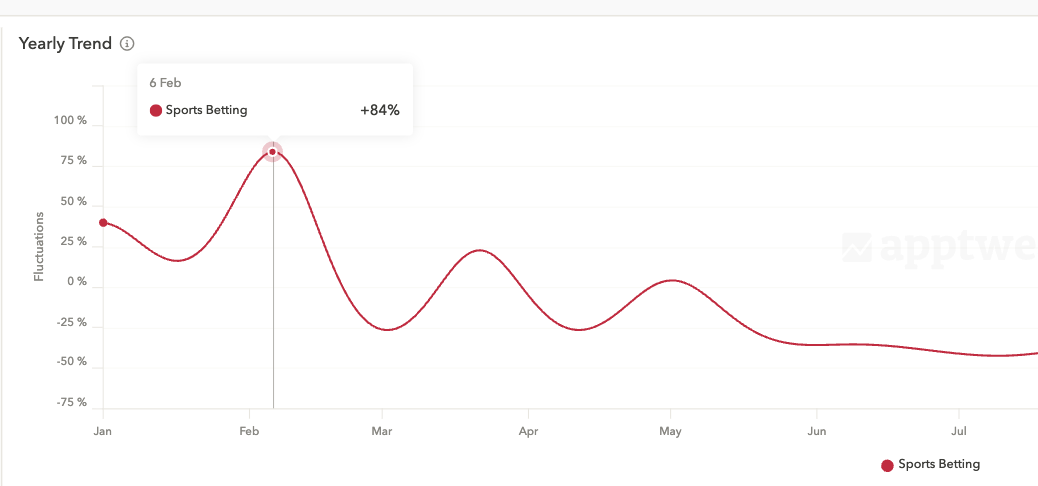
This pattern shows that even when sports events generate sustained interest, demand for betting apps often concentrates into short, high-intent peaks, making early relevance and conversion efficiency more important than ongoing visibility.
Expert Tip
With AppTweak’s ASO timeline and competitor alerts, teams can see when rivals refresh event creatives, update metadata, or launch experiments—and adjust their own store presence before visibility is lost.Different sports moments drive different betting behavior
Not all seasonal demand behaves the same, and treating it as such leads to missed opportunities.
Tent-pole events like the Super Bowl or World Cup finals attract a large number of casual or once-a-year bettors. These users are highly sensitive to trust signals, onboarding friction, and clarity of value proposition, and they churn quickly if expectations aren’t met.
Other moments, such as March Madness or league playoffs, tend to attract more loyal or semi-loyal bettors who engage repeatedly across multiple match days. Their sessions are deeper, their engagement more consistent, and their likelihood to place multiple bets significantly higher.
Other events like the Olympics often drive broad experimentation but lower long-term loyalty, while playoff-driven events create concentrated windows of repeat engagement.
As you can see, these behavioral differences affect everything from engagement depth and average bet size to retention and lifetime value. Strategy needs to reflect these realities. Ignoring them—and applying the same ASO messaging, custom product pages, or Apple Ads structure across all sports moments—leads to missed opportunities and may limit your ability to maximize campaign effectiveness.
Why relevance is built before demand peaks (and why most apps are late)
One of the biggest misconceptions teams have is believing they can “optimize” once an event is already underway.
By the time demand peaks, the race has already begun.
Relevance compounds while competition is still relatively low, and that advantage becomes increasingly difficult to displace as competition increases. Keyword indexing is locked behind version updates, meaning last-minute metadata changes often go live after the most valuable window has already passed.
Sports betting apps face the same dynamic during events like March Madness or playoff finals—except with even tighter conversion windows and higher sensitivity to timing and trust.
Max (now rebranded back to “HBO Max”) is a good example of what “early” looks like in practice. Ahead of March Madness, Max pushed a version update in early March and began ranking on high-volume March Madness searches as demand started rising—giving them a head start before the tournament hit peak intensity. During the event, they reinforced that early relevance by pairing Apple Ads (to increase download velocity during peak intent) with a March Madness-focused custom product page (to lift conversion), supported by an in-app event to keep the experience timely for existing users.
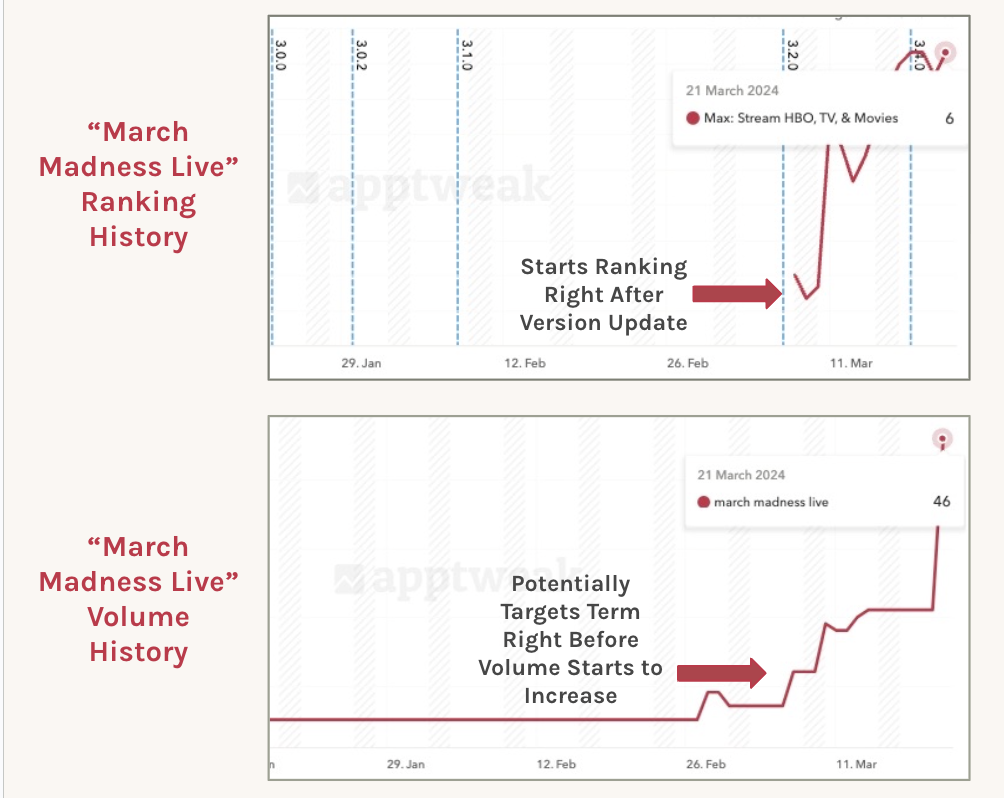
What sports betting apps most often underestimate is how early “early” actually is. Waiting until odds, promotions, or final creative assets are approved frequently means missing the window where relevance is cheapest and most powerful.
The event playbook: A timeline for winning the peak
4–6 weeks before: Build relevance before demand peaks
This phase is about foundations, not scale.
High-performing teams begin by locking their event calendar early and breaking it down into micro-peaks such as match days, rivalry games, finals, and even half-time windows. This allows them to anticipate where intent will actually concentrate, rather than treating the event as a single spike.
At this stage, experienced teams map how users will search—and why—during the event. In practice, this means breaking demand into brand searches, generic betting terms, event-level queries, team or player searches, and bonus-driven keywords. Keyword coverage is refreshed accordingly, with seasonality assumptions validated using historical data rather than instinct.
This matters more than ever as the app store increasingly rewards early, consistent relevance signals, not last-minute optimization. This is a shift we break down in detail in our analysis of how AI is reshaping app store search relevance.
Store messaging is then aligned to the moment by blending event hooks with strong trust cues, while avoiding over-promising features or promotions that won’t hold once the event ends. Creative production and localization workflows are planned early so execution isn’t blocked later under pressure.
In-app events are also finalized during this window. Rather than treating in-app events as last-minute promotional assets, advanced teams map them deliberately to the same event calendar and micro-peaks. They decide which moments warrant an in-app event—such as tournament kickoffs, rivalry games, playoff launches, or finals—and define the role each event will play alongside store creatives and paid acquisition.
Because in-app events require setup, approvals, and coordination across product, creative, and marketing teams, planning them 4–6 weeks in advance ensures they can go live exactly when demand peaks—not after it has already passed.
Finally, custom product page strategies are defined well in advance. Teams should decide which pages will exist, which audiences they target, when they go live, and what fallback rules apply. Clear success criteria are agreed upfront by defining an event KPI stack that balances visibility, conversion, efficiency, and incrementality—not installs alone.
The 4–6 weeks-out checklist
- Which micro-peaks to pursue
- A mapped view of every way users are likely to search for betting apps during the event—across brand, generic betting terms, event-level, team or player, and bonus-driven searches—validated using historical event data.
- The store message you’ll lead with (event hook + trust cues, without overpromising)
- Creative + localization workflows (so approvals don’t become the bottleneck)
- Which in-app events you’ll run, and the role each plays alongside store creatives and paid acquisition
- Your custom product page plan (pages, audiences, timing, fallback rules)
- Your event KPI stack (visibility, conversion, efficiency, incrementality—not installs alone)
3-4 weeks before: QA, finalize, and instrument for speed
As the event approaches, focus shifts from planning to execution.
Metadata across titles, subtitles, keyword fields, and descriptions is finalized to ensure indexing windows are fully captured ahead of peak demand. Store listings are thoroughly QA’d so screenshots are ordered correctly, creative variants are approved, videos function properly, and ratings and reviews reinforce trust at the moment of decision.
Monitoring systems are put in place, including competitor watchlists, keyword movement tracking, and category ranking alerts. On the paid side, Apple Ads structures are finalized with clear separation between brand, generic, and competitor, with event-specific intent clusters isolated to allow fast, controlled adjustments.
Guardrails for live execution—including bid caps, budget limits, and placement rules—are defined in advance. Custom product page scheduling logistics are confirmed early, accounting for approval timelines, time zones, and backup pages.
Because performance can shift faster than teams can react manually, experienced teams rely on predefined rules and monitoring to enforce those guardrails during peak windows. Internal stakeholders across growth, product, legal, and creative teams are aligned on decision rights so friction doesn’t emerge under pressure.
Expert Tip
During major sports events, teams use AppTweak’s Campaign Manager to predefine Apple Ads automation rules and alerts—helping protect visibility, control budgets, and flag performance issues as they happen, rather than discovering problems after the peak has passed.The 3-4 weeks-out checklist
- Metadata finalized for indexing
- Validate App Store listing assets are ready
- Monitoring systems like competitor watchlist, keyword movement, and category alerts are in place
- Apple Ads structure and guardrails are locked
- Custom product page scheduling confirmed
- Decision rights aligned among your different teams
Game week and match days: Execute in peak windows (not averages)
This is where preparation either pays off—or doesn’t.
During game week and match days, execution must align with peak betting windows rather than daily averages. Demand concentrates into short, high-intent moments, and messaging needs to shift accordingly.
This is when in-app events go live.
Well-prepared teams activate IAEs in sync with key moments of the event, using them to surface timely betting opportunities, promotions, or live experiences to both new and existing users. IAEs play a critical role here, reinforcing relevance at the exact moments users are searching while also re-engaging lapsed users who may not arrive through search alone.
At the same time, custom product page scheduling becomes critical, allowing store creatives and messaging to align with pre-game anticipation, live betting moments, half-time surges, and post-game activity. Apple Ads spend is adjusted dynamically by intent and timing, focusing budget where conversion probability is highest while pulling back during low-intent periods.
Teams should closely monitor two real-time signals:
- Shifts in conversion rate
- Increases in competitive pressure driven by bidding or creative changes.
Ensure your messaging adapts quickly when context changes— such as unexpected upsets, star player injuries, or transitions into knockout rounds — while efficiency is protected by avoiding overly broad expansion that dilutes conversion.
During the event, keep ASO, Apple Ads, and in-app events aligned around a single “match-day message.” The queries you bid on, the creatives users land on (via custom product pages), and the in-app events you highlight should all reinforce the same moment and intent. Take daily snapshots of rankings, conversion rate, Apple Ads performance, and competitor activity so you can capture learnings and document what to do better next time.
The game week and match days checklist
- Confirm the match-day calendar for the next 24–72 hours, including kickoff times, half-time windows, and post-game windows by time zone
- Publish the planned in-app events for each micro-peak and verify they appear correctly in App Store surfaces before the window starts
- Activate the correct custom product pages for each micro-peak and confirm fallback pages are queued if approvals or timing slip
- Align the match-day message across Apple Ads keywords, custom product page creatives, and in-app event messaging so the same intent is reinforced end to end
- Adjust Apple Ads budgets and bids by intent cluster and time window, increasing coverage only during high-intent periods and reducing exposure during low-intent periods
- Monitor conversion rate shifts in near real time and treat sustained drops as a signal to change messaging, creative, or traffic mix
- Monitor competitive pressure signals, including bidding intensity and competitor creative changes, and isolate responses to the affected intent cluster rather than broad expansion
- Update messaging quickly when the event context changes, such as injuries, upsets, or bracket progression, while keeping trust cues consistent
- Capture daily snapshots of app store rankings, conversion rate, Apple Ads performance, and competitor activity to document learnings by micro-peak and intent segment
Post-event: Turn the spike into repeatable growth
Once the event ends, speed still matters, just in a different way. You should clean up event-specific messaging and custom product pages quickly to avoid post-peak mismatch and budget misalignment. Then, audit performance by micro-peak and intent segment so you can see what worked, when it worked, and for whom.
Next, separate temporary lift from durable gains by analyzing which keywords, creatives, and pages retain momentum after the peak. Use what you learn to guide newly acquired users toward repeat engagement through aligned lifecycle messaging and refreshed store creatives.
Finally, document those insights into a reusable playbook. Refine your keyword sets, custom product page structures, creative templates, and monitoring dashboards so the next major sports moment starts from a stronger baseline rather than from scratch.
Expert Tip
Teams use AppTweak to analyze historical seasonality, monitor competitor behavior, and measure incrementality—helping them forecast upcoming sports-event opportunities, understand what actually drove growth, and turn one-off spikes into a repeatable playbook.How ASO and Apple Ads reinforce each other under pressure
At peak moments, ASO and Apple Ads don’t operate independently—they form an App Store growth loop.
ASO builds relevance and conversion foundations, Apple Ads drives install velocity at critical moments, and that velocity combined with strong conversion feeds organic performance. Custom product pages and creatives amplify both channels simultaneously.

What this changes in practice:
- Build relevance early so Apple Ads spend converts efficiently at peak
- Align custom product pages and creatives to the intent driving the click
- Monitor conversion shifts and competitive pressure, not installs alone
Under peak competition, this ASO and Apple Ads growth loop is what separates efficient growth from reactive spend, as relevance, velocity, and conversion must work together to sustain performance.
Why timing and execution matter more than spend
Betting demand is uneven by nature. Weekends, match times, and finals create distinct micro-peaks.
Manual CPP and bid management doesn’t scale under this pressure. This is where CPP scheduling emerges as a strategic evolution—aligning messaging and spend with real betting behavior, reducing wasted impressions outside peak windows, and formalizing what advanced teams already attempt manually.
It’s not about more spend. It’s about better timing.
Expert Tip
For app marketers running time-sensitive Apple Ads and CPPs during major sporting events, schedule the launching of your campaigns and CPPs with AppTweak’s CPP Scheduler.From peak demand to durable lift: What to measure and repeat
Each event should reduce guesswork the next time around by showing which search categories, moments, and messages actually drove incremental installs under peak pressure—not just which tactics generated volume during the spike.
That requires looking beyond total installs and asking harder questions after the event: which keyword clusters retained momentum once urgency faded, which event phases or time windows (pre-game, live, post-game) delivered strong conversion at sustainable cost, and which store messages continued to convert after competition normalized. This is where incrementality impact, peak-period efficiency, early retention, and payback matter more than raw volume because they reveal what actually earned growth rather than simply riding the spike.
Once the sporting event ends, teams can start to remove related elements associated with it, without overcorrecting. Event-specific messaging, visuals, and promotions are removed as demand drops, but anything that continues to drive strong conversion such as certain keywords, page layouts, or value propositions should stay live. This way, the app returns to a stable baseline without discarding improvements that proved effective, and the next major event starts from a stronger position.
Expert Tip
Using AppTweak’s incrementality approach, teams can analyze Apple Ads performance alongside organic visibility to separate true lift from cannibalization during peak windows.Conclusion: Don’t react to sports events—Operationalize them
Major sports events reward preparation, not panic.
Visibility is won early. Execution is tested under pressure. ASO and Apple Ads work best when planned together—not stitched together mid-game.
The teams that win consistently are the ones that turn seasonality into a system.
In sports betting, growth during major events isn’t accidental—it’s engineered.
Frequently asked questions
What changes in app store user behavior during major sports events?
Major sports events shift app store behavior from discovery to high-intent decision-making. Users search with urgency, compare fewer apps, and install the option they trust to perform immediately.
During these periods:
- Search demand spikes sharply around micro-peaks such as pre-game, live play, half-time, and post-game moments
- Install velocity increases alongside app switching and re-downloads
- Competitive pressure intensifies as more apps target the same high-intent keywords
Because decision cycles are compressed, visibility alone is not enough. Sports betting apps must combine relevance and conversion efficiency to capture installs during these short windows.
Why is early App Store Optimization critical for sports betting apps?
App Store Optimization must start weeks before an event because relevance compounds before demand peaks. Keyword indexing depends on version updates, and late metadata changes often go live after the most valuable windows have passed.
Early optimization allows apps to rank for event-related app store keywords while competition is still manageable. As more advertisers enter Apple Ads auctions, replacing early organic relevance becomes increasingly expensive, making early preparation a cost and performance advantage.
How do different sports events affect betting app strategy?
Different sports events attract different bettor profiles and engagement patterns. Tent-pole events like the Super Bowl attract casual bettors who prioritize trust and simplicity, while playoff series and tournaments drive repeat engagement from loyal users.
These differences affect optimal messaging, creative emphasis, custom product page structure, and Apple Ads intent segmentation. Applying the same strategy across all sports moments leads to inefficient spend and missed conversion opportunities.
How does AppTweak support sports betting apps?
AppTweak supports event-driven strategies through seasonality analysis, competitor monitoring, and incrementality measurement. Teams use AppTweak data to forecast demand patterns, track competitor metadata and creative changes, and monitor keyword and category movements in real time.
By combining organic visibility insights with Apple Ads performance analysis, AppTweak enables teams to distinguish incremental lift from cannibalization and turn one-off event execution into a repeatable growth playbook.


 Sukanya Sur
More articles in App Market Insights

 Micah Motta

 Pierre-Antoine Roy

 Nathalie